
Clinical Research Support Services for CROs

The complexity of clinical research has escalated over the years, with the need for smooth cooperation between the sponsor, Contract Research Organizations (CROs), hospitals, investigators and regulatory authorities. With the expansion of clinical trials, multiple sites and therapeutic areas, CROs need to manage multiple study timelines, regulatory requirements, patient recruitment and data quality efficiently. Many of the organizations use specialized CRO Support Services to achieve these goals, as they improve the efficiency of the operation and the outcomes of the studies.
Professional CRO Support services deliver complete support for the entire clinical trial process. These services allow CROs to provide top-notch research without compromising on the sponsor’s expectations or regulatory considerations, ranging from Clinical Operations to Clinical Trial Support, Patient Recruitment to Clinical Monitoring.
READ THIS ALSO: Trusted Clinical Site Coordination Services for Sponsors
What Are CRO Support Services?
CRO Support Services refer to a variety of specialized operational solutions that assist Contract Research Organizations in running clinical trials more efficiently. These services complement internal research teams, offering a set of specialized services, processes, and expertise throughout the entire study.
Comprehensive CRO Support can involve:
- Study start-up assistance
- Regulatory documentation
- Site management support
- Clinical data management
- Patient Recruitment
- Clinical Monitoring
- Project management
- Quality assurance
By delegating certain tasks, CROs can dedicate more of their time to strategic study management, while maintaining the operation’s excellence.
Why CROs Need Professional Clinical Trial Support
Clinical trials are highly regulated, complex trials, and they require a significant amount of clinical data. These responsibilities may become resource-heavy if there are several studies happening at the same time, and the work is done in-house.
Professional Clinical Trial Support helps CROs:
- Accelerate study start-up
- Improve regulatory compliance
- Enhance operational efficiency
- Strengthen site performance
- Improve patient retention
- Reduce project delays
- Maintain high-quality clinical data
These advantages contribute directly to faster study completion and improved sponsor satisfaction.
Core Components of Clinical Operations
Efficient Clinical Operations are essential for ensuring clinical trials remain compliant, organized, and on schedule.
Study Start-Up Support
Before patient enrollment begins, experienced support teams assist with:
- Site feasibility assessments
- Regulatory documentation
- Ethics committee submissions
- Investigator file preparation
- Site activation
Efficient study start-up reduces delays and accelerates participant recruitment.
Regulatory Compliance
Clinical research must comply with Good Clinical Practice (GCP), ICH guidelines, and local regulatory requirements.
Professional CRO Support Services ensure all documentation remains complete, accurate, and audit-ready throughout the study.
Project Management
Project managers coordinate communication among sponsors, investigators, research sites, laboratories, and vendors.
Strong project oversight improves collaboration while minimizing operational risks.
Importance of Patient Recruitment
One of the greatest challenges in clinical research is identifying and enrolling suitable participants within planned timelines.
Professional Patient Recruitment services help CROs by:
- Identifying eligible participants
- Managing screening activities
- Coordinating enrollment
- Supporting participant retention
- Improving follow-up compliance
Higher enrollment rates contribute to timely study completion and stronger research outcomes.
Key Clinical Operations Services
| Service Area | Purpose | Benefit to CROs |
| Study Start-Up | Site activation and documentation | Faster trial initiation |
| Regulatory Support | Compliance and ethics documentation | Reduced regulatory risks |
| Patient Recruitment | Participant screening and enrollment | Higher enrollment rates |
| Project Management | Coordinate trial activities | Improved workflow |
| Clinical Data Management | Data collection and validation | Better data quality |
| Clinical Monitoring | Site monitoring and compliance | Reduced protocol deviations |
| Quality Assurance | Continuous quality review | Improved inspection readiness |
| Study Close-Out | Final documentation and archiving | Successful project completion |
How Clinical Monitoring Improves Trial Quality
Accurate monitoring is essential for maintaining participant safety and data integrity.
Professional Clinical Monitoring services include:
- Site monitoring visits
- Source document verification
- Protocol compliance reviews
- Risk assessment
- Query resolution
- Audit preparation
- Sponsor reporting
Regular monitoring helps identify operational issues early while ensuring consistent research quality.
Benefits of Professional CRO Support
Organizations that utilize specialized CRO Support services gain significant operational advantages.
Improved Efficiency
Professional support teams streamline workflows, allowing CROs to manage multiple studies simultaneously without compromising quality.
Better Compliance
Experienced research professionals ensure all clinical activities follow regulatory requirements and sponsor protocols.
Higher Data Quality
Accurate documentation, monitoring, and quality control improve the reliability of clinical trial data.
Cost-Effective Resource Management
Outsourcing selected operational activities reduces recruitment costs and enables flexible resource allocation according to project requirements.
Enhanced Sponsor Satisfaction
Timely study completion, regulatory compliance, and high-quality deliverables strengthen relationships between CROs and sponsors.
Role of Clinical Trial Support Throughout the Study Lifecycle
Effective Clinical Trial Support extends beyond administrative assistance. It provides structured operational expertise throughout every phase of clinical research.
Support activities include:
- Trial planning
- Site activation
- Regulatory documentation
- Patient Recruitment
- Site communication
- Clinical Monitoring
- Data management
- Quality assurance
- Study close-out
This integrated approach ensures smooth study execution from initiation through completion.
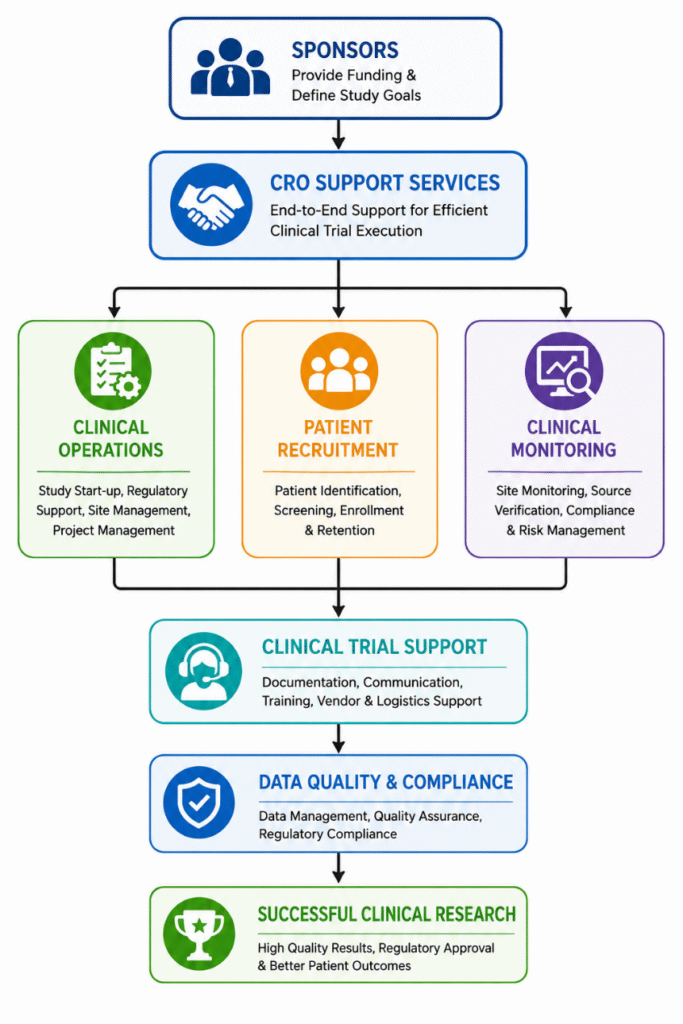
Flowchart: CRO Support Services Workflow
Choosing the Right CRO Support Services Provider
Before selecting a support partner, CROs should evaluate:
- Experience providing CRO Support
- Expertise in Clinical Operations
- Proven Patient Recruitment capabilities
- Comprehensive Clinical Trial Support
- Skilled Clinical Monitoring professionals
- Regulatory knowledge
- Flexible service models
- Transparent communication
- Strong quality management systems
An experienced provider works collaboratively with CROs to improve operational performance while ensuring successful clinical trial execution.
Clinical research is becoming more complex, and it requires expertise in operations and the efficient use of resources. Professional CRO Support Services for Contract Research Organizations (CRO) assist in bolstering Clinical Operations, optimizing Clinical Trial Support, optimizing Patient Recruitment and keeping Clinical Monitoring effective throughout a study.
Whether it’s starting a study, following regulations, or overseeing quality assurance and study completion, seasoned support professionals help CROs run a successful clinical trial with efficiency, precision, and adherence to regulations. Collaborating with a reputable provider of CRO Support Services can help enhance the efficiency of studies, speed up development schedules, and make a huge contribution to the advancement of innovative healthcare solutions.
FAQs
1. What is CRO Support Service?
2. Why are CRO Support Services important in clinical research?
3. What does Clinical Trial Support include?
4. How does Patient Recruitment impact clinical trial success?
5. What is the role of Clinical Monitoring in clinical trials?
6. How do Clinical Operations improve clinical trial performance?
7. What should CROs consider when choosing a CRO Support Services provider?
8. Can CRO Support Services reduce clinical trial costs?
Book a free consultation for appointment
Email us at : grow@simbi.in