
Clinical Research Coordinator (CRC) Services for Clinical Trials: Building High-Performing Research Sites Through Expert Operational Support
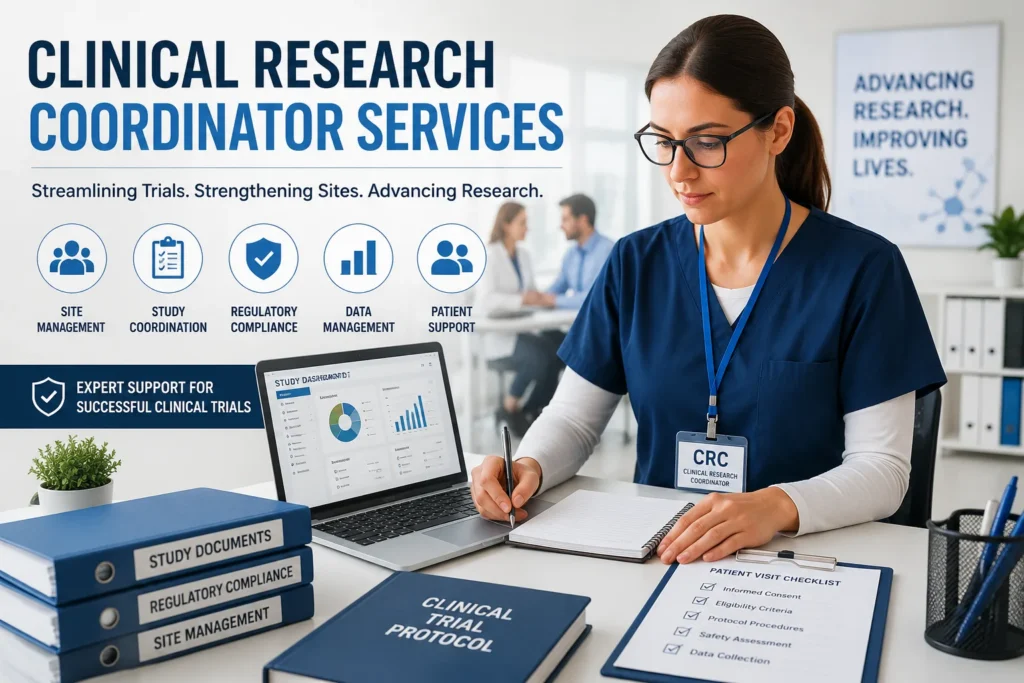
The complexity of clinical trials is growing as sponsors move to multi-center trials, patient engagement through technology, adaptive trial designs, and decentralized trial models. Clinical research is fundamentally about scientific innovation, but equally on operational excellence in the conduct of studies. Other challenges can arise, such as delays in patient enrollment, deviation from the protocol, incomplete documentation, or lack of communication among stakeholders that can affect the timing of the study and regulatory compliance. This has made Clinical Research Coordinator Services a strategic operational resource for sponsors, CROs, biotechnology companies and research institutes.
The proper functioning of a clinical trial is supported by Clinical Research Coordinators (CRCs). They oversee study activities, ensure adherence to the protocol, oversee regulatory documentation, ensure communication between investigators and sponsor, and help maintain participant engagement throughout the study lifecycle. Modern CRCs are more than just administrative staff, contributing to the quality of studies, risk mitigation and operational efficiency.

Why Clinical Research Coordinator Services Have Become Mission-Critical
The complexity of conducting clinical trials today is much greater than it was 10 years ago. Collaborative studies are frequently conducted with several research centers, electronic data capture, decentralized patient visits, remote monitoring and adherence to international regulations (ICH-GCP). Without specific coordination, these activities are more likely to experience delays and compliance problems.
Professional Clinical Research Coordinator Services streamline overall study operations, enabling investigators to concentrate on clinical decisions and guaranteeing smooth day-to-day operations. This approach will help to ensure that the trial is run in a coordinated manner, which will make the administrative process more efficient and streamlined, and will enhance communication between all parties involved in the trial.
Operational Challenges Addressed by Clinical Research Coordinator Services
| Clinical Challenge | How CRC Services Help |
| Slow patient recruitment | Coordinate screening, scheduling, and participant follow-up |
| Protocol deviations | Monitor visit windows and ensure protocol adherence |
| Documentation gaps | Maintain complete regulatory and source documentation |
| Communication delays | Act as the central point between sponsors, investigators, and vendors |
| Data inconsistencies | Support timely EDC entry and query resolution |
| Inspection readiness | Maintain audit-ready investigator site files |
Clinical Research Coordinator Responsibilities Across the Trial Lifecycle
The Clinical Research Coordinator Services are more than just about arranging participant visits. CRC professionals are engaged at every phase of the clinical trial process, from site activation to study close-out.
In study start-up, coordinators support in regulatory submissions, ethics committee documentation, investigator site file preparation and site initiation activities. Following recruitment, they arrange for screening of participants, informed consent, eligibility verification and scheduling visits. During the conduct of the study CRCs oversee source documentation, investigational product accountability, adverse event reporting, preparation of monitoring visits, and sponsor and CRO communication. For study closure, they audit documentation, archive records and assist in regulatory closure.
CRC Responsibilities by Study Phase
| Trial Phase | Primary CRC Activities |
| Start-Up | Site preparation, regulatory documentation, ethics submissions |
| Recruitment | Screening, informed consent, participant scheduling |
| Study Conduct | Visit coordination, protocol implementation, sample management |
| Data Management | Source documentation, EDC support, query resolution |
| Monitoring | Document review, audit preparation, issue resolution |
| Close-Out | Final reconciliation, record archiving, site closure |
Integrating Clinical Research Coordinators into Modern Clinical Operations
The practice of clinical research requires the cooperation of investigators, monitors, laboratories, pharmacies, imaging centers, and regulatory bodies. Without centralized coordination, communication gaps can cause scheduling issues, missing documentation, or delayed study milestones.
Dedicated Clinical Research Coordinator Services set up standard workflows that ensure that operational activities are carried out in accordance with the protocol requirements. The coordinators monitor participants’ visits, handle protocol changes, report safety events and keep accurate records in all study systems.
This is especially helpful in oncology, rare disease, vaccine, and medical device trials due to their complex protocols and intensive participant follow-up.

Technology Has Redefined Clinical Research Coordination
The modern CRC does not use paper-based documentation. The Clinical Research Coordinator Services now have to be skilled in several technologies to facilitate real-time collaboration, data management, and regulatory compliance.
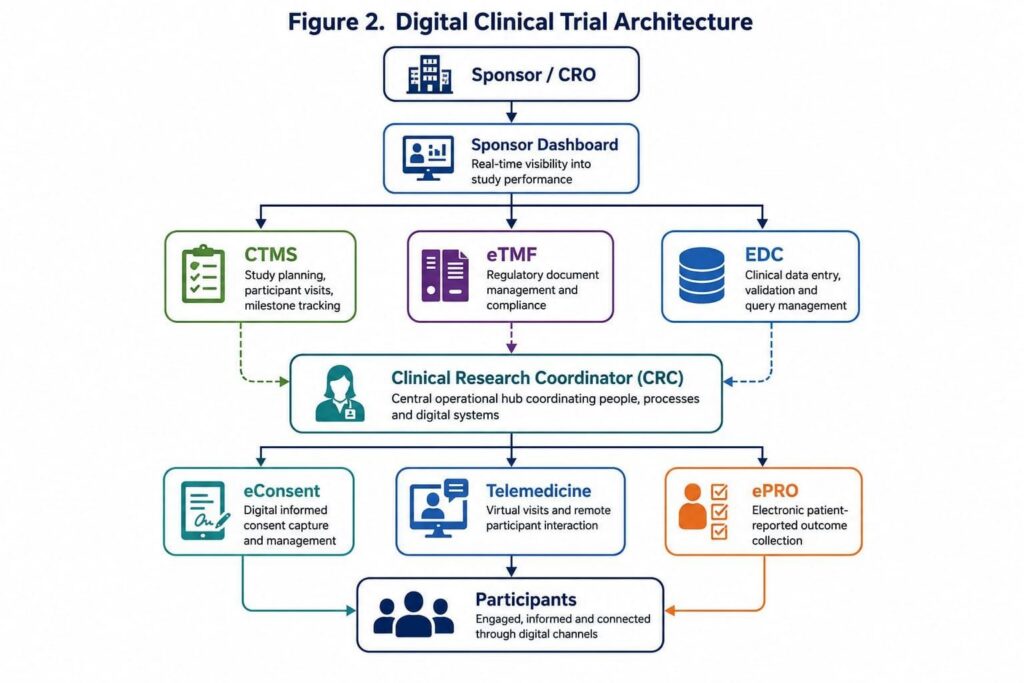
Electronic Data Capture (EDC) and Clinical Trial Management Systems (CTMS) are examples of software that can facilitate the timely entry of clinical data and the monitoring of trial milestones and participant visits. Electronic Trial Master Files (eTMF) ease document handling and Interactive Response Technology (IRT) facilitates randomization and Investigational Product (IP) accountability. Digital tools like eConsent platforms, electronic patient-reported outcomes (ePRO), and telemedicine apps have also broadened the scope of CRC professionals’ work.
Digital Technologies Supporting Clinical Research Coordinator Services
| Platform | Operational Purpose |
| EDC | Clinical data entry and query management |
| CTMS | Study planning and milestone tracking |
| eTMF | Regulatory document management |
| IRT | Randomization and drug accountability |
| eConsent | Digital informed consent |
| ePRO | Patient-reported outcome collection |
| Telemedicine | Remote participant coordination |
Digital Clinical Trial Architecture
Flexible Clinical Trial Staffing Models Improve Operational Agility
Clinical trial workloads fluctuate considerably during recruitment, protocol amendments, interim analyses, and database lock. Consequently, organizations increasingly choose to Hire CRC professionals using flexible staffing models that match study requirements.
Some sponsors require a Contract CRC for a defined project, while others adopt Outsourced CRC solutions to support multiple research sites through a specialized service provider. These models allow organizations to rapidly expand operational capacity without maintaining permanent staffing levels.
The appropriate Clinical Trial Staffing strategy depends on study complexity, therapeutic expertise, enrollment targets, and geographic coverage.
Comparing CRC Staffing Models
| Model | Best Application | Key Advantage |
| In-House CRC | Long-term research programs | Institutional knowledge |
| Contract CRC | Temporary operational support | Rapid deployment |
| Outsourced CRC | Multi-center clinical trials | Scalable workforce |
| Hybrid Model | Enterprise clinical operations | Operational flexibility |
Measuring the Value of Clinical Research Coordinator Services
Clinical Research Coordinator Services should be assessed by objective operational results and not by administrative efforts. High-performing CRC teams play an important role in enrolling participants in a timely fashion, ensuring that protocols are followed, resolving queries, retaining participants and being prepared for inspection.
Key performance indicators for sponsors often include monitoring the efficiency of enrollments, protocol deviation rates, documentation completion rates, monitoring observations, query turnaround time, and participant retention. On going monitoring of these metrics can help organizations optimize operational performance in subsequent studies.
However, there are more components than the scientific skills needed for successful clinical trials – there’s also the need for structured coordination, regulatory precision, and seamless collaboration throughout the study execution. Professional Clinical Research Coordinator Services are designed to maximize site performance, optimize participant management, ensure regulatory compliance, and speed up study timelines for sponsors, CROs, biotechnology firms, hospitals and research institutions. From conducting a single study to providing Outsourced CRC solutions for multi-center trials, the role of CRC professionals is vital to ensure operational excellence and high-quality research results.
Ready to Strengthen Your Clinical Trial Operations?
Simbi Labs India is a complete Clinical Research Coordinator Service provider company which specializes in fulfilling the operational requirements of pharmaceuticals, CROs, biotechnology firms, hospitals, and research organizations. We have clinical research professionals who can help with study start up, participant coordination, regulatory documentation, site management and clinical trial operations with standardized workflows and industry best practices. From full clinical research resources to flexible Clinical Trial Staffing, and end-to-end clinical research support, our solutions are scalable, compliant, and quality-driven, ensuring studies reach their desired endpoints efficiently. Learn more about Simbi Labs India and discover how our clinical research solutions can support your next study.
Book a free consultation for appointment
Email us at : grow@simbi.in
Frequently Asked Questions
1. What are Clinical Research Coordinator Services?
Clinical Research Coordinator Services provide operational support for clinical trials, including participant coordination, regulatory documentation, informed consent management, study scheduling, data entry support, and communication between investigators, sponsors, and CROs.
2. Why should sponsors hire dedicated CRC professionals?
Organizations choose to Hire CRC professionals to improve operational efficiency, maintain protocol compliance, enhance participant engagement, and reduce administrative burden on investigators.
3. What is the difference between a Contract CRC and an Outsourced CRC?
A Contract CRC is engaged for a defined project or duration, whereas an Outsourced CRC model provides managed staffing, training, deployment, and ongoing operational oversight through a specialized service provider.
4. Which clinical trials benefit most from Clinical Research Coordinator Services?
These services support Phase I–IV clinical trials, medical device studies, observational research, decentralized clinical trials, and multi-center global research programs.
5. How do CRC Services improve regulatory compliance?
CRC professionals maintain investigator site files, manage informed consent, coordinate protocol amendments, support adverse event reporting, and ensure documentation remains inspection-ready throughout the study.
6. Can Clinical Research Coordinator Services support decentralized clinical trials?
Yes. Modern CRCs coordinate telemedicine visits, eConsent, remote patient monitoring, wearable device integration, and electronic patient-reported outcomes.
7. What should organizations consider when selecting a CRC service provider?
Key considerations include therapeutic expertise, ICH-GCP knowledge, technology proficiency, staffing flexibility, quality management systems, scalability, and experience supporting multi-site studies.
8. How do Clinical Research Coordinator Services improve clinical trial timelines?
By streamlining recruitment, documentation, communication, and study coordination, CRC professionals help reduce operational delays and support timely completion of clinical milestones.