
Clinical Trial Phases in India: A Complete Guide to the Drug Development Journey
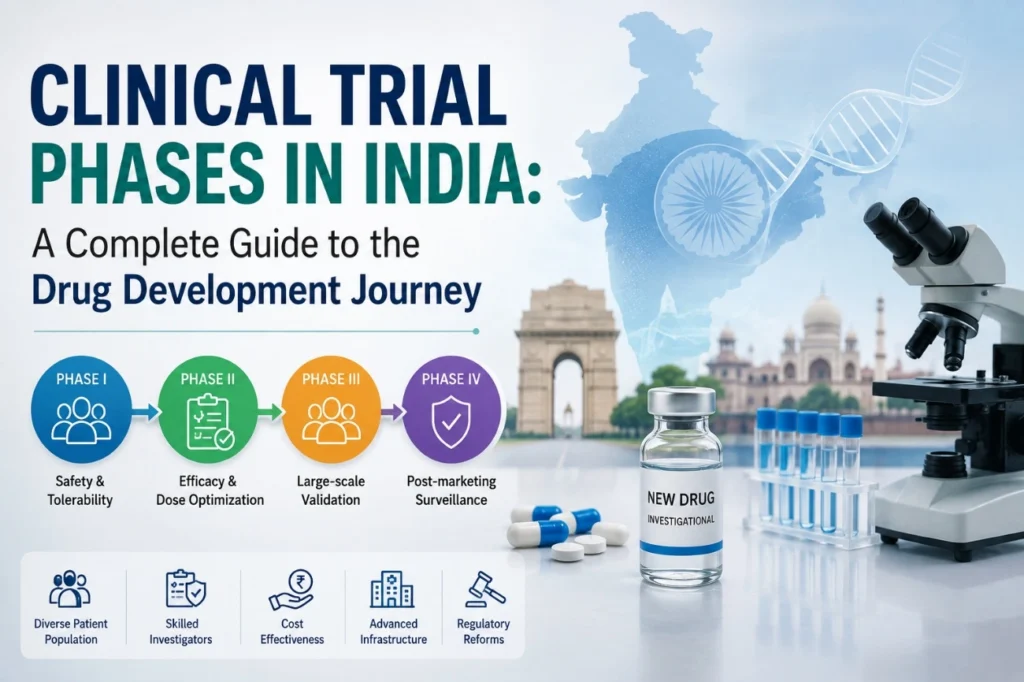
Clinical Trial Statistics at a Glance
A new medicine goes through a long and very carefully controlled process of development before it is available to patients. It takes 10-15 years or more to develop a new drug, and only a few of drug candidates investigated ultimately make it to clinical trials. The most resource intensive phase of drug development is clinical trials, especially Phase III trials, which may include thousands of participants at various clinical sites. These figures make a strong case for the need for proper designed clinical trials with scientifically sound data on safety and efficacy before a drug is available for general clinical practice.
The country of India has become one of the most vibrant clinical research centres in the world in recent years. The country has proven to be appealing to sponsors from all over the world, thanks to its large and diverse population, the skills of its investigators, and the regulatory infrastructure that continues to be improved. However, before we get into the importance of India in this area, we must first understand the step-by-step process that every investigational drug undergoes before it can be approved for public use known as the Clinical Trial Phases in India.
This guide explains each of the four phases of clinical trials, the agencies that regulate them, the process of a clinical trial from concept to approval, and the problems and prospects for the future of clinical research in the nation. If you are a clinical researcher, a pharmaceutical professional, a CRO or a student looking to understand more about the process of drug development, this article will provide you with a clear and practical overview of the process.
Scientific Foundations of Clinical Trials
A clinical trial is an investigation carried out on human subjects to assess the safety, efficacy and overall impact of a medical intervention. This may be a new drug, vaccine, medical device, diagnostic or even treatment procedure. A clinical trial is simply a well-designed study of the way a treatment affects the human body how much it is absorbed, how it works, what side effects it has, and whether it helps patients more than existing treatments or a placebo.
Purpose
The core purpose of a clinical trial is to answer specific research questions:
- Is the treatment safe for human use?
- Does it work as intended?
- What is the correct dosage?
- Are there side effects, and how severe are they?
- How does it compare with existing treatments?
Importance
No drugs can go on the market without clinical trials. They safeguard patients against unhelpful and potentially harmful treatment, and they provide researchers with the evidence needed to demonstrate the worth of a therapy. This thorough testing process has been used to lead every medical advance from vaccines to cancer cures.
Drug Development Lifecycle
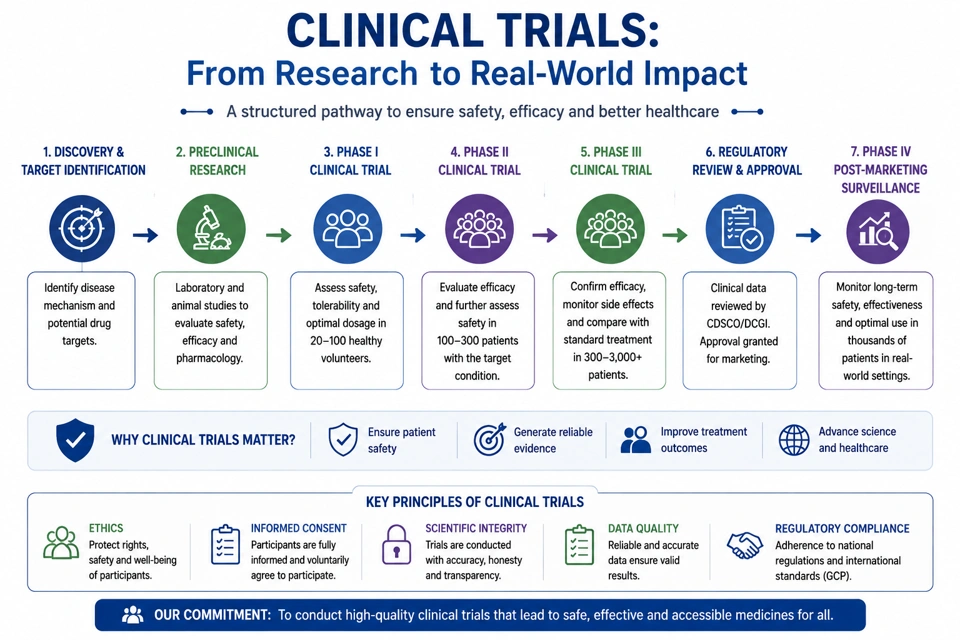
The general progression of a new drug is discovery, identification of a target, preclinical studies in the lab and animal models, and human clinical testing, which consists of 4 phases, review by regulators and continued surveillance following its approval for commercialisation. The phase-wise structure is essential because it is the evidence of the previous stage that is used in the next.
Regulatory Framework for Clinical Trials in India
India’s clinical research ecosystem is governed by a well-defined regulatory structure designed to protect participant safety while enabling scientific progress.
a. CDSCO: The Central Drugs Standard Control Organization (CDSCO) is India’s national regulatory authority for pharmaceuticals and medical devices. It reviews and approves clinical trial applications, inspects trial sites, and monitors compliance with safety standards throughout the study.
b. DCGI: The Drugs Controller General of India (DCGI) heads the CDSCO and is the primary authority responsible for granting permission to conduct clinical trials in the country. No trial involving a new chemical or biological entity can begin in India without DCGI approval.
c. ICMR Ethical Guidelines: The Indian Council of Medical Research (ICMR) publishes national ethical guidelines for biomedical and health research involving human participants. These guidelines set standards for informed consent, participant welfare, data confidentiality, and ethical conduct across all trial sites.
New Drugs and Clinical Trials Rules, 2019
This is the basic legislation of clinical research in India. The New Drugs and Clinical Trials Rules, 2019 shortened the time limits for approval of clinical trials, established norms for compensation for injuries and death arising from clinical trials, introduced regulation of the role of Ethics Committees and provided greater clarity for speedy approval processes. All of these regulations comprise the legal and ethical basis for each clinical trial in India.
Clinical Trial Phases Explained
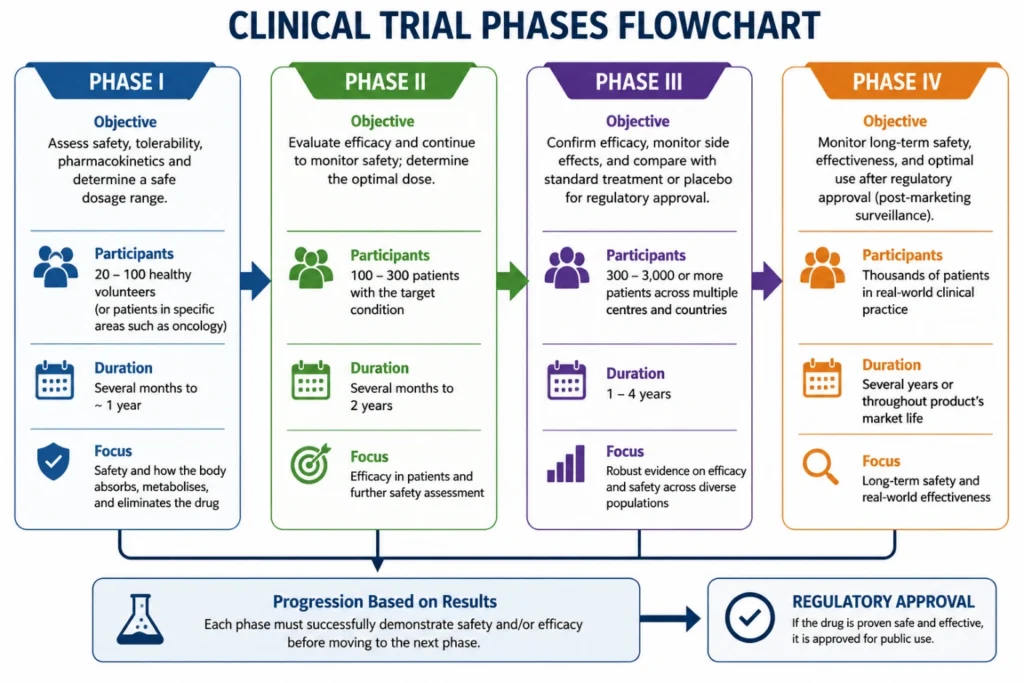
The Phases of a Clinical Trial.Understanding the stages of a clinical trial. For any pharmaceutical researcher, sponsor, investigator or student, it is important to understand the various phases of clinical trials in India. These phases are applied for different scientific purposes and they are based on data collected during the previous phase.
| Clinical Trial Phase | Primary Objective | Typical Participants | Typical Duration | Key Advantages | Key Limitations |
| Phase I | Assess safety, tolerability, pharmacokinetics, and determine a safe dosage range by evaluating absorption, metabolism, and elimination of the investigational drug. | 20–100 healthy volunteers (or patients in areas such as oncology where appropriate). | Several months to approximately 1 year | • Establishes initial safety profile• Determines appropriate dose range• Identifies common adverse reactions | • Small sample size may miss rare adverse events• Findings from healthy volunteers may not fully reflect patient responses |
| Phase II | Evaluate therapeutic efficacy while continuing to assess safety and optimise dosage in patients with the target disease. | 100–300 patients with the target condition | Several months to 2 years | • Provides first evidence of clinical effectiveness• Refines optimal dosage• Detects additional side effects | • Limited sample size• Controlled trial conditions may not represent real-world clinical practice |
| Phase III | Confirm efficacy, monitor adverse effects, and compare the investigational treatment with standard therapy or placebo to support regulatory approval. | 300–3,000 or more patients across multiple centres and, frequently, multiple countries | 1–4 years | • Generates robust evidence of efficacy and safety• Detects less common adverse events• Evaluates treatment across diverse populations | • High cost and long duration•Operationally complex with extensive regulatory and logistical requirements |
| Phase IV | Monitor long-term safety, effectiveness, and optimal use after regulatory approval through post-marketing surveillance. | Thousands of patients in routine clinical practice | Several years or throughout the product’s market life | • Identifies rare and long-term adverse effects•Assesses effectiveness in real-world settings•Provides evidence across broader patient populations | • Less controlled monitoring environment•Underreporting of adverse events may delay safety signal detection |
Clinical Trial Process in India
Beyond the four phases themselves, every trial in India follows a defined administrative and regulatory pathway:
- Research Idea – A scientific hypothesis or unmet medical need is identified.
- Protocol Development – A detailed study protocol is designed, outlining objectives, methodology, and endpoints.
- Ethics Committee Approval – An Institutional Ethics Committee reviews the protocol for participant safety and ethical compliance.
- CDSCO Approval – The DCGI reviews and grants permission to proceed with the trial.
- Participant Recruitment – Eligible volunteers or patients are enrolled based on defined inclusion and exclusion criteria.
- Clinical Trial Conduct – The study is carried out according to the approved protocol, with ongoing safety monitoring.
- Data Analysis – Collected data is statistically analysed to evaluate outcomes.
- Regulatory Review – Findings are submitted to CDSCO for evaluation.
- Marketing Approval – If the data supports safety and efficacy, the drug receives approval for commercial use.
Example: Covishield Vaccine Clinical Trials in India
The development of Covishield COVID-19 Vaccine is a reflection of the clinical trial methodology set in India. The vaccine was developed by the University of Oxford and AstraZeneca and manufactured by the Serum Institute of India (SII) and multiple phases of clinical evaluation have been conducted before it was granted emergency approval by the Drugs Controller General of India (DCGI). Early clinical trials (Phases I and II) have proved the vaccine to be safe and to elicit an immune response. It was also shown to be effective through large-scale Phase III trials conducted on thousands of participants, and they also kept track of potential side effects. Consequently, the vaccine has received emergency use authorization in India in 2021. Phase IV studies followed to observe long-term safety and effectiveness in the general population after approval.
Challenges in Conducting Clinical Trials in India
Despite significant progress, clinical research in India faces several practical challenges.
- Recruitment: Finding and enrolling eligible participants within planned timelines can be difficult, particularly for rare disease trials or highly specific patient criteria.
- Ethics: Ensuring informed consent is genuinely understood, especially in populations with lower health literacy, requires careful communication and oversight.
- Compliance: Maintaining strict adherence to Good Clinical Practice (GCP) standards across multiple sites demands consistent training and monitoring.
- Data Quality: Inconsistent data recording or site-level errors can compromise the integrity of trial results if not caught early.
- Patient Retention: Long trial durations, especially in Phase III studies, can lead to participant dropout, affecting statistical power.
- Regulatory Requirements: Navigating approval timelines, documentation standards, and periodic compliance checks requires experienced regulatory affairs support.
Role of Clinical Trial Support Services
As trials become more complex and require a high degree of quality and compliance, specialised Clinical Trial Support Services are becoming more important for sponsors and CROs to manage trials efficiently.
I. Statistical Analysis: Trial data and outcomes are rigorously analysed using statistical methods and results are interpreted with confidence.
II. Data Management: Structured systems ensure accurate collection, cleaning and storage of clinical data throughout the study.
III. Medical Writing: Clear, compliant documentation from protocols to clinical study reports is key to regulatory submissions.
IV. Biostatisticians design studies, calculate sample sizes, and create randomisation plans, as well as conduct interim analyses, to enhance study design.
V. Regulatory Documentation: Formulation and upkeep of dossiers, consent form and submission file as per CDSCO guidelines.
VI. Data Visualization: Presenting complex trial data in a clear chart or dashboard allows sponsors and regulators to interpret the data quickly.
Why India is Becoming a Global Clinical Trial Destination
India is now a favoured destination for clinical research organizations from all over the world because of the many strategic benefits it offers. The size and diversity of its patient population allows for quick participant enrollment in a wide variety of therapeutic areas, such as rare, infectious and chronic diseases.
There are also well-established investigators, experienced physicians and clinical researchers available in the country with significant exposure to international clinical trials and Good Clinical Practice (GCP) standards. In addition, the clinical trials happen in India with a better quality of data, ethical scrutiny and regulatory compliance at a lesser cost than most of the western countries. The presence of advanced multispecialty hospitals, modern diagnostic facilities and the presence of accredited laboratories further assists in the successful execution of complex clinical trial protocols.
Further, the regulatory reforms, including the New Drugs and Clinical Trials Rules, 2019 have also streamlined the process of approval, improved transparency and enhanced participant protection, making the nation more competitive globally as a clinical research hub.
Best Practices
For sponsors and researchers planning trials in India, a few practical recommendations can improve outcomes:
- Engage experienced local investigators early in the planning process.
- Invest in robust site feasibility assessments before finalising trial locations.
- Prioritise participant education to strengthen informed consent quality.
- Partner with established Clinical Trial Support Services for data management and regulatory documentation.
- Build in realistic timelines that account for ethics committee and CDSCO review cycles.
- Use centralised monitoring systems to catch data quality issues early.
Future of Clinical Trials in India
The landscape of clinical research in India is transforming with the introduction of digital technologies and a patient-centric approach. AI is being applied more and more to patient recruitment, protocol optimisation, predictive analytics and early identification of safety signals. The use of Electronic Data Capture (EDC) systems and cloud-based clinical trial platforms are enhancing data quality and minimizing manual mistakes and delays. The use of telemedicine, wearable devices and remote patient monitoring are helping to create more convenient participation and increasing participant retention, especially when it comes to Decentralized Clinical Trials (DCTs).
A second significant development is the increasing reliance on adaptive clinical trial designs that enable specific changes that can be made to the design of clinical trials based on interim analyses that are not compromises to the scientific integrity of the trial. Real-World Evidence, also known as RWE, data from electronic health records, patient registries, and healthcare databases are also increasingly used in research alongside clinical trial results. Furthermore, eConsent systems are enhancing the comprehension, documentation and compliance of informed consent with regulatory guidelines. These innovations are working together to accelerate clinical trials, enhancing their efficiency and patient-centred research, and making India an increasingly competitive research location.
Key Takeaways
- Clinical trials are conducted in four sequential phases, each addressing a specific scientific objective before a medicine reaches patients.
- Phase I primarily evaluates safety and dosage, while Phase II focuses on therapeutic efficacy.
- Phase III generates the large-scale clinical evidence required for regulatory approval.
- Phase IV monitors long-term safety and effectiveness after the medicine enters the market.
- Clinical trials in India are regulated by the CDSCO, DCGI, Ethics Committees, and the New Drugs and Clinical Trials Rules, 2019.
- India’s diverse patient population, experienced investigators, modern healthcare infrastructure, and cost-effective research environment have made it an important global hub for clinical research.
- Advances such as artificial intelligence, electronic data capture, decentralized clinical trials, and precision medicine are shaping the future of clinical research in India.
Looking for Expert Clinical Trial Support?
Successful clinical trials require scientific expertise, regulatory compliance, and accurate data management at every stage. Simbi Labs India provides comprehensive Clinical Trial Support Services, including biostatistics, statistical analysis, clinical data management, medical writing, regulatory documentation, and research consulting to help sponsors, CROs, pharmaceutical companies, and academic researchers conduct high-quality clinical studies with confidence.
Contact our experts today to discuss your clinical research requirements and discover how our end-to-end support services can help accelerate your project from protocol development to regulatory submission.
Book a free consultation for appointment
Call Now : +91 99505 66669
Email : grow@simbi.in