
Crowd Evacuation Planning with NetLogo:Optimizing Exit Capacity for Safer Public Spaces

Introduction
When an emergency occurs in a crowded public facility, evacuation performance depends on more than simply having an exit. Occupancy level, the number of available exits, exit width, and the way people converge on those exits can change how quickly a space is cleared. For planners, the practical question is therefore not only “How fast can people evacuate?” but also “What is the minimum exit capacity needed to meet a defined evacuation target?”
A NetLogo-based research study addresses this question through a Crowd Evacuation Capacity Planning (CECP) framework. Instead of selecting only the fastest possible design, the framework screens simulated exit configurations against target evacuation times and identifies the least exit infrastructure that still satisfies the required performance. This makes the approach useful for evidence-based crowd evacuation planning in exhibition halls, public assembly spaces, event venues, transport facilities, and similar environments.
Why Exit Capacity Needs to Be Tested Against Occupancy
A building can have wide exits and still experience congestion if too many occupants reach the same location at the same time. Likewise, adding more exit width may improve local flow but may not distribute the crowd as effectively as providing additional exit points. The study therefore treats crowd size, number of exits, and exit width as connected planning variables rather than isolated design choices.
The model was built around a virtual 80 × 80 m exhibition hall. Occupants were represented as autonomous agents that identified the nearest emergency exit, moved toward it, avoided nearby agents, and continued until leaving the hall. The simplified setting deliberately held other factors constant so the effect of exit capacity could be examined more clearly.
How the NetLogo Experiment Was Designed
Three occupancy conditions were tested: 500, 1,000, and 2,000 visitors. Each occupancy level was combined with one to four emergency exits and exit widths of 2 m, 4 m, or 6 m. This produced 36 unique scenarios. Because the random starting locations of agents can influence a simulation, every scenario was repeated 30 times using different random seeds, resulting in 1,080 simulation runs in NetLogo BehaviorSpace.
| Planning Variable | Tested Levels | Purpose |
| Crowd size | 500, 1,000, 2,000 | Represents different occupancy conditions |
| Number of exits | 1, 2, 3, 4 | Tests distributed evacuation capacity |
| Exit width | 2 m, 4 m, 6 m | Tests local flow capacity at exit points |
| Repetitions | 30 per scenario | Reduces dependence on a single stochastic run |
From Simulation to a CECP Decision
The workflow combines simulation, statistical analysis, and a practical screening rule. Mean total evacuation time is calculated for each scenario, and a General Linear Model (GLM) is used to evaluate the main and interaction effects of crowd size, number of exits, and exit width. The CECP stage then compares the simulated mean evacuation time with a selected target and removes configurations that fail to meet it.
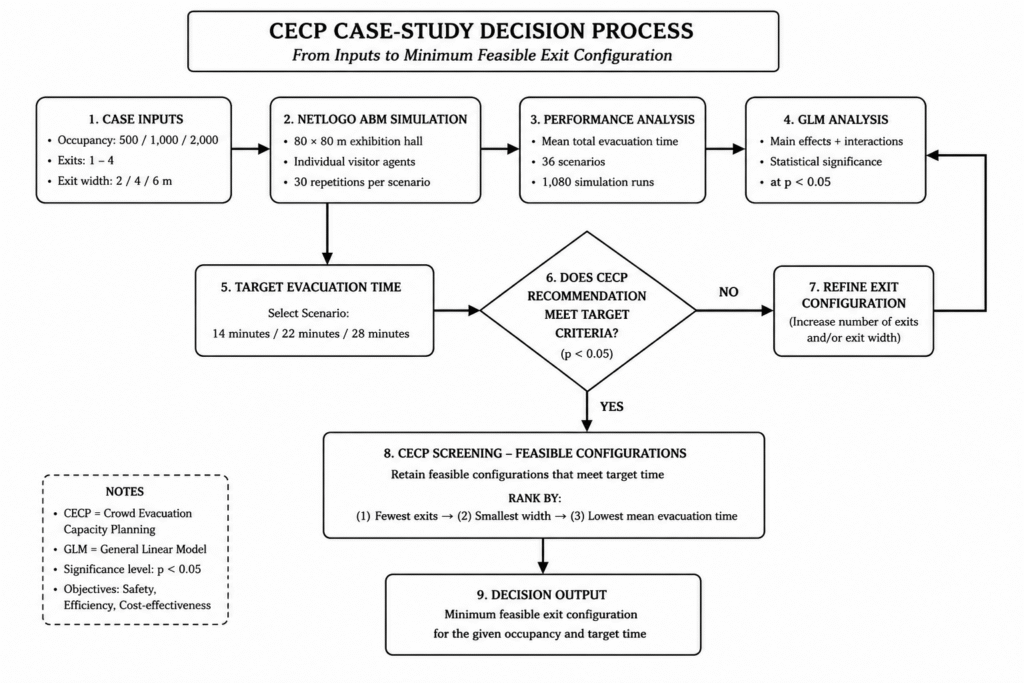
Figure 1. CECP crowd evacuation planning workflow derived from the simulation study.
What the Simulation Results Show
The tabulated results show a clear pattern: evacuation time rises substantially as occupancy increases and falls as exit capacity improves. Across all tested conditions, mean evacuation time increased from 16.66 minutes for 500 visitors to 31.76 minutes for 1,000 visitors and 57.48 minutes for 2,000 visitors.
The number of exits had a particularly strong effect. The overall mean evacuation time fell from 62.62 minutes with one exit to 31.35 minutes with two exits and 17.34 minutes with four exits. In the paper’s combined results table, four exits corresponded to a 72.32% reduction compared with one exit. Wider exits also improved performance: overall mean evacuation time decreased from 43.59 minutes at 2 m width to 28.29 minutes at 6 m width.Statistical analysis supported these patterns. Crowd size, number of exits, and exit width were all significant at p < 0.001, and the fitted GLM reported R² = 98.60% and adjusted R² = 98.57%. Crowd size produced the largest F-value, followed by number of exits and exit width. For planning purposes, this reinforces an important point: exit design should be matched to expected occupancy rather than evaluated independently.
What Is Different About the CECP Approach?
Many evacuation studies naturally focus on the configuration that produces the shortest evacuation time. CECP uses a different planning logic. Once a target time is selected, it asks which configurations are feasible and then chooses the smallest one that meets the target. The ranking sequence is simple: first choose the fewest exits, then the smallest exit width, and finally the lowest mean evacuation time if more than one option remains.
This changes simulation from a descriptive tool into a capacity-planning tool. A facility manager may not need the absolute fastest configuration if a smaller design can already meet the required performance. At the same time, a target may be impossible under the tested infrastructure, which gives planners a clear signal that additional capacity or lower occupancy is needed.
How the Recommended Exit Capacity Changes with the Target
| Occupancy | Target | Recommended Exits | Exit Width | Mean Time | Status |
| 500 | ≤ 14 min | 2 | 4 m | 12.54 min | Achieved |
| 1,000 | ≤ 14 min | 4 | 4 m | 13.66 min | Achieved |
| 2,000 | ≤ 14 min | — | — | — | Not achievable |
| 500 | ≤ 22 min | 2 | 2 m | 18.71 min | Achieved |
| 1,000 | ≤ 22 min | 2 | 6 m | 18.68 min | Achieved |
| 2,000 | ≤ 22 min | 4 | 6 m | 21.56 min | Achieved |
| 500 | ≤ 28 min | 1 | 4 m | 27.73 min | Achieved |
| 1,000 | ≤ 28 min | 2 | 4 m | 23.81 min | Achieved |
| 2,000 | ≤ 28 min | 4 | 4 m | 26.26 min | Achieved |
The contrast between the three targets is useful. A 14-minute requirement is achievable for 500 and 1,000 visitors within the tested configurations, but not for 2,000 visitors. At 22 minutes, all three occupancy levels become feasible, although 2,000 visitors still require four 6 m exits. With a 28-minute target, the infrastructure requirement reduces further for the lower occupancies, while 2,000 visitors still require four exits.
Why More Exits Can Matter More Than Simply Wider Exits
Widening an exit increases local throughput, but it does not automatically solve the problem of many people choosing the same evacuation point. Multiple exits can distribute demand spatially and reduce the concentration of agents at a single bottleneck. This is consistent with the study’s overall results, where increasing the number of exits produced a larger reduction in mean evacuation time than increasing exit width alone.
Where This Type of Model Can Support Planning
A simulation-based capacity framework can be useful during early design reviews, event planning, renovation studies, emergency preparedness exercises, and occupancy assessments. For example, planners can use a model to compare alternative exit layouts before physical modifications are made, test whether a proposed attendance level is compatible with a target evacuation time, or identify when infrastructure changes are required instead of relying only on intuition.For crowd-management teams, the same logic can complement wider safety planning by connecting expected occupancy with measurable evacuation performance. Simbi Labs currently groups NetLogo and simulation content within its Crowd Management knowledge area and also provides crowd-management and safety services, making this type of research-based application a natural fit for the website’s existing content.
Important Limitations Before Applying the Results to a Real Building
The study is a controlled simulation, not a validation of a specific real building. Agents begin evacuation immediately, know the exit locations, move at a constant speed, remain calm, and encounter no furniture, temporary structures, mobility limitations, or environmental hazards. Real evacuation performance can differ when these factors are present.For real-world application, the model should therefore be calibrated to the actual building geometry, occupant profile, movement behaviour, obstructions, route choices, and emergency conditions. The value of the CECP framework is the decision logic: define an occupancy, test infrastructure options, evaluate evacuation performance, and identify the minimum configuration that satisfies the chosen target.
Conclusion
Crowd evacuation planning becomes more useful when simulation results are translated into decisions. The NetLogo-based CECP framework demonstrates how occupancy, number of exits, and exit width can be evaluated together instead of as separate design questions. In the study, crowd size was the strongest determinant of evacuation time, while increasing the number of exits produced substantial performance gains. Most importantly, CECP converted those results into minimum feasible exit configurations for different evacuation targets.For planners, facility managers, and event organisers, the message is straightforward: evacuation capacity should be tested against both expected occupancy and a clearly defined performance objective. Agent-based simulation provides a structured way to make that assessment before changes are implemented in the physical environment.
Call to Action
Planning crowd movement, evacuation scenarios, or simulation-based safety assessments? Simbi Labs’ Crowd Management & Safety Solutions can support data-driven planning, modelling, monitoring, and crowd-safety analysis. Explore the Crowd Management section on Simbi Labs or connect with the team for a project discussion.
Book a free consultation for appointment
Email us at : grow@simbi.in
Frequently Asked Questions
What is crowd evacuation planning?
Crowd evacuation planning evaluates how occupants can move from a facility to safety during an emergency and whether available routes and exits can handle the expected occupancy within an acceptable time.
Why use NetLogo for crowd evacuation simulation?
NetLogo supports agent-based modelling, allowing individual occupants to be represented as agents whose movements and local interactions produce crowd-level effects such as congestion and bottlenecks.
What is the CECP model?
Crowd Evacuation Capacity Planning (CECP) is the decision framework proposed in the study. It screens simulated exit configurations against a target evacuation time and selects the minimum feasible exit capacity.
Which factor had the largest effect on evacuation time?
In the study’s GLM analysis, crowd size had the largest F-value, followed by number of exits and exit width. All tested main effects were statistically significant at p < 0.001.
Can the study’s recommended exit sizes be directly used for a real building?
No. The recommendations come from a simplified 80 × 80 m simulated hall with controlled assumptions. Real buildings require site-specific modelling, applicable codes, engineering review, and validation using the actual layout and occupant characteristics.