
How to Validate a NetLogo Crowd Evacuation Model Before Using It for Safety Planning
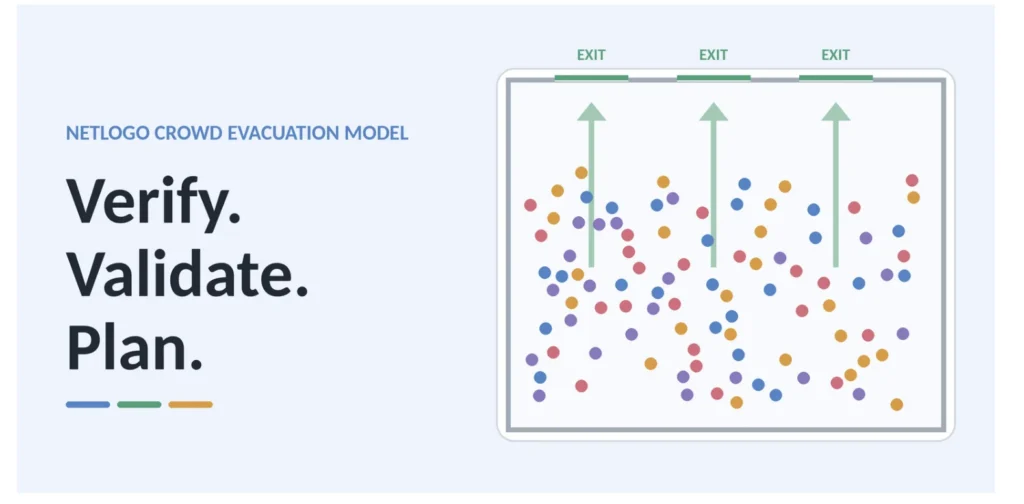
A NetLogo Crowd Evacuation Model can produce clear animations, tidy charts and precise-looking evacuation times within a short period. That is exactly why it needs to be checked. A model that runs without errors is not necessarily a model that represents reality, and decisions about exits, occupancy or evacuation-time targets should not rest on output that nobody has tested.
Validation is the step that turns a working simulation into evidence that planners can rely on. This blog explains how crowd evacuation simulation can be verified and validated in NetLogo, which checks are the most useful, and how the limits of the results should be described before the model is used for emergency evacuation planning.
Verification and Validation: What Is the Difference?
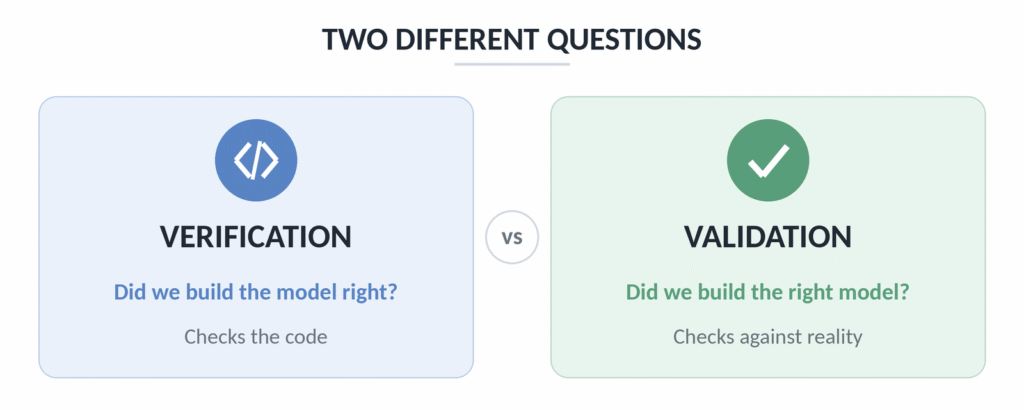
The two terms are often used as if they mean the same thing, but they answer different questions. Verification asks whether the model was built correctly. It concerns the code: do agents move as intended, do they leave through the exits, and is the evacuation time recorded correctly? Validation asks whether the right model was built. It concerns the match between the model and the real situation it is meant to represent: are the assumptions reasonable, and are the results credible when compared with what is known about real crowds?
A model can pass verification and still fail validation. For example, the code may implement agents that all walk at the same speed and never hesitate exactly as designed, but that may not be a fair picture of the crowd being studied. Good evacuation modeling and simulation needs both.
Start by Defining the Intended Use
Before any tests are run, the purpose of the model should be written down. “Compare exit configurations for a public exhibition hall at a stated occupancy” is a clear purpose. “Tell us whether the building is safe” is not. The intended use decides how much validation is enough: a model used to compare options in an early design phase needs different evidence from one used to support a formal safety decision.
It also helps to record the assumptions of the model in a structured way. The ODD protocol (Overview, Design concepts, Details) is widely used for agent-based models and lets anyone reviewing the work see exactly what was, and was not, represented.
Verifying the NetLogo Implementation for Crowd Evacuation
A careful NetLogo implementation for Crowd Evacuation starts with simple checks that have known answers. The first is a single-agent test. If one agent is placed at a known distance from an exit, the evacuation time should equal the distance divided by the walking speed. For a hypothetical agent 40 m from an exit walking at 1.2 m/s, the time should be about 33 seconds. If the model returns something very different, there is a problem in the code.
The second group of checks uses extreme conditions. The model can be run with very few agents and then with a very large crowd, or with one very narrow exit and then a very wide one. Evacuation time should move in the expected direction each time. A conservation check is also useful: every agent that starts in the space should either still be inside or be counted as evacuated, and nobody should disappear, become stuck in a wall or leave through a closed exit.
Finally, watching runs at a slow speed often reveals problems before they appear in the numbers, such as odd clustering, agents walking through obstacles or queues forming in the wrong place. A second person reading the code can also catch mistakes that the original author has stopped noticing.
READ THIS ALSO: Crowd Evacuation Planning with NetLogo
Checking That Results Are Stable Across Random Seeds
Agent-based models are stochastic. Two runs of the same scenario with different random seeds will not give identical evacuation times, because agents start in different positions. This is why repeated runs matter. In the study behind our earlier blog on NetLogo crowd evacuation planning, each of the 36 scenarios was repeated 30 times with different random seeds, giving 1,080 simulations run through NetLogo BehaviorSpace.
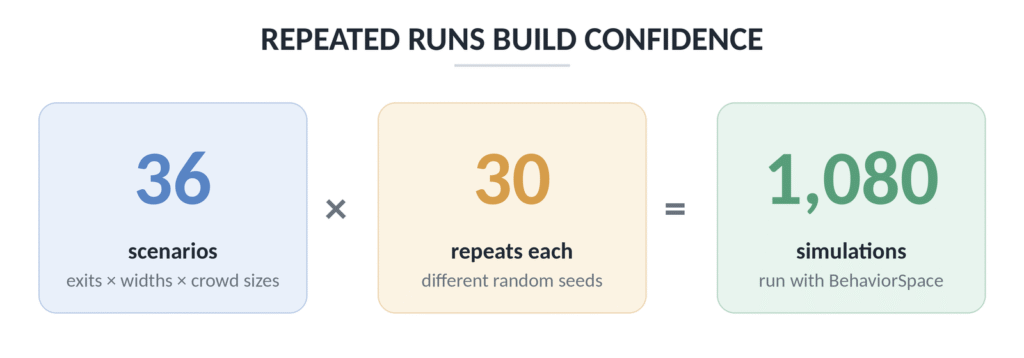
Reporting a mean together with a measure of spread, rather than a single run, shows the reader how much of a difference is real and how much is random variation. A useful test is to ask whether the conclusion would change if another set of replications were run. If it would, more replications are needed.
Testing Sensitivity to Assumptions
Every NetLogo Crowd Evacuation model depends on assumptions such as walking speed, starting positions, exit widths and the way agents choose an exit. Sensitivity analysis changes one assumption at a time and observes how the results respond. If a small change in walking speed reverses which exit configuration looks best, the recommendation is fragile and should be presented with caution. If the ranking stays the same across a reasonable range of values, confidence in the finding grows.
BehaviorSpace is well suited to this work because it varies parameters systematically and records the outputs, so the tests can be repeated and reported clearly.
| Section | Key Points | What Should Be Documented |
| Comparing the Model With Real-World Evidence | Compare the evacuation model with real-world evidence such as evacuation drills, video observations, published walking-speed and exit-flow data, results from established evacuation tools, and expert judgement. | Record the type and source of evidence used for comparison. |
| Purpose of Validation | Perfect agreement between the model and real-world data is not necessary. The main goal is to determine whether the model reproduces important crowd-movement patterns. | Check whether evacuation time increases with crowd size, congestion develops near exits, and additional or wider exits improve evacuation. |
| Investigating Differences | If model results differ from observed or published data, the reasons for the differences should be investigated rather than ignored. | Record possible causes, assumptions, parameter differences, and limitations affecting the results. |
| Lack of Empirical Data | Some sites may not have sufficient real-world evacuation data available for validation. | Clearly state when empirical evidence is unavailable and avoid making claims beyond what the available evidence supports. |
| Documenting the Model | A validated model should also be reproducible and understandable to clients and reviewers. | Document the model’s purpose, assumptions, simplifications, parameters, data sources, replications, and result-summary methods. |
| Verification and Validation | The documentation should show how the model was checked and how its performance was compared with evidence. | Record all verification and validation tests carried out and their outcomes. |
| Known Limitations | Every model has limitations, and these should be explicitly acknowledged. | Document known limitations, uncertainties, data gaps, and situations where the model may not accurately represent reality. |
| Traceability of Results | Clear documentation makes it easier to explain how assumptions and inputs led to the final conclusions. | Maintain a clear path from assumptions → parameters → model runs → results → conclusions. |
How Validation Supports Emergency Evacuation Planning
- Architects: Compare different exit-capacity alternatives during the design phase.
- Facility managers: Assess whether existing exits are suitable for expected occupancy.
- Event organisers: Compare expected attendance with available evacuation facilities.
- Planners: Use validated models for more credible “what-if” evacuation scenarios.
- Decision-making: Identify which results are robust and which depend strongly on specific assumptions.
Why does Simbi Labs Provide This Service?
Many organisations can build a simulation, but fewer can explain, with evidence, why its results deserve to be trusted. Simbi Labs supports simulation-based research and analytics by combining NetLogo Agent-Based Modeling with structured testing and clear reporting. Depending on the project, this can include scenario design, NetLogo implementation, BehaviorSpace experiments, sensitivity testing, statistical analysis, documentation of assumptions and research-ready reporting.
The aim is to give architects, facility managers, event organisers, emergency planners and researchers results that they can understand, question and defend before making a costly or safety-critical decision.
Book a free consultation for appointment
Email us at : grow@simbi.in
Important Limitations
Validation shows that a model is fit for a defined purpose; it does not make the model a perfect copy of reality. Many simulations assume that people start moving immediately, know where the exits are, walk at similar speeds and behave calmly. Real emergencies can involve delayed reactions, groups moving together, people with reduced mobility, blocked routes and stress. Simulation results should therefore be treated as decision-support evidence, not as a substitute for local building codes, fire-safety regulations or the judgement of qualified professionals.
Conclusion
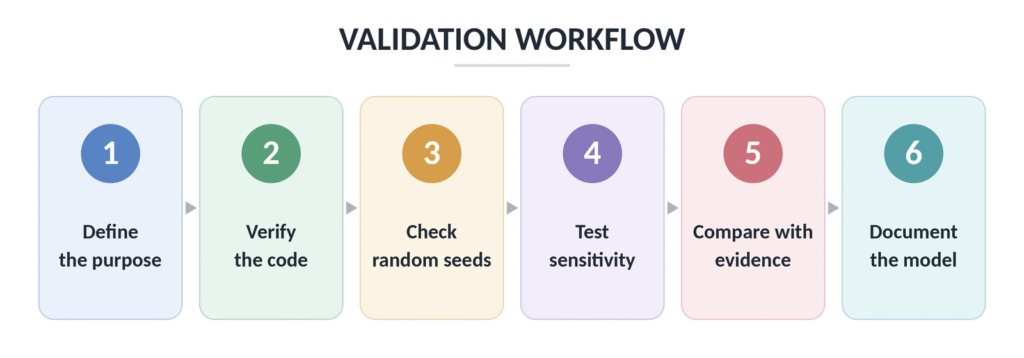
A NetLogo Crowd Evacuation Model earns trust step by step: define the purpose, verify the code, check stability across random seeds, test sensitivity to assumptions, compare with real-world evidence and document the limits. Skipping these steps risks turning an attractive simulation into a misleading one.
When validation is done properly, crowd evacuation simulation becomes a practical tool for comparing options, testing “what if” scenarios and explaining safety-related choices with evidence. For anyone using evacuation modeling and simulation to support emergency evacuation planning, validation is what makes the results worth acting on.
Frequently Asked Questions
1.What does it mean to validate a NetLogo crowd evacuation model?
It means checking that the model is suitable for its intended purpose. This includes verifying that the code works as designed and comparing the behaviour and results of the model with real-world evidence, published research or expert judgement.
2. What is the difference between verification and validation?
Verification checks that the model has been built correctly and that the code does what it is meant to do. Validation checks that the model represents the real situation well enough for its intended use.
3. How many simulation runs does a crowd evacuation simulation need?
There is no single number. Because agent-based models are stochastic, each scenario should be repeated with different random seeds until the conclusions are stable. The earlier Simbi Labs study repeated each scenario 30 times.
4. Can a validated NetLogo model replace building-code requirements?
No. A validated model can support planning decisions with evidence, but it should be used alongside local building codes, fire-safety regulations and qualified professional judgement.
5. How can Simbi Labs support a NetLogo crowd evacuation project?
Simbi Labs supports research and simulation projects involving NetLogo Agent-Based Modeling, scenario design, BehaviorSpace experiments, sensitivity testing, statistical analysis, visualisation and research-ready reporting.