
Contract Clinical Research Coordinators vs Full-Time CRC: Which Staffing Model Is Right for Your Clinical Trial?

While cutting-edge science is key to clinical trial success, so is the right operational staff at the right time. With a growing complexity of clinical research programs, sponsors and Contract Research Organizations (CROs) are constantly confronted with the challenge of finding a balance between resources, study timelines, regulatory expectations, and budget efficiency. While experienced Clinical Research Coordinators (CRCs) remain indispensable for trial execution, one strategic question continues to influence operational planning: Should organizations engage Contract Clinical Research Coordinators or invest in Full-Time CRCs?
The solution is often not a simple one. The process of clinical trials has several stages and each stage has varying operational demands. There are varying degrees of coordination needs for site activation, participant recruitment, protocol changes, interim analyses and database lock. An effective staffing model for the start-up of the study could become ineffective in the ongoing follow-up or extended follow-up of the participants.
Organizations should not consider Contract and Full-Time CRCs as mutually exclusive models but rather choose the model that reflects the complexity, length, size and goals of a clinical study. The right staffing approach maximizes resources, adds to regulatory compliance, and allows research programs to adapt to the changing needs of studies.
Why Staffing Strategy Has Become a Competitive Advantage
The operational patterns for clinical trials are not consistent. The number of participants recruited varies and amendments to research protocols add to the process, and decentralized trial technologies need to be managed across several sites. Thus, staffing has changed from being a typical HR function to a strategic business decision.
By choosing the right CRC model, organizations can enjoy tangible benefits such as streamlined study processes, quicker resolution of issues, and better adaptability to changing workloads. On the other hand, a suboptimal staffing strategy can lead to higher training expenses, lower productivity, and add unnecessary administrative work to research teams.
An effective staffing strategy should support:
- Consistent protocol implementation across study sites
- Efficient utilization of operational resources
- Timely participant recruitment and retention
- Inspection-ready documentation
- Rapid adaptation to changing study requirements
- Sustainable workforce planning throughout the trial lifecycle
Instead of asking which model is universally better, sponsors should determine which approach best supports their operational priorities.
Understanding the Value of Contract Clinical Research Coordinators
Contract Clinical Research Coordinators are generally hired to work on a specific study, a specific phase of a study or an operational need. These are not permanent staff members but are added to help with specific expertise when needed in the time of coordination.
This method of staffing has become more common in contemporary clinical research because the workload of studies typically fluctuates throughout the study. Operational needs during busy enrollment periods, protocol changes, or database lock can often overload the permanent research staff. Contract CRCs enable organisations to scale up resources rapidly, without having to sign long-term contracts.
Contract professionals also have the flexibility, and expertise having worked with several sponsors, CROs and clinical research sites for therapeutic-specific work. They have experience in quickly adapting to new protocols and contribute tried and tested practices to support the implementation of studies.
Contract CRCs are particularly valuable for:
- Clinical trial start-up and site activation
- High-volume participant recruitment campaigns
- Multi-center clinical studies
- Short- and medium-duration research projects
- Temporary staffing gaps
- Database lock and study close-out activities
Rather than replacing internal teams, Contract Clinical Research Coordinators complement existing operational resources by providing targeted expertise where it is needed most.
Contract Clinical Research Coordinators vs Full-Time CRC Comparison
| Evaluation Criteria | Contract CRC | Full-Time CRC |
| Deployment Speed | Rapid deployment | Standard recruitment process |
| Workforce Flexibility | High | Moderate |
| Specialized Expertise | Easily available | Depends on internal capability |
| Resource Scalability | Excellent | Limited |
| Best Fit | Short- to medium-term studies | Long-term research programs |
| Workforce Commitment | Project-based | Permanent organizational resource |
The comparison highlights that Contract CRCs are designed to provide operational agility, making them particularly effective for organizations managing fluctuating study workloads or expanding research programs across multiple locations.
When Full-Time CRC Teams Deliver Greater Long-Term Value
While Contract Clinical Research Coordinators offer a great deal of flexibility, Full-Time CRCs are still crucial for organizations that do clinical research on an ongoing basis. Multiple studies are common to research hospitals, academic medical centers, committed oncology centers, and big pharmaceutical firms throughout the year. A permanent operational expertise has many benefits in these environments.
Full-Time CRC builds an institutional knowledge of the laboratory, investigational SOPs and long-term relationships with investigator, ethics committee, laboratory and sponsor teams. They have an understanding of organizational processes that decreases the onboarding needs and helps to increase the consistency of the operation in the long term.
Organizations with permanent research infrastructure frequently benefit from Full-Time CRC teams because they support:
- Ongoing research programs across multiple therapeutic areas
- Long-term participant follow-up studies
- Institutional knowledge retention
- Continuous regulatory readiness
- Standardized operational processes
- Stable collaboration with investigators and sponsor teams
Rather than focusing solely on flexibility, Full-Time CRCs strengthen organizational capability by providing continuity across successive clinical research programs.
Beyond Cost: Evaluating the Operational Impact of CRC Staffing Models
When comparing Contract Clinical Research Coordinators and Full-Time CRCs, many organizations initially focus on salary or recruitment costs. But the operational contribution of a staffing model over the clinical trial life cycle is what makes its worth. Onboarding time, workforce utilization, productivity, regulatory preparedness and knowledge retention are more important components of studies’ performance than compensation.
Contract CRCs offer immediate operational support without the commitment of a long-term hire. They can seamlessly integrate into continuous studies, allowing sponsors to cope with resource limitations in specific stages of the study, like participant recruitment, protocol changes, and database locking. In contrast, Full-Time CRCs provide institutional knowledge, process standardization and long-term stability of operations that can be advantageous to organizations operating regular research programs.
Sponsors need to consider staffing models based on operational indicators, not on monetary indicators. These encompass study start-up timetables, participant recruitment efficiency, protocol adherence rates, observation during monitoring, documentation quality, and the utilization of the workforce.
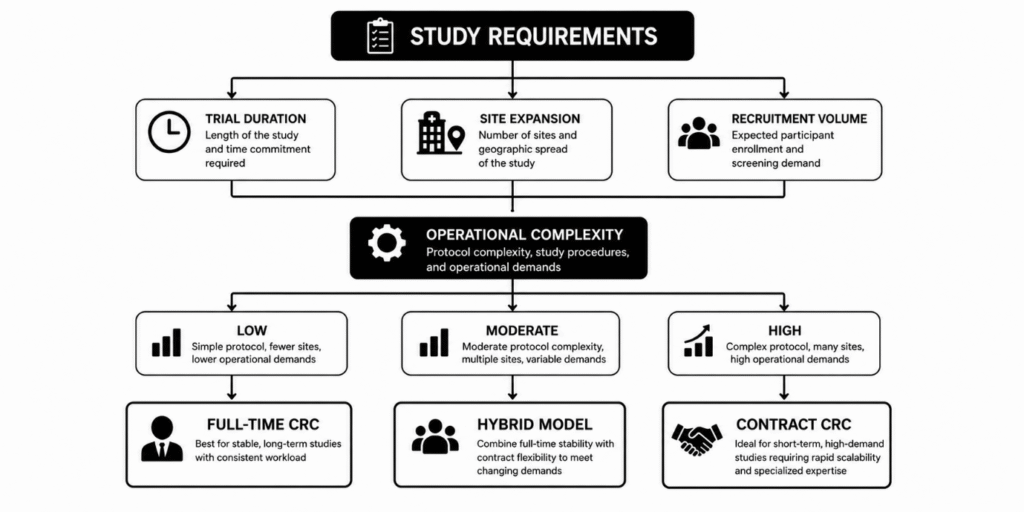
Before selecting a staffing model, organizations should evaluate:
- Clinical trial duration and projected workload
- Number of participating research sites
- Frequency of protocol amendments
- Expected participant enrollment volume
- Internal operational capacity
- Long-term research objectives
- Availability of therapeutic area expertise
Selecting the appropriate staffing strategy based on these operational indicators enables research organizations to improve efficiency while maintaining compliance throughout the study lifecycle.
Matching the Staffing Model to Clinical Trial Requirements
The most successful sponsors never use only one staffing model in all of their research programs. Rather, they link workforce planning to the needs of each study. Early-phase studies are usually time sensitive and specialized studies, while permanent research centers can gain from having a team of Full-Time CRC. Both models are often used together in large multinational studies, resulting in a hybrid team that can respond to project needs.
The question should not be “which is better?” but “which is most clinically and operationally valuable to the organization?” when considering whether to use a Contract CRC or a Full-Time CRC.
Recommended CRC Staffing Model by Clinical Trial Type
| Clinical Trial Type | Recommended Staffing Model |
| Phase I Clinical Trial | Contract CRC |
| Phase II Clinical Trial | Contract / Hybrid Model |
| Phase III Multi-Center Study | Contract CRC |
| Oncology Research Program | Full-Time CRC |
| Medical Device Clinical Study | Contract CRC |
| Academic Research Institution | Full-Time CRC |
| Decentralized Clinical Trial | Hybrid Model |
| Long-Term Registry Study | Full-Time CRC |
This comparison demonstrates that staffing decisions should reflect study characteristics rather than organizational preference. A flexible workforce strategy often delivers better operational outcomes than applying a single staffing model across every project.
The Future of Clinical Trial Staffing
Clinical research is still progressing on a path to becoming more flexible and technology-driven. Organizations need to rapidly scale operations in order to remain compliant with regulations and quality standards in global studies, decentralized clinical trials and adaptive research design. This has led many sponsors to abandon traditional structures of staff and adopt a hybrid model of permanent staff with project specific specialists.
Emerging trends shaping clinical trial staffing include:
- Hybrid workforce models combining Contract and Full-Time CRCs
- Resource-on-demand staffing for peak study activities
- Increased adoption of decentralized and hybrid clinical trials
- Greater use of digital collaboration platforms and remote coordination
- Functional outsourcing for specialized operational activities
- Workforce planning based on real-time study performance metrics
These developments demonstrate that the future of clinical research staffing is centered on operational agility rather than fixed organizational structures.
Choosing the Right CRC Staffing Model
About Simbi Labs India
Clinical research organizations need staffing partners with both a regulatory and operational awareness. Simbi Labs India caters to the pharmaceutical and biotechnology companies, Contract Research Organizations (CROs), hospitals and research institutes through its specialized clinical research staffing and operational support services. Whether it is Clinical Research Coordinators, site management professionals, regulatory documentation, clinical operations support, and everything in between, the organization works with research teams to improve study efficiency, ensure compliance, and improve clinical operations performance in various therapeutic areas.
Conclusion
The decision between Contract Clinical Research Coordinators and Full-Time CRCs isn’t a matter of which staffing model is best in all cases; it is simply about finding the model that is appropriate for a particular clinical trial. Full-Time CRCs have a long term institutional memory, continuity and stability of operational staff, whereas Contract CRCs can be flexible and deployed quickly for dynamic or project-specific studies, with the added benefit of specialized staff expertise. With the increasing complexity of clinical research, many organisations are turning to hybrid staffing approaches in order to harness the best of both worlds for successful study execution, efficient resource usage and maintaining regulatory compliance.
Need Expert Guidance on CRC Staffing?
From Contract Clinical Research Coordinators to stable long-term clinical research teams; Simbi Labs India offers flexible clinical research staffing solutions that cater to your clinical trial goals. Speak with our staff to determine which staffing model works best in your coming clinical research project.
Book a free consultation for appointment
Email us at : grow@simbi.in
Frequently Asked Questions
1. What is a Contract Clinical Research Coordinator?
A Contract Clinical Research Coordinator is a clinical research professional engaged for a specific study, project, or operational phase. They provide specialized support without becoming permanent employees of the organization.
2. How is a Contract CRC different from a Full-Time CRC?
Contract CRCs are hired for defined projects or temporary operational needs, whereas Full-Time CRCs are permanent employees who support ongoing clinical research programs and organizational operations.
3. Which staffing model is better for multi-center clinical trials?
Multi-center clinical trials often benefit from Contract CRCs because they can be deployed rapidly across multiple sites and scaled according to study requirements.
4. Can organizations combine Contract and Full-Time CRCs?
Yes. Many sponsors adopt a hybrid staffing model where Full-Time CRCs manage core operations while Contract CRCs provide additional support during peak workload periods or specialized study phases.
5. What factors should sponsors evaluate before choosing a CRC staffing model?
Sponsors should consider trial duration, participant volume, site expansion, operational complexity, therapeutic expertise, regulatory requirements, and long-term workforce planning.
6. Why are hybrid staffing models becoming more common in clinical research?
Hybrid models provide operational flexibility by combining the stability of Full-Time CRCs with the scalability and specialized expertise offered by Contract Clinical Research Coordinators, enabling organizations to respond effectively to changing study demands.