
TAM, SAM and SOM: A Practical Guide to Market Sizing for Business Growth
A business can operate in a rapidly growing industry and still struggle to find enough customers for sustainable growth. The problem is often not the industry itself but an unclear understanding of the market that the business can actually serve. Market sizing helps convert a broad business opportunity into a structured assessment of potential customers, demand, competition and realistic revenue potential.
TAM, SAM and SOM provide a useful framework for making that assessment. However, these measures become valuable only when they are connected to the actual customer, product, geography, pricing model and route to market rather than presented as three impressive numbers in a business plan.
A Large Industry Does Not Automatically Mean a Large Business Opportunity
A common mistake in market analysis is starting with the size of an entire industry. Such figures may include customer groups, regions or product segments that a company cannot serve. A meaningful estimate therefore starts with who is likely to buy, what they need and whether they can realistically be reached.
The official Startup India guidance on evaluating business opportunities highlights market size, customer identification, competitive analysis, target audiences and obtainable market share. This helps determine whether a broad industry figure represents a genuine opportunity, rather than simply a large theoretical audience.
Read Also : Market Research Basics for Smarter Business Decisions

TAM, SAM and SOM Define Three Different Business Questions
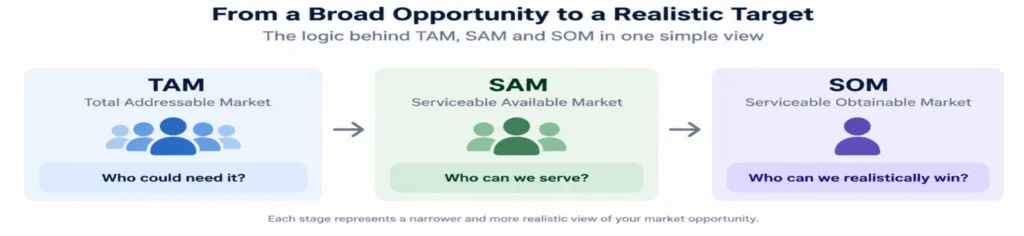
TAM, SAM and SOM should be viewed as progressively narrower interpretations of the same opportunity.
| Measure | Business question | What should determine it? |
| TAM – Total Addressable Market | How large could the opportunity be under the broadest relevant definition? | Potential customers, demand and category boundaries |
| SAM – Serviceable Available Market | Which part of that opportunity fits the current product and business model? | Geography, customer segment, product scope, pricing and channels |
| SOM – Serviceable Obtainable Market | Which part can the business realistically acquire? | Competition, sales capacity, distribution, resources and execution |
TAM therefore represents the broad opportunity rather than a sales forecast. SAM introduces the constraints created by the actual offering. SOM goes one step further by considering what the organisation can realistically reach and convert.
This progression prevents businesses from treating the entire industry as their immediate customer base.
Build the Market Around Real Customers and Buying Conditions
The most defensible market estimates are built from identifiable customers rather than an arbitrary percentage of a large industry. The analysis should consider who needs the product, their purchasing ability, location, pricing and other market constraints.
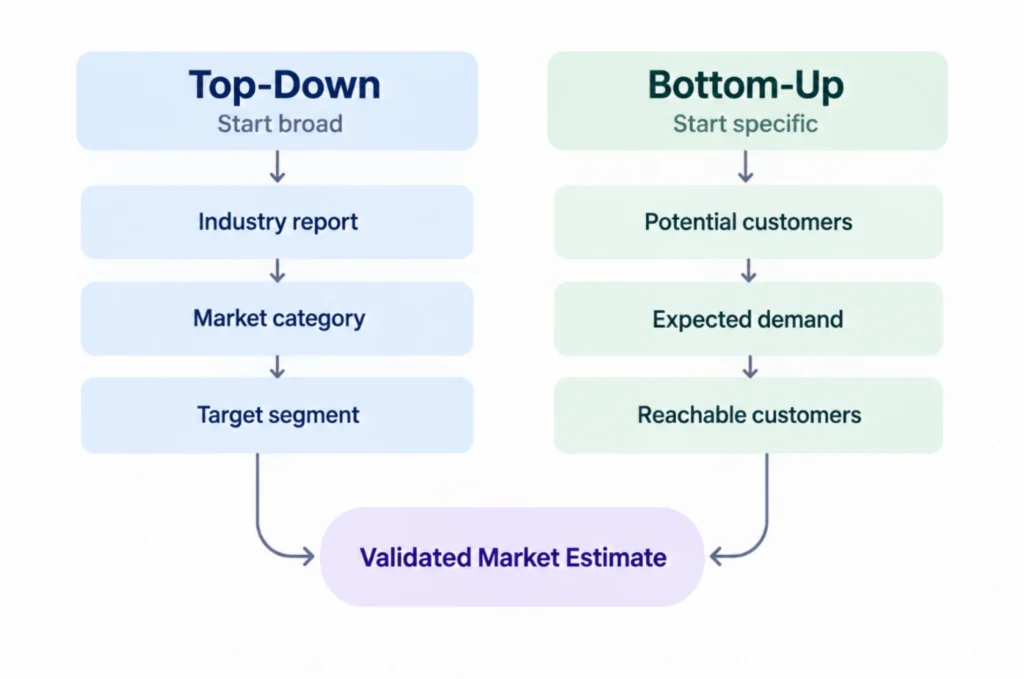
Consider a subscription-based professional software company entering a new regional market. Instead of treating every business as a potential customer, it can narrow the market to organisations whose needs, size, location and budget match the offering. Its available sales and distribution channels can narrow the reachable market further, helping distinguish TAM, SAM and SOM.
This bottom-up approach makes the estimate easier to validate because it shows how potential customers are identified, which ones fit the offering and how the business can realistically reach them.
Read Also : Porter’s Five Forces Guide: Unlocking Market Research for Smarter Business Decisions
SOM Is Where Market Potential Meets Operational Reality
SOM is often the weakest part of a market-sizing exercise because businesses sometimes treat it as an arbitrary percentage of SAM. A realistic SOM should be connected to the organisation’s ability to acquire and serve customers. Sales capacity, marketing reach, distribution coverage, production or service capacity, onboarding resources, customer retention and competitive intensity can all limit the portion of SAM that is realistically obtainable.
For example, returning to the software company, a large pool of suitable businesses does not mean the company can immediately reach all of them. If the business has a limited sales team, restricted marketing reach and only a few acquisition channels, its initial obtainable market will be considerably narrower. This is why SOM should be treated as an operationally supported estimate, not simply as a percentage selected because it makes the business plan look attractive.
Use Multiple Evidence Sources Before Trusting the Estimate
A strong market-sizing exercise rarely depends on one report. Industry research can establish broader category conditions, while customer research and operational data provide greater specificity.
Useful evidence may include:
- Government demographic and economic statistics
- Industry and trade-association data
- Competitor pricing and product information
- Customer surveys and interviews
- Company filings and investor disclosures
- Search and demand indicators
- Internal sales, CRM and customer data
- Distribution and channel information
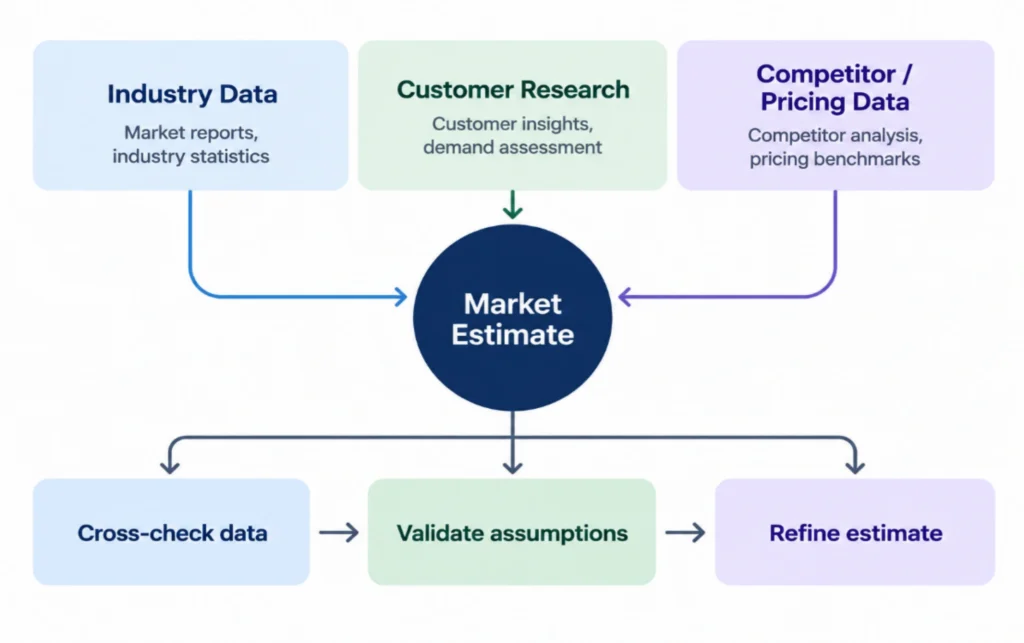
Official datasets can be particularly useful when the analysis requires geographic, demographic or economic validation. For businesses analysing the Indian market, the Ministry of Statistics and Programme Implementation (MoSPI) provides access to official statistics and datasets covering areas such as economic activity, industries, employment and household characteristics. These government sources can complement commercial market research and help businesses validate assumptions with credible secondary data.
The important principle is triangulation. If an industry report suggests strong market potential but customer research indicates weak willingness to pay, the difference should be investigated rather than hidden.
Do Not Let a Large TAM Hide a Weak Business Case
A large TAM can create a false sense of security. It does not demonstrate product-market fit, competitive advantage or the ability to acquire customers. Using a broad industry figure for a geographically restricted business can inflate TAM, while unexplained percentages for SAM or SOM make estimates difficult to validate.
Market-sizing studies can also become unreliable when they mix revenue, users, transactions and market value without clearly defining each measure and its time period. Counting everyone who could theoretically use a product, without considering actual need or purchasing ability, can further distort demand.
Most importantly, assumptions should be transparent. A credible estimate should allow another analyst to understand where the inputs came from, why segments were excluded and how the final market size was derived.

Turn Market Size Into a Decision, Not Just a Number
The real value of TAM, SAM and SOM lies in the business decisions they support. Market sizing can help determine whether a product is commercially attractive, which customer segment to prioritise, whether to enter a new geography, how much sales capacity is required and whether projected revenue is realistic.
It can also reveal when an apparently attractive opportunity is too constrained. If SAM is limited by regulations, geography or customer demand, the business may need to reconsider its product, pricing or distribution strategy before making a major investment.
Market sizing should therefore be reviewed when key assumptions change. New competitors, pricing changes, geographic expansion, product extensions or shifts in customer behaviour can materially change the addressable opportunity.
TAM, SAM and SOM are most useful when they explain who the customers are, which customers the business can serve and which customers it can realistically win. The objective is not to produce the largest possible market figure but to develop an estimate that can withstand scrutiny. A well-structured market sizing exercise combines customer evidence, industry information, competitive conditions and operational capacity, allowing TAM to define the broader opportunity, SAM to identify the relevant market and SOM to translate that opportunity into a realistic path for growth.
Strengthen Your Market Analysis With Data-Driven Research
Reliable market decisions require more than headline industry figures. Simbi Labs can support businesses with structured market research, data analysis, competitor assessment and evidence-based market sizing to develop a clearer view of where genuine growth opportunities exist.
Build your market strategy on evidence, not assumptions. Connect with Simbi Labs for professional market research and analytical support.