Healthcare Data Analytics: Transforming Public Health and Medical Intelligence
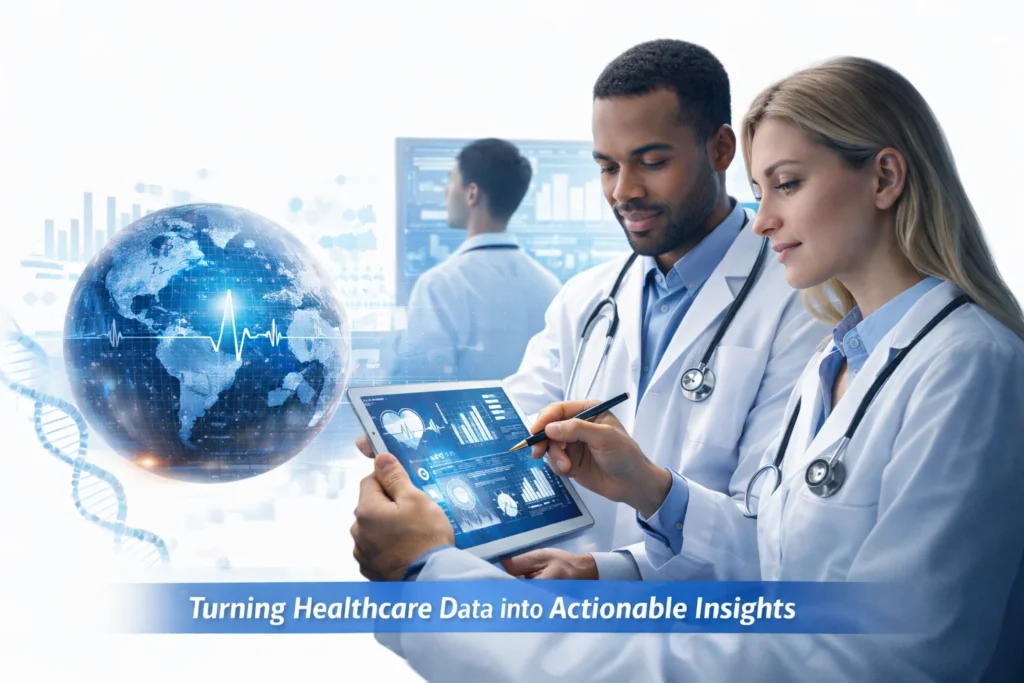
The healthcare sector is changing dynamically, and Healthcare Data Analytics is now the foundation of decision-making in contemporary medicine. Hospitals, insurance companies, and even governments are now not just looking back. Instead, they are using real-time data and information to improve healthcare, reduce costs, and increase efficiency.
Rather than reacting to healthcare emergencies, healthcare organizations and institutions are now using predictive models and statistical tools to forecast and prevent them. This change from reactive treatment to proactive intelligence is revolutionizing healthcare.
According to the World Health Organization, data generation in healthcare is increasing every year. Data generated includes digital medical records, wearable devices, and telemedicine. However, this data can be useful only when strategically analyzed.
The Growing Role of Healthcare Data Analytics in Modern Systems
Every day, healthcare institutions and organizations generate huge amounts of information, both structured and unstructured. Data generated includes clinical data, billing information, and monitoring devices. However, this data remains dormant and unused unless strategically analyzed.
Healthcare organizations and institutions use data analytics and statistical tools to transform raw data into actionable outcomes. For example, predictive modeling can be used to forecast the number of beds required in ICUs during seasonal outbreaks.
Common healthcare data sources include:
- Electronic Health Records (EHRs)
- Insurance claims databases
- Clinical trial data
- Laboratory and imaging reports
By integrating these datasets, Healthcare Data Analytics supports both operational stability and improved clinical accuracy.
Statistical Analysis with R in Healthcare Data Analytics
Statistical modeling plays a significant role in extracting value from healthcare data. One of the most widely used statistical tools in healthcare research is R programming. R programming is widely used in healthcare because of its power in epidemiology and biostatistics.
Healthcare analysts use R programming to analyze treatment efficacy, risks, and even population health. For example, during vaccination drives, statistical modeling can be used to analyze regions where vaccination rates are declining.
However, the models need continuous validation and recalibration with fresh patient data to ensure accuracy and minimize bias.
R enables professionals to:
- Perform survival and regression analysis
- Analyze clinical trial outcomes
- Monitor disease surveillance patterns
- Develop predictive health risk models
As digital health infrastructure expands, proficiency in statistical tools strengthens institutional resilience and evidence-based decision-making.
Artificial Intelligence Enhancing Healthcare Intelligence
Artificial intelligence is further enhancing the scope of Healthcare Data Analytics, going beyond traditional reporting systems. Machine learning algorithms can analyze huge patient data in mere seconds, discovering hidden patterns in the data.
In the radiology section of hospitals, AI systems analyze thousands of images used in diagnostics on a regular basis. These systems can aid doctors in highlighting areas of potential concern.
AI applications in healthcare include:
- Early disease detection algorithms
- Predictive readmission risk scoring
- Personalized treatment recommendations
- Automated clinical decision support
When AI integrates with analytics platforms, healthcare moves closer to preventive and precision-based medicine.
Financial Intelligence Through Claims Analytics
Financial sustainability is one of the major issues that the healthcare industry is struggling with today. The data related to claims can provide valuable insights regarding cost trends, frequency of treatment, and payment practices.
Through Healthcare Data Analytics, the chances of fraud can be identified and eliminated, and financial forecasting can be conducted.
In addition, the analytics systems used in the healthcare industry need to comply with regulations and documentation requirements, which is essential in the regulated environment of the healthcare industry. For example, irregularities in the frequency of certain procedures can be identified by the analytics system.
Apart from the detection of fraud, the data related to claims can provide valuable insights regarding the prevalence of chronic diseases in the population of certain regions.
Healthcare Analytics for Quality and Performance Improvement
Quality improvement is one of the major issues that the healthcare industry is focusing on today. The structured analytics systems provide valuable indicators of quality improvements.
For hospitals, analytics is often used to reduce hospital readmission, monitor surgical outcomes, and streamline patient flow. In the case of emergency departments, during certain shift hours, the patient flow can get congested, and the data can provide valuable insights regarding the causes of the problem.
In many hospitals, predictive risk score calculations are now embedded within the electronic health record system, enabling the display of alerts in the point-of-care environment rather than in reporting dashboards.
Key quality monitoring areas include:
- Readmission rates
- Surgical success metrics
- Medication safety indicators
- Emergency department wait times
Through systematic analysis, Healthcare Data Analytics strengthens both patient satisfaction and operational efficiency.
Data Visualization and Business Intelligence in Healthcare
The power of data is realized when it is understandable to decision-makers. Business intelligence applications bring together clinical, operational, and financial information in an interactive format.
Instead of reviewing static monthly reports, leadership teams can access real-time performance indicators. This allows quicker responses to emerging risks and more strategic resource allocation.
The ability to visualize information helps bridge the divide between analysis and strategy.
Career Growth and Skills in Healthcare Analytics
Due to an increase in the demand of Healthcare Data analytics, there is also an increase in the need of skilled professionals who will be able to combine the analytical skills with the expertise of the healthcare domain.
Effective healthcare analysts generally have skills in statistical modeling, SQL database management and in programming languages like R or Python. Moreover, knowledge of the regulations and standards of compliance in the healthcare field also boosts professional credibility.
Career opportunities span roles such as Healthcare Data Analyst, Clinical Data Manager, Public Health Data Scientist, and Healthcare Business Intelligence Analyst. Companies that invest in analytics talent prepare themselves to be innovative in the long run.
The Future of Healthcare Data Analytics
Predictive intelligence and automated decision support systems are the future of health care. With aging populations and rising chronic disease rates, the strategies based on analytics will gain more and more urgency. Due to the growth of healthcare data ecosystems, powerful data governance policies are necessary to safeguard privacy, secure data handling, and ethical use of patient information.
Emerging trends include:
- AI-assisted diagnostics
- Real-time wearable monitoring systems
- Precision medicine models
- Automated population risk prediction
These technologies are still growing up and as they grow, Healthcare Data Analytics will keep on redefining the way the healthcare systems provide care, manage resources and plan public health initiatives.
Clinical expertise is not the only thing that drives healthcare. It is driven by wisdom based on trusted and smartly analyzed information.
Conclusion
Healthcare Data Analytics has evolved from a supportive reporting function into a strategic driver of modern healthcare transformation. It improves clinical decision-making, financial sustainability, and proactive planning, which reinforces the public health.
Unexpectedly, data-driven intelligence enables healthcare providers to offer safer, quicker, and less expensive care to patients regardless of predictive modeling and integration of artificial intelligence to claims analysis and performance monitoring.
Those organizations that adopt analytics strategically will spearhead the coming of innovation in the area of medicine. Making healthcare data actionable is no longer considered as a technological breakthrough but it is an obligation to improved patient care and smarter healthcare systems.
Frequently Asked Questions (FAQs)
What is Healthcare Data Analytics?
It is the systematic analysis of medical and operational data to improve patient outcomes and optimize healthcare performance.
Why is R widely used in healthcare analytics?
R provides advanced statistical modeling and visualization capabilities essential for epidemiological and clinical research.
How does healthcare analytics improve patient care?
It enables predictive risk identification, treatment optimization, quality monitoring, and data-driven intervention strategies.
What skills are required for a healthcare analytics career?
Core skills include statistical analysis, SQL, R or Python programming, and healthcare domain expertise.