
What Is a Safe Turnitin Score? What Percentage Is Acceptable?
The Question Every Student Asks
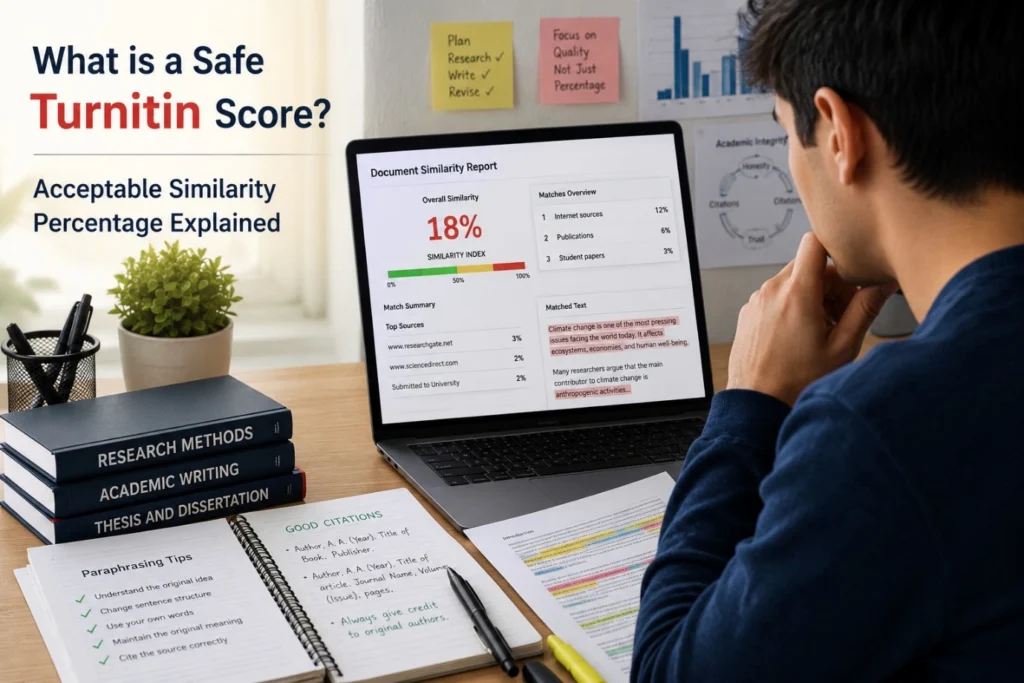
After submitting an assignment, dissertation, or research paper, one number often causes immediate anxiety—the Turnitin similarity percentage.
For many students, seeing anything above 10% feels alarming. Others assume that scores under 30% are always acceptable. The truth is more nuanced. A safe Turnitin score depends on context, citation quality, institutional guidelines, and the type of academic work submitted.
Understanding what this percentage really measures can help you avoid unnecessary stress and make informed revisions when needed. In this article, we break down acceptable Turnitin similarity percentage ranges and explain what they actually mean in practical academic settings.
READ THIS ALSO: Turnitin AI Detection Removal Services Ultimate Smart Guide
A Turnitin Score Is Not a Plagiarism Verdict
One of the biggest misconceptions is assuming that Turnitin directly detects plagiarism. It does not. Turnitin compares submitted text against published sources, journals, websites, and student databases to find matching patterns. The resulting percentage reflects overlap—not academic dishonesty. Understanding the Turnitin score meaning is important before interpreting similarity percentages incorrectly.
Similarly, a high percentage does not automatically mean copied work, while a low score does not guarantee perfect originality. Universities and academic reviewers usually analyze the nature of matched content rather than relying only on percentages. Proper citations, technical terminology, and commonly used academic phrases can naturally contribute to overlap without indicating intentional plagiarism. Therefore, understanding a safe Turnitin score requires more than looking at a single number.

How Similarity Percentages Are Usually Interpreted
While every university applies its own standards, most institutions use general similarity ranges to guide review. To help students better understand plagiarism reports, the following table provides a simplified overview of how Turnitin similarity percentages are commonly interpreted in academic environments. These ranges should be viewed as general guidelines rather than fixed rules, as institutional policies and assignment requirements may vary.
Turnitin Similarity Score Interpretation
| Similarity Range | Interpretation | Common Reasons |
| 0%–10% | Usually Excellent | Common phrases, references, standard definitions |
| 10%–20% | Normally Acceptable | Proper citations, technical terminology, shared methodology |
| 20%–35% | Requires Careful Review | Weak paraphrasing, excessive quotations, citation inconsistencies |
| 35% and Above | Often Needs Revision | Missing citations, copied sections, structural similarity |
Why Acceptable Scores Vary by Assignment Type
There is no universal safe Turnitin score because different academic documents naturally generate different overlap levels. The expected similarity percentage often depends on the purpose and structure of the document being submitted.
- Research Papers: Research papers are typically expected to show lower similarity because they emphasize analytical thinking and original interpretation.
- Literature Reviews: Literature reviews often generate higher similarity percentages since they summarize, compare, and discuss previously published academic studies.
- Scientific Reports: Scientific reports may naturally contain higher overlap due to technical terminology, standardized methodology descriptions, and repetitive scientific phrasing.
- Dissertations and Theses: Dissertations and theses usually show moderate similarity because they integrate extensive references, literature discussions, and multiple academic sources.
Understanding document context helps interpret acceptable Turnitin similarity percentage more accurately. This is why universities often differ when determining what is considered a good turnitin score for research papers, dissertations, or literature reviews.
What Actually Matters More Than the Percentage
A 25% score with properly cited references can be safer than a 5% score containing uncited copied material. In many academic cases, a high Turnitin score may result from references, quotations, or technical terminology rather than intentional plagiarism. For this reason, reviewers focus on several academic integrity factors instead of relying solely on the similarity percentage.
These factors typically include:
- Source attribution accuracy
- Quality of paraphrasing
- Presence of original analysis
- Intentional vs. unavoidable overlap
This is why focusing only on a “magic number” misses the purpose of academic integrity checks. A truly safe Turnitin score reflects well-structured, ethically written content—not just a low percentage.
How to Lower a Risky Similarity Score
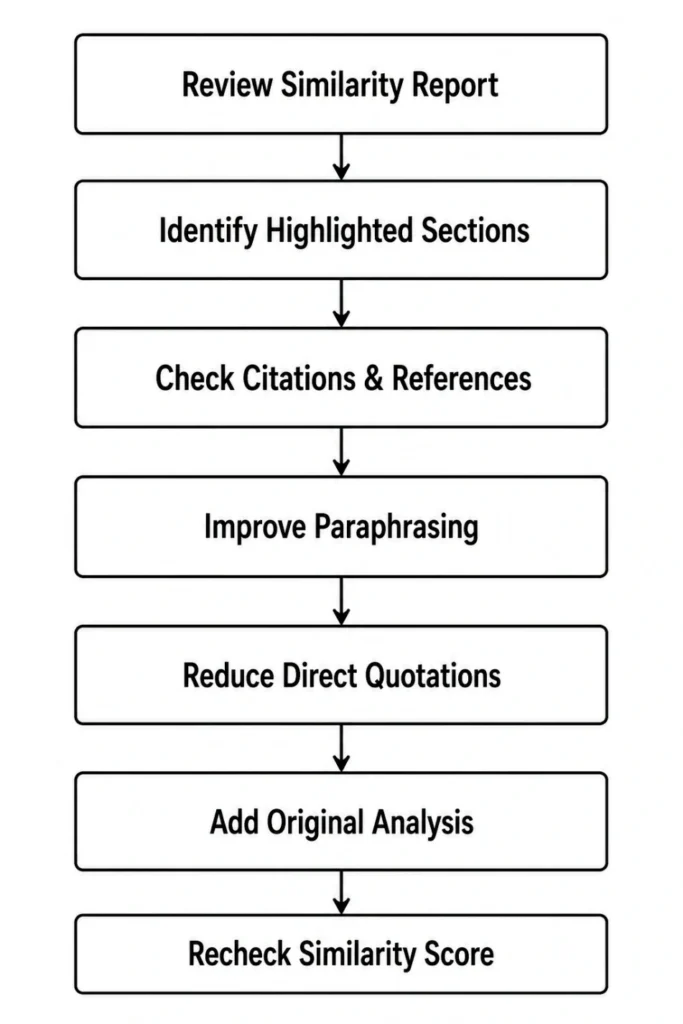
If your report looks concerning, focus on improving quality rather than chasing arbitrary numbers. Students searching for how to lower Turnitin score percentages should focus on improving paraphrasing quality and citation accuracy instead of making superficial edits.
Some effective ways to reduce similarity scores while maintaining academic integrity include:
- Strengthen Paraphrasing: Rewrite ideas completely instead of replacing individual words.
- Fix Citation Formatting: Correct missing or incomplete references.
- Reduce Direct Quotations: Use source ideas in your own academic voice.
- Add More Analysis: Original interpretation improves authenticity.
By applying these practices, students can improve writing quality and reduce similarity scores naturally.
Why Students Often Misread Similarity Reports
Many panic because highlighted text looks severe. This usually happens because students misunderstand what the similarity score means on Turnitin and assume every highlighted section indicates plagiarism.
However, similarity reports often flag:
- Bibliographies
- Common phrases
- Correctly quoted text
- Institutional templates
Without proper review, students may waste time rewriting sections unnecessarily. Therefore, learning to read reports correctly is essential for interpreting a safe Turnitin score.
When Professional Review Helps
For dissertations, journal submissions, and final projects, expert review can provide clarity. Professionals can identify risky overlap, improve paraphrasing quality, preserve academic meaning, and ensure stronger originality while maintaining academic integrity standards, often leading to safer and more credible submissions.
Ultimately, understanding similarity reports correctly is more important than obsessing over a single percentage score.
Final Thoughts
There is no single universal safe Turnitin score. The idea of an acceptable Turnitin score depends largely on citation quality, assignment type, and institutional guidelines. What matters is how your similarity percentage is created and whether your writing demonstrates originality, correct citation, and genuine understanding.
Instead of aiming for the lowest possible percentage, focus on producing thoughtful, ethical, and original academic writing, as that is what truly defines academic quality.
Need help improving your Turnitin similarity score?
Book a free consultation with our academic experts for guidance on plagiarism reduction, paraphrasing, citation improvement, and originality enhancement.
Book a free consultation for appointment
Email us at : grow@simbi.in