
How to Remove AI Detection from Content Without Losing Meaning: A Complete Guide for India
Introduction
With the rise of AI tools and the increasing trend of their use in content creation, authenticity and quality similar to that of a human are essential to ensure. How to remove AI detection from content (without losing meaning) is now a critical concern for businesses, researchers, and students in India.
While AI-generated content can be time and resource-efficient, it may lack authenticity in terms of tone or style that resonates with academic standards or platforms, search engines, or professional writing. It outlines the process and guidelines for editing AI-generated content to enhance its quality and clarity, ensuring it remains relevant and accurate.

With the evolution of these AI detector tools, content creators, students, researchers, and businesses are more mindful of the detection of AI content. By understanding the criteria that an AI text detector uses to assess text, you can make it easier for readers to understand your writing, more original, and better overall.
What is AI Content Detection?
AI Content Detection: It involves determining whether a text was primarily generated by artificial intelligence or by a human being. Today’s AI detectors examine the style of writing and not copied text. They look at things like sentence structure, word predictability, vocabulary diversity, repetition, and contextual flow to determine if the content is machine-generated.
AI content detection is different from plagiarism detection, because it does not detect content duplication, but rather writing behavior. A high AI score is not only given when the document is plagiarized, but it can also be awarded for a document that is entirely original but uses repetitive or overly predictable language patterns.
The rise in AI writing assistants has led to more and more businesses, universities, publishers, and search engines integrating AI detector software into their content review processes.
READ THIS : How Turnitin Detects AI Content
Understanding AI Detector Technology Concept Overview
AI detection removal involves rewriting content that has been created by AI to match the content that a human would write, and to avoid being flagged for plagiarism by AI plagiarism software. This indicates that the language must be restructured, contextualised and expertly validated.
Core Objective
It’s not just about lowering the AI detection score, it’s about enhancing content quality. Whether it’s an AI detector or a human editor that’s reviewing, a well-edited article is easier to read and will show more originality.
Importance of AI Detection Removal in India
AI detector tools are becoming more popular among universities, publishers, businesses, and digital marketing agencies for content analysis. With the rise of AI content detection, writers are now emphasizing on creating informative, original, and engaging content for readers.
Key Demand Drivers
- Increased research and thesis writing activities;
- The growing importance of SEO-based digital marketing,the rising influence of SEO in digital marketing.
- Integrating AI into writing.
- Plagiarism and AI detection is strictly enforced.
How the AI Detection Removal Process Works
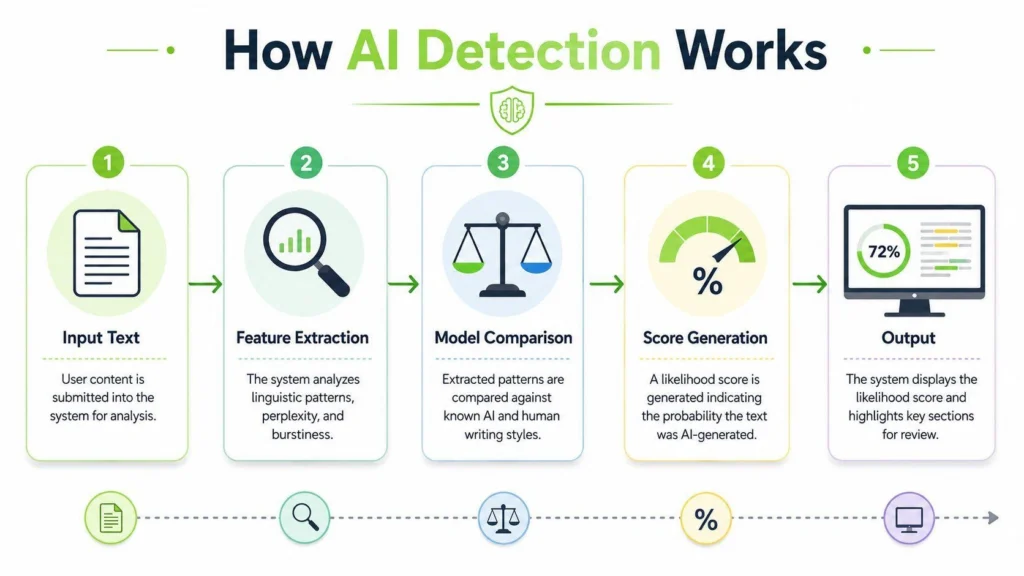
The process involves a structured combination of AI tools and human expertise to ensure high-quality output.
Content Processing Workflow
| Step | Process | Outcome |
| Initial Analysis | AI scans content for patterns and detectability | Identifies AI-generated markers |
| Content Restructuring | Sentence and paragraph rewriting | Improves natural flow |
| Semantic Refinement | Adjusts tone and context | Maintains original meaning |
| Human Editing | Expert review and polishing | Enhances clarity and quality |
| Final Validation | Re-check with detection tools | Ensures human-like output |
Key Features of AI Detection Removal Services
- Contextual understanding of rewriting with AI.
- Tone and natural variation of sentence structure.
- Preservation of meaning and intent in the original text.
- SEO-friendly content structuring Have confidential and secure processing
READ THIS : Best AI Detection Tools 2026
Benefits of Removing AI Detection from Content
Organizations should not only aim to pass an AI detector, but also produce valuable, informative, and accurate content that will benefit readers.
1.Content Quality Enhancement
Optimized content for increased engagement and trust. Refined content is more readable, interesting, and meets audience expectations. It is particularly important for businesses and researchers who want to be taken seriously.
2. Improved Acceptance Rates
Academic institutions and publishers are more likely to accept content that appears human-written and original.
3. Better SEO Performance
High-quality, natural content ranks higher in search engines, enhancing the visibility and ranking.
4. Time and Efficiency Gains
Professional AI content refinement services automate the editing process and identify any repetitive elements, enhance sentence structure, and ensure that the text retains its original meaning. This can save writers, researchers, and companies significant time and help them create clear, engaging and publishable content.
Industry Use Cases in India
The use of AI detection removal services has become increasingly prevalent in various industries, highlighting their relevance.
- Academic Sector: These services are used by students and researchers to improve their theses, dissertations, and research papers for originality and adherence.
- AI Blog Content: Agencies learn how to use AI to create compelling blog posts, web content, and SEO content that ranks higher and attracts more traffic.
- Corporate Sector: Enhance reports, presentation, documentation for professional communication in the corporate sector. d.Market Research and Consulting: Organizations apply analysis and take the time to make it clear and credible.
Tools and Technologies Used
Today’s services depend on the use of the latest and best technology to ensure accuracy.
Technology Stack
- Natural Language Processing (NLP)
- Machine Learning algorithms
- AI rewriting tools
- Plagiarism and AI detection software
- Data analytics platforms
Common Mistakes to Avoid
Most users will attempt to hide AI detection from their content, but won’t have the best result if they aren’t technically well-versed. Users sometimes encounter unnatural and out-of-context phrases and sentences when using automated writing. If you don’t optimise your content for SEO, it also may not be as effective.
Before vs After: Effective Similarity Reduction Strategy
| Poor Approach (High Risk) | Smart Approach (Effective) |
| Rewriting every sentence blindly | Rewriting only high-match sections |
| Using paraphrasing tools | Manual conceptual rewriting |
| Removing technical definitions | Keeping + properly citing theory |
| No examples added | Adding real company or case examples |
| Ignoring report details | Analyzing highlighted sections first |
| Focus only on percentage | Focus on content quality + structure |
Choosing the Right Service Provider in India
It’s important to select a professional service provider to ensure high-quality results. The value in integrated solutions that include data collection, data analysis, AI services and market esearch.
Selection Criteria
- Proven experience in AI and content services
- Use of advanced tools and technologies
- Strong portfolio and client feedback
- Commitment to data confidentiality
- End-to-end service capabilities
Expert Tip:
AI can be a great resource for creating initial drafts, outlining, and brainstorming. But, the most successful content is nearly always created through careful human edits, original ideas and knowing the audience. This is a case study on enhancing AI-powered research writing.
Case Study: Improving AI-Assisted Research Writing
A master’s student used an AI writing tool to draft the introduction and literature review for a research paper. While the draft provided a good starting point, an AI content detection tool highlighted portions of the text due to repetitive wording and a lack of critical analysis.
The student improved the document by:
- adding original interpretations of previous studies,
- including recent research findings,
- restructuring repetitive paragraphs,
- incorporating discipline-specific examples, and
- reviewing the content for clarity and consistency.
The final paper was better written academically, argued and read. Instead of trying to obtain a lower detection score, the student worked on being original, creative, and accurate in referencing, which led to a better submission.
Key Takeaway: AI can accelerate the drafting process, but meaningful human editing is essential for producing credible academic content that demonstrates genuine understanding.
Future of AI Content Detection
The future of AI content detection. Future AI detector technologies are supposed to be more sophisticated when it comes to considering context, reasoning, factual accuracy, and consistency of writing. The evolving nature of AI content detection will make it more common for organizations to use AI to analyze content before having humans do it. Meanwhile, AI writing tools are advancing at a rapid pace, and the role of human editing is becoming even more critical. Instead of trying to trick AI detection, content creators should prioritize generating quality, informative, and audience-centric content that showcases their knowledge and expertise.
Call to Action:
Need professional advice to enhance AI writing? Collaborate with a professional AI services, plagiarism detection, data analysis and market research company in India. Convert your content into high-quality, human-like copy that really works—reach out to us today to get started.
Book a free consultation for appointment
Email us at : grow@simbi.in