
AI Content vs Human Content in 2026: What Google and Universities Prefer

Introduction
In today’s digital era, AI has revolutionized content generation. Every day, millions of people are benefiting from AI tools such as ChatGPT, Gemini, Claude, and Copilot for their writing, whether it’s composing blog posts, emails, research papers, or business reports.
One question that is gaining momentum is:
Which type of content does Google favor: Artificial Intelligence or human writing?
Likewise, pupils and scholars frequently ask:
Are assignments and research papers from Artificial Intelligence accepted by universities?
It is not as black and white as picking one option over another. Google and universities put much more emphasis on quality, originality, accuracy, and transparency in 2026 than on whether it was AI or human who wrote the initial draft.
In this guide, we’ll explore AI content vs human content, and clarify what Google and universities actually prefer, while also providing some tips for using AI responsibly.
What is AI-Generated Content?
AI generates text by predicting the next word from a vast set of data. While AI may be very fast, it is not truly human to understand emotions or personal experiences as human beings do. AI-generated content: Text, images, or other content generated by AI tools.
Common examples include:
- Blog articles
- Product descriptions
- Marketing emails
- Social media captions
- Research summaries
- Coding assistance
- Business reports
What does Human-Written Content Mean?
Humans have the ability to provide explanations for complex situations, stories, and real-life examples, and to engage with readers on an emotional level.
This creates a more real and interesting human content.
Human written content is developed with a person’s:
- Knowledge
- Experience
- Critical thinking
- Creativity
- Emotions
- Personal opinions
AI Content vs Human Content: Key Differences
| Feature | AI Content | Human Content |
| Speed | Very fast | Slower |
| Creativity | Limited | High |
| Emotional Connection | Low | Strong |
| Personal Experience | No | Yes |
| Research Accuracy | Needs verification | Depends on writer |
| SEO Optimization | Easy with prompts | Requires expertise |
| Original Thinking | Limited | Excellent |
| Editing Required | Yes | Usually less |
What Does Google Want in 2026?
There is a widespread misunderstanding that Google penalizes AI-generated content automatically. A lot of people think that Google automatically penalizes AI-written content.
That is not true.
Whether or not it was created by AI, Google prioritizes helpful, original, trustworthy and people-first content.
Google values content that:
- Solves users’ problems
- Provides accurate information
- Contains original insights
- Demonstrates expertise
- Is easy to read
- Offers real value
In this day and age, Does Google Detect AI Content?
The quality of AI-generated content is determined by its value, originality, and relevance to the platform’s context, so copying it for ranking purposes is unlikely to yield positive results. Google does have advanced algorithms to measure page quality, but there isn’t any open evidence that it is ranking or penalizing pages due to being authored by AI.
Instead, Google evaluates: Helpfulness, Originality, Expertise, Accuracy, User satisfaction
What university considers preferable?
AI usage is more strictly monitored at universities in assignments and research. Most institutions welcome AI as an aid to learning, rather than a substitute for actual student work. Universities will normally require students to:
- Write in their own words
- Cite sources correctly
- Demonstrate independent thinking
- Adhere to institutional AI policies
- Be honest about it when necessary
Benefits of AI Content Generation
AI will have numerous advantages:
1. Saves Time: AI can generate drafts in just a matter of minutes.
2. Enhances Productivity: Writers can edit rather than make new writing.
3. Supports SEO: AI can assist with creating keyword concepts, headings, and meta descriptions.
4. Generates Content Ideas: AI can help with writer’s block by providing content outlines and ideas.
5. 24/7 brainstormer and draft writer: AI tools are always available for brainstorming and drafting.
Limitations of AI Content
Even though AI has advantages, it also has its drawbacks.
It may:
- Generate inaccurate information
- Miss emotional depth
- Repeat common ideas
- Produce generic writing
- Include outdated facts
- Lack real-world experience
There are benefits to human content
Human content comes with its pros. AI can’t quite capture the elements that human writers can.
Human content offers:
- Personal experiences
- Original opinions
- Emotional storytelling
- Better judgment
- Creative thinking
- Stronger audience connection
When to Use AI?
AI is ideal for:
- First Drafts – Quickly creates an initial version of your content, saving time and effort.
- Blog Outlines – Organizes ideas into a clear structure before you start writing.
- Brainstorming – Generates fresh ideas and topic suggestions when you’re out of inspiration.
- Grammar Checks – Identifies spelling, grammar, and punctuation errors to improve writing quality.
- Keyword Research – Suggests relevant keywords to help optimize content for search engines.
- Summarizing Information – Condenses lengthy articles or documents into easy-to-read summaries.
- Email Writing – Drafts professional, clear, and personalized emails in just a few seconds.
Where do humans fit in:
Human writers are needed to:
- Research Papers- These are papers that require human input for original research, analysis of results and appropriate conclusions.
- Academic Assignments – Students should use their own knowledge and critical thinking to produce authentic academic work.
- Legal Documents – Legal writing involves being precise and judging professionally and following the laws and regulations.
- Medical Writing – Human experts verify medical content, ensuring that it is both accurate and evidence-based, and safe for consumers.
- Personal Stories – Personal stories are real-life experiences and feelings that make them genuine, relatable and engaging.
- Thought Leadership – Industry experts provide unique insights, opinions, and experiences that AI can’t provide.
- Investigative Journalism – Journalists use research, interviews and fact checking to find and report the truth.
Common Myths About AI Content
Myth 1: Google prohibits all AI content.
Reality: Google rates quality and not just whether AI was applied.
Myth 2: Plagiarized content is always AI-generated.
Reality: AI-generated text is not plagiarism by itself but requires users to go out of their way to copy and check for plagiarism.
Myth 3: AI can write all the time.
Reality: AI is a powerful tool, human creativity, judgment, and experience are just as important.
Final Thoughts
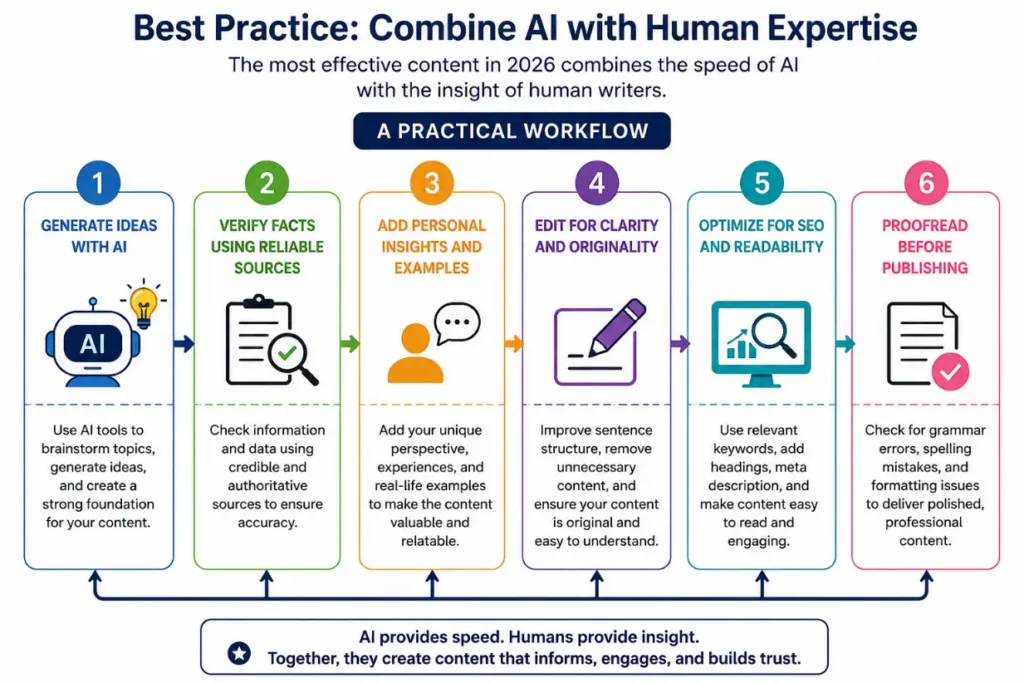
You don’t have to choose between AI and Human Content, it’s about both. By 2026, the most successful content creators will leverage AI to boost efficiency and ensure accuracy, originality, and authenticity, while maintaining a grasp of human knowledge. Remember this simple rule when writing for Google, a University or your audience:
While AI can write quickly, humans can build trust.
The future is content that takes advantage of the best of both worlds.
Book a free consultation for appointment
Email us at : grow@simbi.in
Contact Simbi Labs today to discover how AI content analysis and human content evaluation solutions can help businesses, educators, and institutions improve content authenticity, maintain academic integrity, reduce plagiarism risks, and create high-quality, trustworthy digital content in 2026.