
How Turnitin Detects AI Content in 2026

AI Writing Is Everywhere—But Can Turnitin Detect It?
The way students and professionals create content has been completely transformed by Artificial Intelligence. The problem is now that tools such as ChatGPT, Gemini, Claude and Microsoft Copilot can produce essays, reports and assignments in seconds, it’s becoming increasingly difficult for educational institutions to tell whether the work has been written by a person.
That’s where Turnitin AI Detection shines in.
This extensive guide will assist you in learning how Turnitin detects AI content in 2026, the factors that impact Turnitin’s AI detection, its weaknesses, and how to submit original academic work without getting caught for plagiarism.
Many, however, ask the question:
1. How Turnitin detects AI content?
2. Is paraphrased AI text detectable by Turnitin?
3. Does Turnitin get it right?
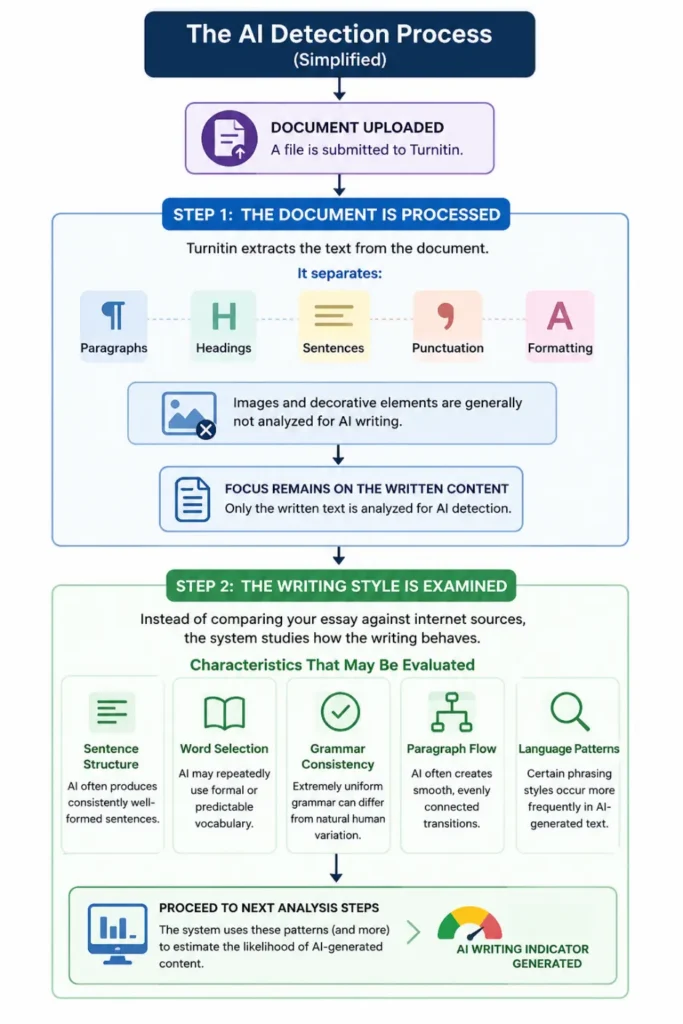
4. How does the document “behave” after it’s uploaded?
Understanding Turnitin’s Approach to AI Detection
Before understanding how Turnitin detects AI content, it’s important to know what AI detection actually means.
AI detection provides a unique method of detecting plagiarism, as it performs a different process than plagiarism detection, which looks for plagiarism in billions of web pages, journals, books, and student papers.
Turnitin does not look for copied text, but rather uses its algorithms to determine if the writing has common characteristics of AI-generated writing.
Think of it this way:
| Plagiarism Detection | AI Detection |
| Seeks out duplicate content | Looks for AI patterns |
| Compares against databases | Analyzes writing characteristics |
| Identify similar sources | Predicts probability of AI generated writing |
| Generates similarity percentage | Generates an AI writing indicator |
The Rising Need for AI Detection
AI writing tools are now more sophisticated than ever.
Students are now able to create:
- Essays
- Research summaries
- Literature reviews
- Programming explanations
- Reports
- Lab documentation
within seconds.
Beyond Similarity: How Turnitin Evaluates AI Writing
This is the question most students ask.
The Short Answer
Turnitin cannot identify a work as plagiarized if it contains only sentences that are copied from ChatGPT.
Instead, Turnitin detects AI content by identifying patterns in language that are commonly found in AI-generated text. does not consider the source of the text, just its style.
Human vs AI Writing Example
| Human Writing | AI Writing |
| Uses personal experiences | Rarely includes genuine experiences unless prompted |
| Sentence lengths vary naturally | Sentence lengths are often more uniform |
| May include informal wording | Usually maintains a consistent formal tone |
| Writing style changes slightly | Style remains highly consistent |
| Small imperfections are common | Grammar is usually polished throughout |
Does Turnitin Compare Your Work With ChatGPT?
Assuming that Turnitin has access to the ChatGPT conversations is a widely held belief.
That’s not the way detection should work.
Instead, Turnitin looks at the writing itself to detect patterns that point to a text using AI writing. It doesn’t require you to send a copy of your ChatGPT conversation to make an estimate.
Can Turnitin Detect Rewritten AI Content?
Many students use:
- paraphrasing tools
- humanizers
- AI rewriters
Hopefully, not to be detected as AI content. Whether rewritten text is flagged or not depends on how different in style and substance the final writing is from the original writing. The change of words for synonyms may not affect many of the patterns, but if there is extensive rewriting and analysis of the text with examples, patterns may be altered, and the writing may be more similar to the author’s own style. The aim should be to make genuine detecting work and not to “beat” the detector.
Content Features That May Resemble AI Writing
When the content is very generic or formulaic, it can exhibit some of the following characteristics common to AI-generated content:
- repetitive sentence structures
- generic explanations
- predictable transitions
- lack of original examples
- little personal analysis
- repetitive wording
he following factors may affect the accuracy of AI detection:
| Factor | Possible Influence |
| Highly repetitive writing | May resemble AI patterns |
| Generic explanations | May increase resemblance to AI-generated text |
| Personal examples | Can make writing more individual |
| Critical analysis | Reflects original thinking |
| Varied sentence structures | Adds natural writing variation |
| Original insights | Strengthens authenticity |
Understanding AI Detection Indicators
The first key piece of information to grasp is that: Use of an AI indicator does not mean someone used AI. It is a prediction that is based on the features of writing. For this reason, it is advisable for teachers to use the AI indicator in conjunction with other documentation, such as student writing history, assignment context and classroom performance.
Common Myths About Turnitin AI Detection
| Myth | Reality |
| Turnitin detects all AI-generated sentences. | No detection system is perfect. |
| Every AI score means cheating. | An AI indicator alone does not prove misconduct. |
| Human writing is never flagged. | Some human writing may share patterns with AI writing. |
| Replacing a few words always avoids detection. | Superficial changes may not significantly alter writing patterns. |
| AI detection and plagiarism are the same. | They are separate analyses. |
Best Practices for Students
When you use AI as a learning assistant, try to produce pieces that express your own comprehension.
Good practices include:
- If possible, write the initial draft yourself.
- Rewrite the following sentences using AI, but do not use AI to write the final product.
- Add your own explanations.
- Include real examples.
- Describe in your own words.
- Designate a place for supplies to be dropped off.
- Use external sources properly.
- Read aloud the assignment to make sure that it sounds like your own voice.
Final Thoughts
While artificial intelligence is revolutionizing education, its impact also extends to the assessment of academic work.AI is reshaping education, and it’s also redefining the landscape of academic assessment. Students’ awareness of Turnitin’s ability to identify AI-generated content will be valuable, as it will help them recognize that the tool is designed to detect patterns of writing and content, not copied text. The best approach is never to seek out methods to evade AI detection. Rather, leverage AI as a tool to brainstorm, learn, and refine concepts and ideas, and ensure that the final product is your own knowledge, reasoning, and writing. Authentic work is not only consistent with academic integrity, but builds the skills upon which education is based.
Book a free consultation for appointment
Email us at : grow@simbi.in
Frequently Asked Questions
Is ChatGPT possible to be caught by Turnitin?
The conversations from ChatGPT are not identifiable in Turnitin. Rather, it assesses the characteristics of submitted writing that are typical of AI-generated writing.
Is Turnitin AI detection 100% accurate?
No, because like any AI detection system, it can yield false alarms or fail to detect something. When using AI indicators, it is important to consider them in conjunction with other data.
Can AI Text be rewritten to ensure that it won’t get flagged?
No. It’s not just about the words being different that makes for a different assessment. It is important that the quality, originality and the overall writing style are considered more important than superficial editing.
Does Turnitin look for spelling errors?
Grammar is only one aspect of writing. AI detection not only looks at grammar but also at the overall flow of the text.
Why AI Detection Is Different from Plagiarism Detection
While plagiarism detection checks for plagiarism against existing works, AI detection will determine if the writing is similar to AI generated writing..