
Turnitin False Positives: Causes, Examples & Solutions

When Original Work Gets Flagged
When you hand in your assignment, thesis or research paper, you should feel good having researched and written so many hours. That’s why many students are frustrated when they see that their completely original assignment is detected by Turnitin, even when they’re certain that it’s their work. Many students are unaware of this situation. A high similarity or flag for AI plagiarism does not necessarily indicate plagiarism or academic dishonesty.
Turnitin false positives are often caused by similarities in statistics, citations, or writing styles when compared to previously indexed content. There has been discussion among many students about the overall rate of errors on the turnit system even though the content is properly cited or even written by a human, since sometimes it will still alert the user.

The knowledge of why this occurs will help students in the interpretation of reports without causing unnecessary panic, improving legitimate problem areas, etc.
What Are Turnitin False Positives?
A false positive is defined as when Turnitin identifies something that is original, properly cited or academically acceptable but is marked as plagiarized. This can occur in both similarity reports and AI detection assessments, as Turnitin is looking at probability of overlap and patterns and not the intent of the work.
This is of vital significance. Detection systems can be used to look for a text or structural similarity but they are not always able to distinguish between a real misconduct or plagiarism.
That’s why ‘does turnitin have false positives’ is a frequent inquiry students and researchers have about turnitin. Many teachers also recognise that there is some degree of false positive that can occur in turnitin reports, particularly in technical/ research oriented, or very formal writing.
Read More : Turnitin Report Analysis Guide: How to Read and Fix Every Section
Myths vs Facts About Turnitin False Positives
| Myth | Fact |
| Every match means plagiarism. | Similarity only indicates text overlap. |
| AI detection is always accurate. | AI detection estimates probability, not certainty. |
| Proper citations never appear. | Properly cited text can still be matched. |
| High similarity automatically means failure. | Instructors evaluate reports within academic context. |
| Turnitin decides misconduct. | Human reviewers make the final decision. |
Why Original Content Gets Flagged
Many students think that if the flagged content is flagged, it must be copied content. But this is not always the case: There are a few valid academic scenarios that can raise similarity scores – or concern about AI.
Academic writing frequently uses standard expressions for research, methodology description, etc., and common terms or expressions that are often used for analysis. Turnitin can identify overlap even if the writing is original, due to the fact that thousands of papers are written in a similar way.
Similarity percentages can be raised using proper citations. In a report, direct quotations, entries in the bibliography, summary of literature, and properly cited content often come up in reports because the system is still able to identify context matches without any attribution.
This is one of the most frequent causes of academic worry of turnitin false positive ai detection. A turnitin ai false positive can happen in certain cases where the plagiarized section of the content is well written and looks like a machine-written one statistically. Sometimes the ability to detect AI-generated writing is triggered solely by the writing’s structure, predictability, or formality.
Read Also : Turnitin vs Manual Editing: Which Is Better for Plagiarism Removal?
Table: Common Causes of Turnitin False Positives
The following table highlights some of the most common reasons why original work may still appear in similarity or AI detection reports.
| Situation | Why It Gets Flagged |
| Properly cited quotations | Text still matches indexed academic sources |
| Literature reviews | Similar research phrasing appears repeatedly |
| Technical writing | Standard terminology and methodology overlap |
| Previously submitted drafts | Institutional repositories store earlier versions |
| Highly polished academic writing | May resemble AI-generated consistency patterns |
Similarity Reports Do Not Always Indicate Misconduct
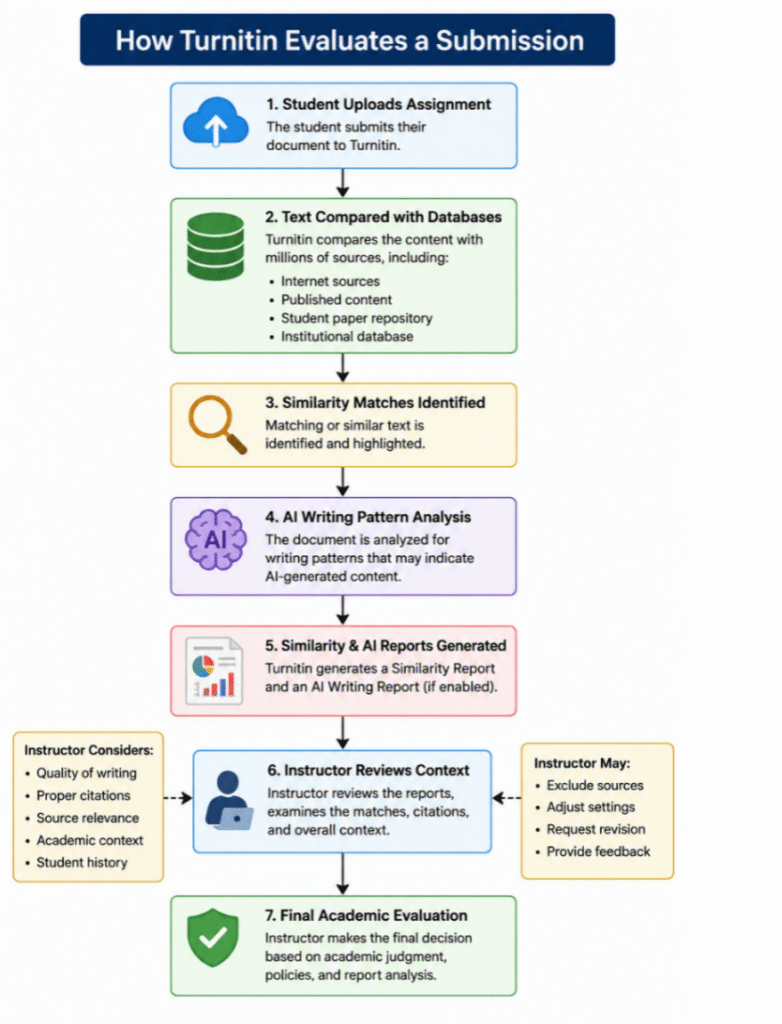
A common error in using Turnitin is thinking that anything that is flagged is plagiarized. In fact, similarity reports are merely detections of patterns of overlap that must then be interpreted by people.
This is why many students wonder if turnitin can give false positives or if turnitin gives false positives after seeing unexpected results on original assignments. Detection systems search for writing against databases and statistical models; they are not able to fully comprehend the academic context, quality of citations, or author’s intent.
Human review is thus still necessary. When teachers or academic readers make a judgment on matched content, they typically look at purpose, paraphrasing, source attribution, and overlap—whether or not there is academic justification.
Read Also : Turnitin AI Detection vs Human Writing: What Gets Flagged?
AI Detection Can Misclassify Human Writing
AI detection is now included in modern Turnitin systems to determine if writing seems AI-made. But AI detection models are based on probability, not on verified evidence. This can lead to AI-proofing sometimes if it’s content written by a real person.
Human writing might seem suspicious when it is:
- Extremely polished
- Highly structured
- Predictable in sentence rhythm
- Over-edited for perfection
- Written using repetitive formal patterns
These scenarios are frequently linked to the concept of “turnitin ai detector false positives” and the larger debate on “turnitin ai detection false positives.
These scenarios are often tied to the topic of “turnitin ai detector false positives” and the general discussion of “turnitin ai detection false positives” in academic circles.
No detection tools are definitive of misconduct. Rather, they make a statistical guess on whether the text is statistically similar to machine generated writing. Hence, turnitin ai checker false positive discussions are proliferating among learners and teachers.
Read Also : Turnitin AI Detection vs DrillBit AI Writing Detector: Which AI Detection Tool Is More Accurate in 2026?
Weak Paraphrasing Can Increase Similarity
Students sometimes blindly follow the original structure of a source when paraphrasing. Even if plagiarism is not intended, making a few changes in wording within a sentence can make it easy to tell that two or more sentences are similar.
Increasing the quality of paraphrasing is then one of the best ways to minimize false positive turnitin concerns due to structural overlap. Effective paraphrasing emphasizes reconstruction of ideas in natural style, enhancement of interpretation, and expression of the content in a way that is based on logical thinking instead of source language.
Students should also not heavily edit content for ‘detection systems’ as too many modifications to the text can make it unreadable and less academically sound.
How to Respond to a False Positive
When you get unexpected similarity or AI-related flags on your assignment, it’s best to review it carefully, not panic. Having a false positive turnitin ai result doesn’t mean that the content is plagiarized, particularly if it’s original.
Students need to carefully scan their matched sources for correct citations, references, or quotations first. Weakly paraphrased parts can then be further revised naturally without altering the meaning.
When selecting a paper for translation, it is also important to refer to institutional guidelines as many universities allow some degree of overlap – particularly in research papers, technical writing, or literature reviews. Most cases of turnitin ai false positives can be resolved with a calm evaluation without any major implications for academics.
Why Human Review Still Matters
.Turnitin is not a final grade-grader. While detection systems can offer you a probability-based analysis, academic judgment involves being able to interpret and understand the context.
Instructors usually evaluate:
- Citation intent
- Quality of analysis
- Source integration
- Writing originality
- Academic necessity of overlap
That is why it is uncommon for experienced teachers to assess originality or academic honesty completely based on automated reports. There is no substitute for human assessment when it comes to knowing the difference between wrongdoing and benign likeness.
Case Study: A Turnitin False Positive
A postgraduate student submitted an original research paper with proper citations, but Turnitin reported a 30% similarity score.
After reviewing the report, the instructor found that most matches came from correctly cited quotations, the reference list, and common academic phrases. Since there was no evidence of plagiarism, the report was considered a false positive in Turnitin rather than academic misconduct.
Key Takeaway: A high similarity score does not always indicate plagiarism. Human review is essential to interpret reports accurately and identify Turnitin false positives.
How to Reduce Future False Flags
The most effective approach to minimising future ‘concerns of detection’ is to write Australian academic texts that demonstrate deep understanding and independent analysis.
Students can lower the risk of future Turnitin false positives by developing good paraphrasing practices, applying original interpretation, maintaining proper citation format, and minimizing their reliance on overuse of academic verbal repetition.
Writing is also made more natural and less statistically predictable with careful analysis and natural sentence variation. It helps boost the quality of academic work and confidence when completing assignments using methods that involve plagiarism or AI detection tools.
READ THIS ALSO : Safe Turnitin Score
Final Thoughts
Students are often concerned about unnecessary similarity or AI-related flags on their own work in turnitin. It is key to note, however, that Turnitin is not looking at the intent behind the writing but instead it is looking at patterns.
Although theAI system can detect and flag plagiarized content or potential AI-generated text in strong human-written content, it is possible for high-quality human content to also generate these alerts or raise concerns due to the nature of the detection system, which works based on probability models and database comparison. This is the reason that the discussion of turnitin false positive ai is getting more and more popular among academic circles.
The most appropriate response is not to panic, but to review the material carefully, paraphrase more accurately, cite properly and have confidence in the own research process. Where a student’s writing reflects a real understanding, originality and academic contribution, an automatic report cannot completely capture the value of their writing.
Book a free consultation for appointment
Email us at : grow@simbi.in