Turnitin AI Detection vs DrillBit AI Writing Detector: Which AI Detection Tool Is More Accurate in 2026?
The impact of AI on academic writing is undeniable. AI-powered tools are now being used by students to brainstorm concepts, polish grammar, gather information and write assignments. With the increase in AI usage, universities have begun to use AI writing detector tools to keep academic integrity.
Turnitin AI Detection and DrillBit AI Detection are two of the most popular platforms. Both tools can detect AI-generated content, but the same document could get very different AI detection scores.
This frequently leaves students puzzled as to which site was more stringent and why the results are different.
This guide will help you understand how AI Detection and DrillBit operate, the variations in AI detection percentages, and what to do with reports to interpret correctly.
Read Also: AI Content Humanization for Turnitin Approval: Complete Guide
How AI Detection Works in Modern AI Writing Detector Tools
The functioning of AI detection in contemporary AI writing detection tools.The way AI detection operates in modern tools for AI writing detection. AI content detection technology can analyze your content and reveal whether it is machine-generated or not, e.g. ChatGPT, Gemini or Claude.
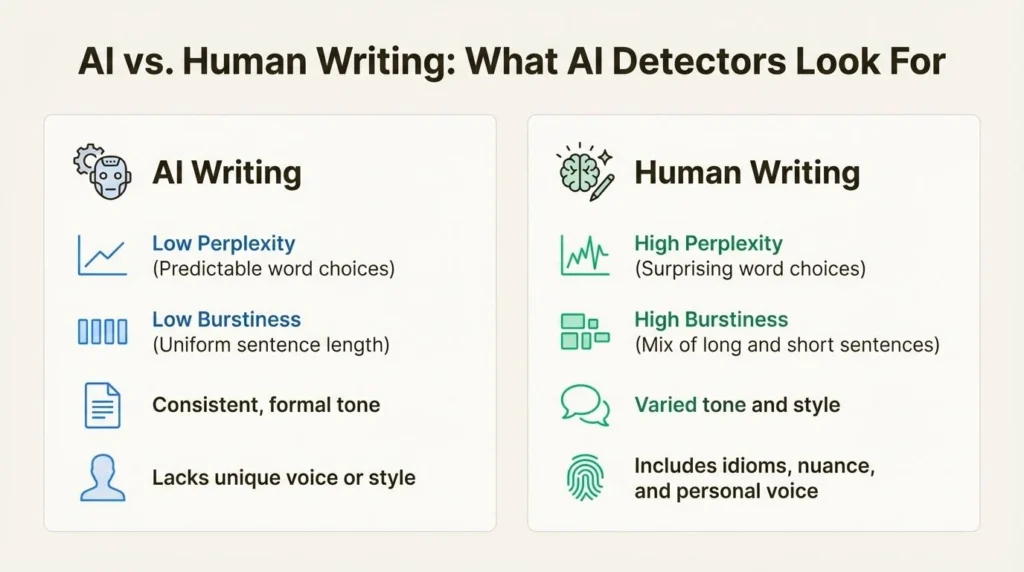
AI detectors are not only focused on plagiarized content, they are also based on writing patterns. They look at and analyze sentence structure, words used, writing style and consistency to decide whether they believe that AI was used or not.
Please note that the AI detection score does not necessarily indicate the use of AI. It only indicates the probability as per the analysis performed by the tool.
Understanding Turnitin AI Detection
Turnitin is one of the top global academic honesty software. It is extremely popular for plagiarism detection, and it has an AI writing detection tool in addition. When a document is uploaded to Turnitin there are two things checked:
- If any content matches existing sources (similarity score)
- If parts of the writing seem to be generated by AI (AI writing score) .
How DrillBit AI Detection Works
DrillBit is a combination of plagiarism analysis and AI writing detection. It examines the characteristics of writing, document consistency, vocabulary distribution, and document structure. One of the reasons the percentage of writing as AI in an institution may vary from other institutions is because they can alter the sensitivity of DrillBit.
Turnitin vs DrillBit: Quick Comparison
Read Also : DrillBit vs Turnitin: Which Plagiarism Checker Performs Better in 2026?
| Feature | Turnitin | DrillBit |
| AI Detection | Yes | Yes |
| Plagiarism Check | Yes | Yes |
| Similarity Score | 93% | 99% |
| AI Writing Report | Yes | Yes |
| Used by Universities | Very Common | Growing Popularity |
| Best For | Large universities | Colleges and institutions |
AI Detection Algorithms Explained:
Most people think AI detectors are comparing your work with ChatGPT’s database.Most people are thinking of comparing your work with the ChatGPT database. This is no way to do it. Rather, both Turnitin and DrillBit analyze characteristics like:
- Sentence patterns
- Word choices
- Grammar consistency
- Repetition
- Writing flow
- Predictability of language
What Does Turnitin AI Detection Actually Analyse?
There is a misconception that many students have about how Turnitin AI detection works that it simply checks your assignment at the same time using a tool, such as ChatGPT, to generate content.
Rather it uses its AI writing detector to analyze writing patterns that are typically linked to AI content. It uses aspects like sentence construction, word choice, consistency of writing and grammar, and the logical sequence of ideas to spot signs of AI detection. It also seeks natural variation in writing and original thinking rather than a uniformity of language.
The report is not a definitive statement as it is based on probability and not proof, so a higher AI detection score does not necessarily indicate that AI was used. This is because teachers are urged to view the report in conjunction with the quality, context and originality of the student’s work before making the decision.
READ ALSO : How to Reduce Turnitin And DrillBit Similarity Score in India
How Can the Same Assignment earn different scores from AI?
This is why students become confused one of the biggest reasons.
Suppose both tools are used to upload the same assignment.
- Turnitin shows 12% AI
- DrillBit shows 28% AI
Does this make one of them incorrect?
Not necessarily,All platforms have their own detection algorithm and scoring function. They don’t examine writing in the same manner, so various AI percentages are entirely feasible.
Which Tool Is More Strict?
There’s no easy solution. Rather, Turnitin is seen as being more conservative, as it generally has reason to be more picky about giving high AI marks. For some instances generated by DrillBit, an AI score may be higher or lower, depending on the institution’s software configuration and evaluation of the writing based on their detection model.
In other words, both of these aren’t always law abiding. The outcome will vary based upon the document and detection system.
READ ALSO : Common Reasons for High DrillBit Similarity Score (And Fixes)
2026 Update: Strictness is Not the Key Metric
By 2026, the question shouldn’t simply be “which is stricter?” when evaluating AI detection tools. The more stringent the tool, the less accurate it will be. Turnitin and DrillBit have different detection models, so there is always some variation in the results depending on writing style, structure, and institutional settings.
It is important to also note that lower AI scores (0-19%) can be false positives and therefore may be flagged with caution by Turnitin. AI Writing Report (Turnitin) DrillBit has found its way into various academic institutions in India and is included in the national-level plagiarism detection programs such as ShodhShuddhi. (INFLIBNET ShodhShuddhi)
Is there a way to tell that human written content is AI-generated?
Yes. For many students, this is a shock but even an original piece of human writing can have an AI score.
Here are some typical causes:
- Very repetitive sentence structure
- Overly formal language
- Lack of personal examples
- Heavy grammar correction
- Predictable writing style
Turnitin vs DrillBit: Pros and Cons
| Turnitin | DrillBit |
| Trusted by universities worldwide | Easy for institutions to manage |
| Strong plagiarism database | Includes AI and plagiarism detection |
| Separate AI and similarity reports | User-friendly reporting |
| Reliable academic reputation | Suitable for educational organizations |
| May still produce false positives | AI scores may vary across documents |
Reason behind the Same Assignment Gets Different AI Scores
The same document can generate different AI scores because detection systems do not “read meaning,” they analyse writing behaviour.
For instance, if a student writes a literature review using highly structured sentences like “This study aims to explore…” or “The findings indicate that…,” Turnitin might classify it as 12% AI, while DrillBit might flag more sections and show 25–30% AI due to its sensitivity to repetition and predictability.
This does not mean one tool is wrong; it simply reflects differences in algorithm design. Similarly, if a student uses paraphrasing tools to refine grammar and improve fluency, the text may become too smooth and uniform, which can increase AI suspicion in one system but not the other.
Read Also : DrillBit Acceptable Similarity Score for Colleges and Universities
Common Myths About AI Detection
| Myth | Reality |
| AI Detection is always accurate | No AI writing detector is 100% accurate |
| High AI score proves cheating | It only indicates probability |
| Human writing never gets flagged | Human writing can trigger AI detection |
| Low AI score guarantees originality | Plagiarism and AI detection are different |
Human Writing Can Look AI-Generated
AI-generated writing is not the only type that can be identified as such by human-written assignments that seem too polished or lack originality. A student might, for instance, write a paragraph that defines the term “emotional intelligence” in a textbook fashion, with no example or case cited, and no personal example or case reference.
While this might be entirely original, it could still be flagged as AI-generated content, as AI plagiarisms often use more academic language. This is more likely to arise in students’ writing in English which his or her native language is not. AI detectors have also been found to have a tendency to misclassify such writing, as there are also language patterns that are not unique to AI tools.
Simple Case Insight
Think of a student who writes on his own but then uses grammar tools to make it clearer. The final version is very smooth, consistent and grammatically correct. Turnitin will give a low AI score when submitted, while DrillBit will give a higher AI score since one system is more sensitive to the uniformity of writing styles.
In this instance, the concern isn’t whether AI is used, but whether it is used too much and the result is to eliminate natural variation among human writers. It is important for students to retain their writing process as evidence in the form of drafts, outlines, and reading notes.
READ ALSO : How DrillBit Detects AI Content and Paraphrased Text
Final Verdict
It is not about which platform is tougher, but students should be aware of how AI detection works. Turnitin AI Detection and DrillBit AI Detection are two AI writing detection systems that calculate the likelihood of AI content based on unique algorithms. No writing-detection algorithm is 100% accurate, so teachers should also rely on the quality of the writing, citations, and overall academic work.
Book a free consultation for appointment
Email us at : grow@simbi.in