
Airport Passenger Flow Analysis: Analytics, Management & Solutions
Airport passenger flow analysis uses passenger data, flow analytics, simulation and predictive techniques to identify congestion, monitor movement and improve passenger management across airports.
What is Airport Passenger Flow Analysis?
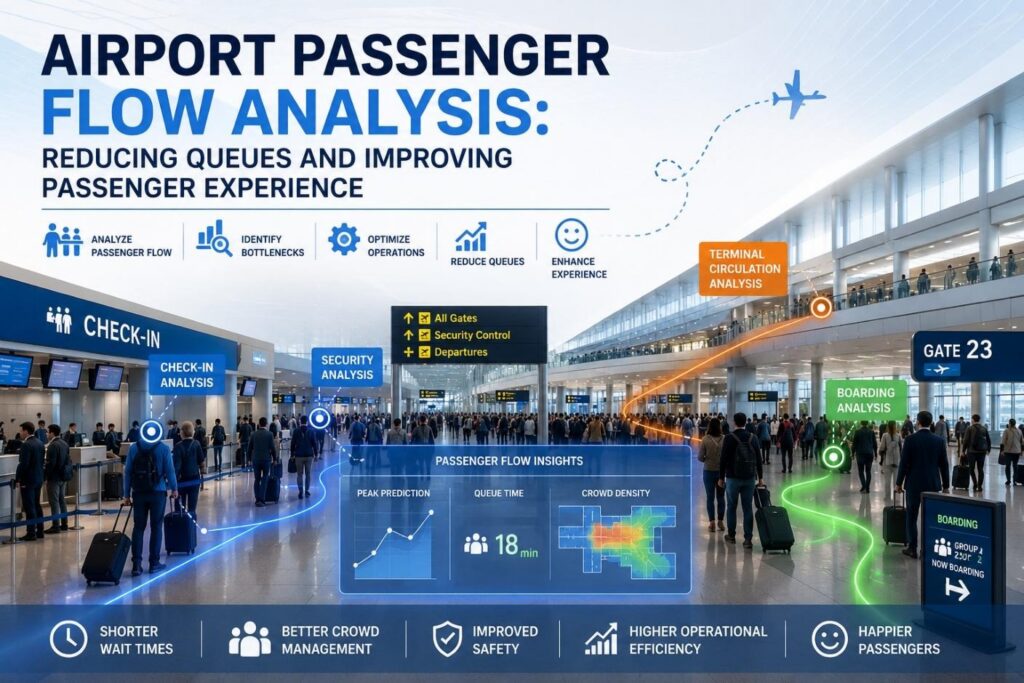
Airport passenger flow analysis is the process of analyzing how passengers move through check-in, security, immigration, terminal areas and boarding gates. It uses passenger data, analytics, monitoring and simulation to identify bottlenecks, reduce waiting times and improve airport operations.
The Basics of Airport Passenger Flow Analysis
Airport passenger flow analysis is the process of studying how travelers move through an airport, from the moment they enter the terminal until they board their flight. Rather than focusing only on passenger volumes, it examines how efficiently people progress through check-in, security screening, immigration, waiting areas, and boarding gates.
The analysis identifies where queues develop, which locations become bottlenecks, how much time passengers spend at each stage, and how movement patterns change during peak travel periods or operational disruptions. By combining operational data, passenger tracking, airport crowd simulation, and predictive analytics, airports can improve efficiency, reduce congestion, and ensure travelers move safely, comfortably, and efficiently while maximizing terminal capacity.
A Closer Look at Airport Passenger Flow Analysis
Modern airports are highly complex environments where thousands of passengers move through multiple operational processes at the same time. Every traveler follows a different journey depending on factors such as domestic or international travel, checked baggage, immigration requirements, family travel, accessibility needs, security screening, and airline-specific boarding procedures.
These different passenger journeys intersect throughout the terminal, creating a constantly changing network of movement and interactions.
Because of this, even a small disruption—such as a delayed security lane, a baggage handling issue, or a last-minute gate change—can quickly create bottlenecks that spread across the airport, affecting queues, passenger movement, and overall operational performance.
For example:
If security processing slows by only two minutes per passenger, hundreds of travelers can accumulate in the queue within an hour. This may lead to flight delays, overcrowded terminals, and operational disruptions throughout the airport. Airport passenger flow analysis helps identify these hidden risks before they impact real passengers.
READ THIS : Metro Station Evacuation Planning
The Complete Passenger Journey: Where Flow Analysis Happens
1. Check-in Area Analysis
The passenger journey begins in the check-in hall.
Here, travelers:
- Drop off baggage
- Receive boarding passes
- Verify travel documents
- Request special assistance
During busy travel periods, check-in counters are often the first major bottleneck.
Airport passenger flow analysis evaluates:
- Queue lengths
- Counter utilization
- Average processing times
- Passenger arrival patterns
- Self-service kiosk usage
- Baggage drop efficiency
Example
Suppose an airport discovers that most passengers on early morning international flights arrive within the same 30-minute period.
Instead of permanently opening additional check-in counters, airport crowd simulation forecasts staffing requirements and recommends opening temporary counters only during peak demand.
The outcome:
- Shorter queues
- Lower staffing costs
- Higher passenger satisfaction
2. Security Screening Analysis
Security screening is often regarded as the most stressful stage of air travel.
Passengers must remove laptops, liquids, belts, and personal belongings while security officers inspect their baggage.
Even small inefficiencies can noticeably increase waiting times.
Passenger flow analysis measures:
- Security lane capacity
- Tray availability
- Passenger preparation time
- Queue formation
- Staff efficiency
- Equipment performance
Observation
Many airports have found that automated tray return systems and advanced CT scanners reduce screening times while maintaining strict security standards. Rather than relying on assumptions, airports use simulation models to estimate the actual time savings before investing in new technologies.
3. Immigration and Border Control
International passengers pass through immigration checkpoints when entering or leaving a country. These areas often experience unpredictable demand because flight arrivals may vary due to weather conditions, delays, or air traffic control restrictions.
Passenger flow analysis helps determine:
- Required immigration counters
- Peak staffing schedules
- Queue forecasts
- Passenger routing strategies
- Processing capacity
4. Terminal Circulation Analysis
After completing essential procedures such as check-in, security screening, and immigration, passengers begin moving freely throughout the terminal. During this stage, they may browse retail stores, eat at restaurants or cafés, relax in airport lounges, use restrooms, wait in seating areas, charge electronic devices, or make their way toward the boarding gate.
Although this stage appears less structured, it has a major influence on both passenger experience and terminal efficiency.
To better understand these movement patterns, airports use airport crowd simulation to evaluate walking routes, corridor congestion, escalator and elevator usage, seating availability, and pedestrian activity in commercial areas.
These insights help airport operators improve terminal layouts, optimize passenger circulation, and create a more comfortable and efficient travel experience.
Behind the Scenes: Preparing for a Surge of Sports Fans
Imagine a major sporting event has just finished in a nearby city.
Within two hours, thousands of fans arrive at the airport wearing team jerseys, carrying souvenirs, and traveling in groups. Although flight schedules remain unchanged, passenger movement throughout the terminal changes dramatically.
Crowd simulation predicts these unusual travel patterns weeks in advance, allowing airport operators to:
- Install temporary signage
- Deploy additional staff
- Reconfigure seating areas
- Redirect pedestrian traffic
- Open alternative walking routes
5. Boarding Gate Analysis
Boarding is one of the final and most important stages of the passenger journey, giving airports one last opportunity to maintain smooth passenger flow before departure. Congestion frequently occurs because many travelers arrive at the gate well before boarding starts, creating overcrowded waiting areas and long queues.
Airport passenger flow analysis evaluates how boarding queues develop, how efficiently waiting areas are used, whether gate assignments are appropriate, when passengers typically arrive at the gate, and how effectively different boarding groups are processed.
These insights help airports and airlines streamline boarding, reduce congestion, improve on-time departures, and deliver a better overall passenger experience.
Example
Simulation may reveal that assigning two wide-body aircraft to neighboring gates creates significant congestion. By relocating one flight to another gate just 150 meters away, passenger density can be reduced substantially without affecting flight schedules.
The Role of Airport Crowd Simulation
While passenger flow analysis explains what is happening today, airport crowd simulation predicts what could happen tomorrow. It creates a digital representation of the airport where thousands of virtual passengers move in the same way as real travelers.
Simulation models typically include:
- Flight schedules – Simulate passenger movement based on planned arrivals and departures.
- Passenger arrival times – Predict peak traffic periods by analyzing when travelers reach the airport.
- Walking speeds – Model different walking speeds according to age, luggage, and mobility.
- Security processing – Evaluate screening times and identify potential checkpoint bottlenecks.
- Check-in behavior – Analyze passenger interactions with counters, self-service kiosks, and baggage drop facilities.
- Boarding procedures – Simulate different boarding strategies to improve gate operations and reduce congestion.
- Unexpected delays – Assess how flight delays, cancellations, and operational disruptions affect passenger movement.
- Emergency scenarios – Test evacuation plans and crowd management strategies to improve passenger safety during emergencies.
How Airport Crowd Simulation Works
A typical simulation follows several steps.
| Stage | Purpose |
| Data Collection | Gather passenger counts, flight schedules, staffing, and terminal layouts. |
| Passenger Modeling | Create virtual passengers with realistic travel behaviors. |
| Movement Simulation | Simulate passenger movement throughout the airport. |
| Bottleneck Detection | Identify congestion points and excessive waiting times. |
| Scenario Testing | Evaluate alternative staffing, layouts, or schedules. |
| Optimization | Recommend the most efficient operational strategy. |
Technologies Supporting Airport Passenger Flow Analysis
Modern airports increasingly depend on advanced technologies to monitor passenger movement and improve operational efficiency.
Some of the most widely used technologies include:
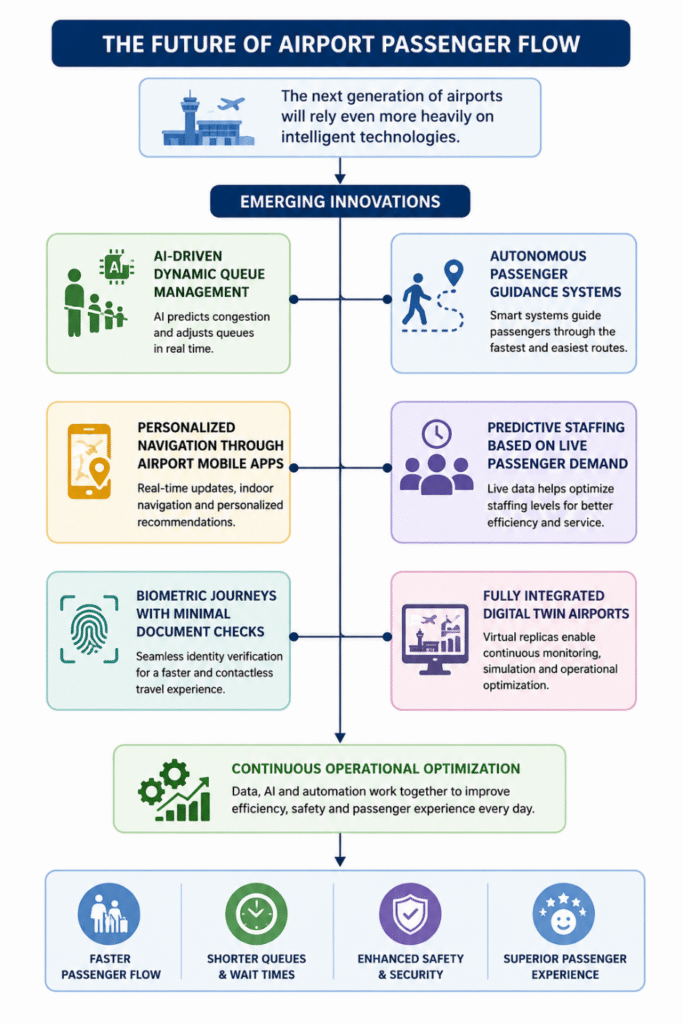
Artificial Intelligence (AI): AI analyzes passenger movement, predicts congestion before it occurs, and recommends operational adjustments to improve traffic flow.
Digital Twins: Digital twin technology creates virtual replicas of airport terminals, allowing operators to evaluate layout changes and operational improvements without disrupting live airport activities.
Computer Vision: Camera-based analytics anonymously measure crowd density, walking speeds, and queue lengths in real time, providing continuous insights into passenger movement.
IoT Sensors: Connected sensors monitor occupancy levels, passenger movement, and equipment usage throughout the terminal to support real-time operational decisions.
Predictive Analytics: Historical flight schedules, passenger trends, and operational data are analyzed to forecast future congestion and anticipate peak demand.
Real-Time Dashboards: Airport operations teams receive live information on queue lengths, passenger density, service levels, and terminal performance, enabling faster and more informed decision-making.
Delivering Better Experiences Through Passenger Flow Analysis
Effective passenger flow management creates measurable benefits for both airport operators and travelers.
For Airports
- Higher terminal capacity without major infrastructure expansion
- Improved operational efficiency
- Better staff allocation
- Reduced operational delays
- Enhanced passenger safety
- Increased commercial revenue from retail and dining areas
- Lower operating costs
For Passengers
- Shorter waiting times
- Reduced travel-related stress
- Faster security screening
- Easier terminal navigation
- A more comfortable airport experience
- Improved on-time departures
- Greater overall satisfaction
A Day in the Life of Two Airports
Consider two fictional airports that handle the same number of passengers each day.
Airport A
- Check-in queues stretch across the terminal.
- Security wait times exceed 40 minutes.
- Boarding gates become overcrowded.
- Flight delays become more frequent.
- Customer complaints continue to increase.
Airport B
Using airport passenger flow analysis and airport crowd simulation, Airport B forecasts passenger demand before travelers even arrive.
Additional staff are scheduled only during peak periods. Security lanes open dynamically as demand increases. Digital displays direct passengers to less crowded checkpoints, while boarding schedules are staggered to minimize congestion around departure gates.
Both airports process the same number of passengers.
Only one delivers a smooth, efficient, and stress-free travel experience.
Key Stages of Airport Passenger Flow and Their Objectives
| Passenger Journey Stage | Common Challenges | How Passenger Flow Analysis Helps |
| Check-in | Long queues, slow baggage drop | Optimizes counter allocation, predicts peak arrivals, improves self-service usage |
| Security Screening | Congestion, extended wait times | Balances security lanes, forecasts queue lengths, improves screening efficiency |
| Immigration | High passenger volume, document verification delays | Optimizes staffing, predicts peak processing periods, reduces waiting time |
| Terminal Circulation | Crowded corridors, seating shortages | Analyzes walking paths, improves layouts, optimizes passenger movement |
| Boarding | Gate crowding, inefficient boarding groups | Optimizes gate allocation, improves boarding sequence, minimizes congestion |
Challenges in Passenger Flow Analysis
Despite significant advances in technology, airports continue to face several challenges when managing passenger flow effectively.
- Sudden flight delays can create unexpected surges of passengers, placing additional pressure on terminal operations.
- Weather disruptions often affect arrival and departure schedules, making passenger movement more difficult to predict.
- Seasonal travel peaks during holidays, festivals, and vacation periods can lead to temporary overcrowding and increased congestion.
- Human behavior is inherently unpredictable, making it challenging to accurately forecast how passengers will move through the terminal.
- Integrating data from airlines, security agencies, baggage systems, and airport operations remains a complex task.
- Airports must continuously balance operational efficiency with strict security requirements to maintain both safety and a smooth passenger experience.
Need help analyzing and optimizing passenger flow at your airport? Contact Simbi Labs for passenger flow analysis and simulation solutions.
Book a free consultation for appointment
Email us at :grow@simbi.in