
How to Bypass Turnitin AI Detection Ethically in 2026

Why This Topic Matters in 2026
Over the past several years, AI has revolutionised academic writing. Students are now using AI tools to brainstorm, outline, summarize information, enhance grammar, and structure assignments more effectively. The technologies help to save time and increase the productivity, but they also raise concerns about the detection systems for AI use in universities and academic institutions. A common topic of search queries these days is how to avoid plagiarizing without breaching academic honesty. It is common to find students asking how to avoid Ai detection on turnitin since they are concerned that even ethical use of AI tools could result in them being flagged. In fact, academic honesty has nothing to do with fooling software or with fiddling with the detection mechanisms.
Why Students Search for “Remove AI Detection Turnitin”?
With the widespread use of AI writing tools in the educational landscape, students often look for ways to circumvent AI detection by platforms such as Turnitin, including terms like remove AI detection Turnitin, How To Avoid AI Detection, and Complete Guide to Bypass Turnitin AI Detection.
In the era of widespread AI writing tools in education, students frequently seek methods to evade AI detection like on Turnitin, such as terms like remove AI detection Turnitin, How To Avoid AI Detection, and Complete Guide to Bypass Turnitin AI Detection before submitting assignments. In most cases, these searches come from concerns about whether responsibly using AI for brainstorming or grammar assistance could affect originality reports. The safest way is to not hide using AI but to develop AI drafted content into real, well-informed academic writing that demonstrates your own knowledge.
READ THIS ALSO: Safe Turnitin Score
Understanding How Turnitin AI Detection Works
Turnitin AI detection systems are developed to look out for writing patterns that are similar to machine-generated texts. These systems analyse sentence structures, predictability, phrasing consistency, paragraph rhythm and linguistic repetition to determine if content has been created using AI systems.
When looking for how to avoid being detected by bypass ai detection turnitin, many students are confused about its purpose. Not only are AI detection tools searching for evidence of AI use, but whether the final product is truly the result of human thinking and creativity. AI’s use is not inherently unethical. Indeed, numerous institutions nowadays realise that AI can help students organise their research, summarise their findings, correct their grammar and provide them ideas.
Common Reasons AI-Written Content Gets Flagged
AI-generated content usually has a set pattern to its writing. Text may sound mechanical due to repetitive sentence patterns, general word choices for transitions, uniformity of sentence length in paragraphs, and a limited amount of personal analysis. Rather than using tricks to subvert AI detection, students should work on making their work more original by rewriting ideas, providing subject-specific points, and checking facts.
READ THIS ALSO: AI Content Humanization for Turnitin Approval
Ethical AI Assistance vs Risky Manipulation
Academic refinement is ethical one thing, but cheating with AI is another. When looking for how to bypass turnitin ai detection, students may come across tools that promise to be invisible or to take off the AI. Most of these platforms mechanically replace words but don’t make the original content more original or meaningful.
These tools frequently create:
- Awkward phrasing
- Distorted sentence structure
- Artificial writing flow
- Grammatical inconsistency
- New detectable AI patterns
Why Raw AI Output Creates Detection Risks
The most common error students commit is to provide AI-generated material with little editing. The output generated by Raw AI can be very repetitive, making it easier for detection systems to spot.
These patterns commonly include:
- Repetitive sentence rhythm
- Generic transitions between ideas
- Uniform paragraph structure
- Surface-level explanations
- Overly balanced formal tone
Refining an AI-Assisted Assignment
The student took a marketing post-graduate course and used ChatGPT to write the initial draft of an online marketing project. The draft provided explanations and definitions of terms like market segmentation and consumer behaviour, but used examples that were too generic and lacked critical analysis. The student checked each section and added recent examples from brands such as Nike and Zomato, compared various marketing strategies, verified all the references and rephrased all the content in her own words before submitting his assignment. The final turn-in demonstrated a grasp of the concepts, contained some original ideas, and featured a somewhat more natural academic writing style rather than just a case of AI-generated text.
READ THIS ALSO: How to Make AI-Generated Assignments
Rewrite Ideas Instead of Replacing Words
Many people think that the key to avoiding being flagged as plagiarized on turnitin is to alter a couple of words in a text. In practice, however, this means that very often, merely substituting the vocabulary for a sentence while keeping the sentence structure the same produces unnatural writing patterns that still sound like a machine. Instead, the way to go is to reconstruct ideas with personal knowledge and natural academic writing. Students should emphasize their own voice, enhance interpretation and analysis.
Helpful questions include:
- How would I explain this idea personally?
- What examples could strengthen the argument?
- What interpretation reflects my understanding?
- How can I improve analytical depth naturally?
Quick Tips: How To Avoid AI Detection
| Instead of… | Try This |
| Copying AI output | Rewrite ideas naturally |
| Replacing random words | Change sentence structure |
| Using AI humanizers | Add personal analysis |
| Trusting AI facts | Verify every source |
| Submitting immediately | Proofread carefully |
Add Personal Analysis and Human Perspective
While AI can handle the task of summarizing information well, it may fall short of providing comprehensive human analysis and understanding. Adding authentic human input into the material is one of the most effective approaches to minimize AI detection risks.
Students can improve authenticity by including:
- Personal interpretation
- Comparative evaluation
Use Natural Sentence Variation
AI-generated writing often follows highly predictable pacing and structure. Human writing naturally contains more variation in sentence rhythm, paragraph length, and analytical flow.
Natural academic writing usually includes:
- Short emphasis-driven statements
- Longer analytical explanations
- Occasional transitional variation
- Different paragraph structures
- Mixed sentence pacing
Fact-Checking Is Essential
Another significant problem of AI generated content is inaccuracies in facts. AI systems provide sometimes ambiguous information or false references, incorrect interpretations, or misinformation. It enhances originality and academic trustworthiness by checking facts. Students who are only concerned with ways to avoid getting caught by turnitin ai detection strategies can overlook the larger academic dangers that exist from unreliable information and low scholarly credibility. Universities do not judge writing solely by percentage of detection, but by quality of writing, knowledge of the subject matter, and honesty. Thorough verification helps to make sure the end product is the result of responsible academic effort.
Before submitting AI-assisted work, students should always verify:
- Citations and references
- Source credibility
- Data interpretation
- Terminology accuracy
- Research claims
Table: Ethical vs Risky AI Writing Practices
The following table highlights the difference between responsible AI-supported writing and risky AI manipulation techniques.
| Ethical Academic Practices | Risky Detection Manipulation |
| Rewriting ideas naturally | Copying raw AI-generated content |
| Adding personal analysis | Using automated AI humanizers |
| Fact-checking citations | Replacing random synonyms mechanically |
| Improving analytical depth | Submitting minimally edited drafts |
| Using AI for brainstorming | Depending entirely on automation |
| Maintaining academic integrity | Attempting deceptive shortcuts |
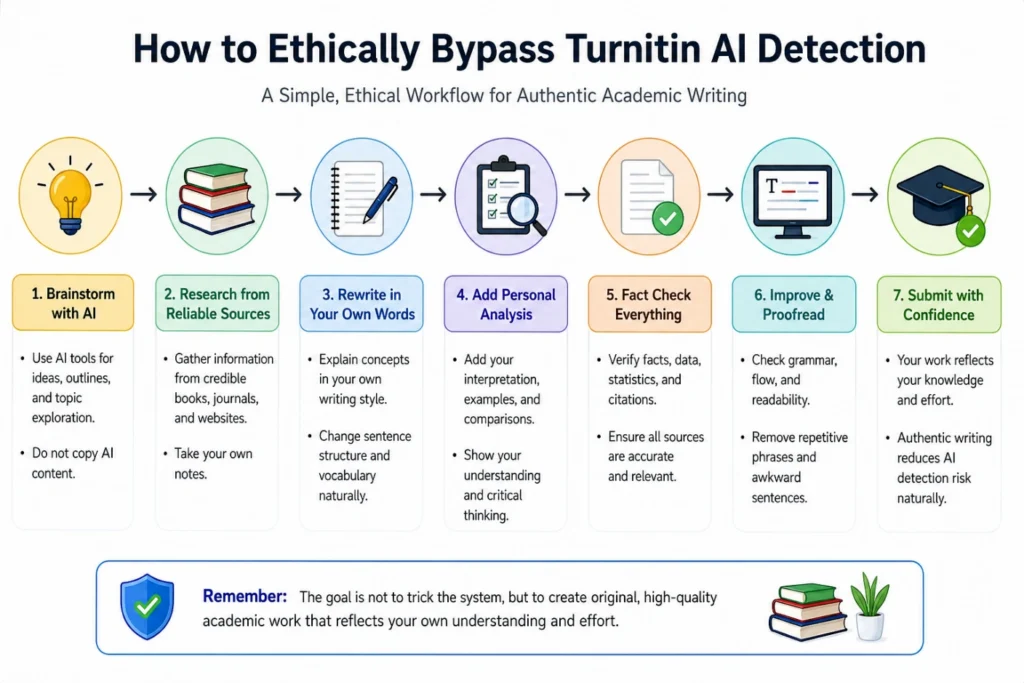
Process to Ethically Reduce AI Detection Risk
The following process is designed to ethically polish up the writing process with the help of AI, enhance original writing, and naturally minimize the probability of plagiarism.
Avoid AI “Undetector” Tools
There are numerous online platforms that offer a turnitin ai detection bypass, typically by utilizing automated re-writing systems or AI humanizers. The majority of these tools only deal with the syntax at a very superficial level and do not help to improve the originality or academic level.
This often creates:
- Robotic sentence flow
- Distorted meaning
- Reduced readability
- New detectable patterns
- Lower academic credibility
Use AI as a Support Tool, Not a Replacement
A healthy academic process is one in which the use of AI is not used to supplant independent learning and writing, but rather as a tool to aid an individual.
Students can responsibly use AI for:
- Brainstorming ideas
- Structuring outlines
- Clarifying difficult concepts
- Improving grammar
- Organizing drafts
FAQs
Can I completely remove AI detection in Turnitin?
No tool can guarantee complete removal of AI detection. The safest approach is to produce original, well-researched work that reflects your own understanding.
How To Avoid AI Detection ethically?
Use AI for brainstorming, rewrite content in your own words, verify facts, and include personal analysis rather than relying on automated rewriting tools.
Is using AI for assignments allowed?
Many institutions allow AI-assisted writing for planning, grammar, and research support, provided the final submission represents the student’s own work and complies with institutional policies.
Final Thoughts
The safest and most sustainable answer to how to bypass turnitin ai detection is not deception, automation tricks, or manipulation software. The real solution is originality because students who genuinely understand their subject matter and contribute meaningful analysis rarely need to fear detection systems.
Instead of obsessing over shortcuts related to turnitin ai detection bypass, students should focus on producing thoughtful, authentic, and well-researched academic writing that reflects genuine understanding and independent reasoning.
When your work demonstrates critical thinking, personal interpretation, and authentic academic voice, detection systems become far less important. That is not bypassing through manipulation. That is earning originality the right way.
Book a free consultation for appointment
Email us at : grow@simbi.in