
Turnitin Report Analysis Guide: How to Read and Fix Every Section
Introduction
Receiving a Turnitin report can feel overwhelming, especially when unfamiliar percentages, color codes, and highlighted matches appear across your document. Many students panic after seeing a high similarity score without fully understanding what it actually means. The truth is, proper Turnitin report analysis is not about chasing the lowest number—it is about understanding where similarities occur and knowing how to fix them correctly.
A detailed review helps identify harmless matches, citation issues, weak paraphrasing, and genuine originality concerns. This guide explains how to read every section of a Turnitin report and the right way to fix each issue while preserving academic integrity.
The Turnitin Report Analysis Guide helps students clearly understand similarity results and take the right corrective steps. Using the Turnitin Report Analysis Guide, you can quickly identify citation errors, improve paraphrasing, and enhance overall originality without affecting academic integrity.
What Is a Turnitin Report?
A Turnitin report compares your submitted document against a large database of academic papers, journals, websites, and published sources. The result is a similarity report that highlights text matching external content.
A proper Turnitin report analysis helps distinguish between:
- Legitimate citations
- Common academic phrasing
- Technical overlap
- Poor paraphrasing
- Potential plagiarism concerns
The similarity percentage alone does not determine misconduct. What matters is where and why those matches exist.
Understanding the Similarity Score
The first thing visible in any report is the similarity percentage.
This score shows how much of your text matches external sources, but it does not confirm plagiarism.
For example:
- Low similarity (0–15%) often reflects strong originality
- Moderate similarity (15–30%) may indicate common references or minor citation overlap
- High similarity (30%+) usually requires deeper Turnitin report analysis
A high score is not automatically bad if the matched content includes properly cited material.
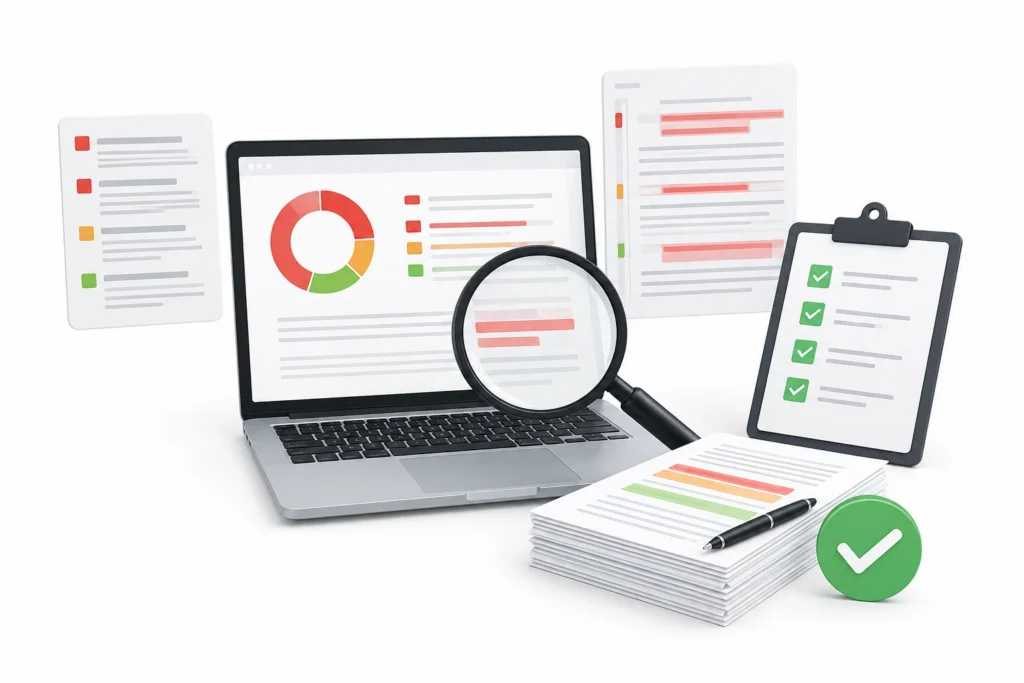
Reading the Color Indicators
Turnitin uses color coding to classify similarity levels.
Blue
Minimal or no matching content
Green
Low similarity detected
Yellow
Moderate similarity requiring review
Orange
Higher overlap needing correction
Red
Substantial similarity needing immediate attention
These indicators guide your Turnitin similarity report fix process by showing where to focus.
Reviewing Matched Sources
Clicking highlighted sections reveals matching sources.
This part of Turnitin report analysis helps identify whether overlap comes from:
- Published journals
- Websites
- Student papers
- Institutional databases
- Commonly used references
When reviewing sources, ask:
- Is the citation complete?
- Is this direct quoting?
- Is the wording too close to the original?
This step is essential for accurate plagiarism report correction.
Fixing Citation Problems
One common issue is incomplete citation formatting.
Even properly borrowed ideas can appear problematic if references are inconsistent.
Check:
- In-text citation placement
- Missing quotation marks
- Incorrect referencing style
- Reference list completeness
Correcting these details often improves Turnitin report analysis results without changing your actual research content.
Improving Weak Paraphrasing
Weak paraphrasing is one of the biggest causes of high similarity.
Simply replacing a few words does not make content original.
Instead:
- Fully understand the source idea
- Rewrite it using your own structure
- Add interpretation where possible
- Preserve academic accuracy
Strong rewriting improves original academic writing and reduces future flags.
Identifying Unavoidable Similarity
Some content naturally triggers matches.
Examples include:
- Technical definitions
- Methodology descriptions
- Standard formulas
- Discipline-specific terminology
During Turnitin report analysis, these sections may not need changes if properly cited and academically required.
Avoid unnecessary rewriting that could weaken clarity.
How to Prioritize Fixes
Not all highlighted sections need equal attention.
Focus first on:
- Large copied blocks
- Poorly paraphrased source material
- Missing citations
- Repeated sentence structure overlap
Smaller common matches often matter less during Turnitin similarity report fix.
Efficient prioritization saves time and preserves quality.
Why Manual Review Matters
Automated rewriting tools often create awkward wording and distort meaning.
Professional manual editing ensures:
- Accurate context preservation
- Better paraphrasing
- Natural academic tone
- Reliable plagiarism-free writing
Expert review often delivers stronger plagiarism report correction than quick software fixes.
Conclusion
A similarity report is not something to fear—it is a tool for improvement. Effective Turnitin report analysis helps you understand what needs attention and what can remain unchanged.
By carefully reviewing matches, correcting citations, strengthening paraphrasing, and preserving original academic writing, you can confidently improve your work while maintaining academic integrity.
The goal is not simply lowering percentages but producing research that clearly reflects your own understanding and contribution.
FAQs
What does Turnitin report analysis show?
It identifies text matches and helps evaluate originality concerns.
Does a high similarity score always mean plagiarism?
No, properly cited references can increase similarity percentages.
How do I fix weak paraphrasing?
Rewrite ideas completely using your own structure and understanding.
Can citations still appear in similarity reports?
Yes, cited material often appears as matched content.
zWhat is the best way to reduce similarity ethically?
Improve paraphrasing, strengthen citations, and review flagged sections manually.
What is a Turnitin Report Analysis Guide?
A guide to read and understand Turnitin similarity reports.
How does the Turnitin Report Analysis Guide help improve scores?
It helps identify issues and reduce similarity to improve originality.
Book a free consultation for appointment
Email us at : grow@simbi.in