
Types of Data in Statistics: Examples and Classification

Knowing what data are available in statistics is fundamental to the accurate analysis. Data may be qualitative or quantitative, and can be categorized as discrete, continuous, nominal, ordinal, interval, and ratio. The correct identification of these types is important for researchers to select appropriate statistical techniques and to interpret the results accurately.
Role of Data Classification in Statistics
Data classification is used to decide which statistical tests, visualisations and data analysis techniques to use. Proper identification of data types further minimises errors and aids in informed decision-making through evidence-based information.

Types of Data in Statistics
| Data Type | Meaning | Example |
| Qualitative | Descriptive/categorical data | Eye color |
| Quantitative | Numerical data | Height |
| Nominal | Categories without order | Blood group |
| Ordinal | Categories with an order | Satisfaction level |
| Discrete | Countable numerical values | Number of students |
| Continuous | Measurable values | Weight |
| Interval | Equal intervals, no true zero | Temperature °C |
| Ratio | Equal intervals with a true zero | Weight, height |
Raw Data vs. Processed Data
Raw Data: Unorganized information collected directly from sources, such as survey responses recorded as “25” or “twenty-five.” It is difficult to analyze without classification.
Processed Data: Organized and standardized information prepared for analysis, such as converting all responses to “25 years.” It helps identify patterns and trends.
How Is Raw Data Processed?
There are six basic steps in processing raw data:
1. Collection of data: Collect data from various sources like surveys, transactions and social media.
2. Data Cleaning: Eliminate inaccuracies, inconsistencies, and duplications.
3. Data Transformation: Transform data into a proper format for analysis.
4. Data Analysis: Use statistics to detect patterns.
5. Data Visualization: Represent data in charts and graphs.
6. Insights as Generation: Make practical inferences for decision-making.
Broad Classification of Data
At its core, statistical data is broadly classified into two types: Qualitative and Quantitative Data
- Qualitative (Categorical) Data – describes qualities, labels, or characteristics.
Example: Gender, colors, brand names. - Quantitative (Numerical) Data – represents numbers that can be counted or measured.
Example: Age, salary, weight.
| Basis of Difference | Qualitative (Categorical) Data | Quantitative (Numerical) Data |
| Definition | Describes attributes, categories, or characteristics | Represents numbers that can be counted or measured |
| Nature | Non-numerical | Numerical |
| Types | Nominal, Ordinal | Discrete, Continuous |
| Examples | Gender, eye color, nationality, brand preference | Age, height, weight, salary, number of books |
| Purpose | Identifies “what kind” or “which category” | Identifies “how much” or “how many” |
| Statistical Analysis | Uses mode, percentages, chi-square tests | Uses mean, median, standard deviation, t-test, ANOVA |
| Graphical Representation | Bar charts, pie charts | Histograms, line graphs, scatter plots |
| Precision | Less precise (descriptive in nature) | More precise (measurable with accuracy) |
Quantitative Data: Discrete vs. Continuous
The quantitative data, which is related to numbers, is divided into two categories: discrete data and continuous data. It is crucial to understand this difference as it influences the way the data is collected, presented, and interpreted in statistics.
1. Discrete Data
Countable data values that are limited are discrete data. They are usually whole numbers and not fractions or decimals.
Common Mistake: Discrete data is assumed to be continuous, e.g., “number of children” is assumed to be continuous when in fact it is not.
Solution: Keep in mind that the values of a discrete data type must be integers.
2. Continuous Data
Continuous data are data that can have any value within some range and can be measured very precisely.
Common Mistake: People tend to round off continuous data too many times, which can potentially mask variations and lead to an inaccurate overall picture.
Solution: Keep decimal places as specified and select appropriate graphs to be able to represent continuous data effectively, such as histograms and line graphs.
Using the correct types of data in statistics ensures proper representation.
| Feature / Aspect | Discrete Data | Continuous Data |
| Definition | Data that can take only specific, countable values | Data that can take any value within a range |
| Nature | Separate and distinct values | Infinite possible values within a range |
| Values | Whole numbers only (no decimals/fractions) | Includes fractions and decimals |
| Examples | Number of cars, number of students, number of phone calls | Height, weight, time, temperature, speed |
| Measurement Method | Counting | Measuring |
| Possible Outcomes | Finite (limited set of values) | Infinite (theoretically unlimited possible values) |
| Graphical Representation | Bar graphs, frequency tables | Histograms, frequency polygons, line graphs |
| Problem | Misinterpreted as continuous data | Oversimplified by excessive rounding |
| Solution | Remember: only integers are valid | Preserve decimals when required for accuracy |
Levels of Measurement (Scales of Data)
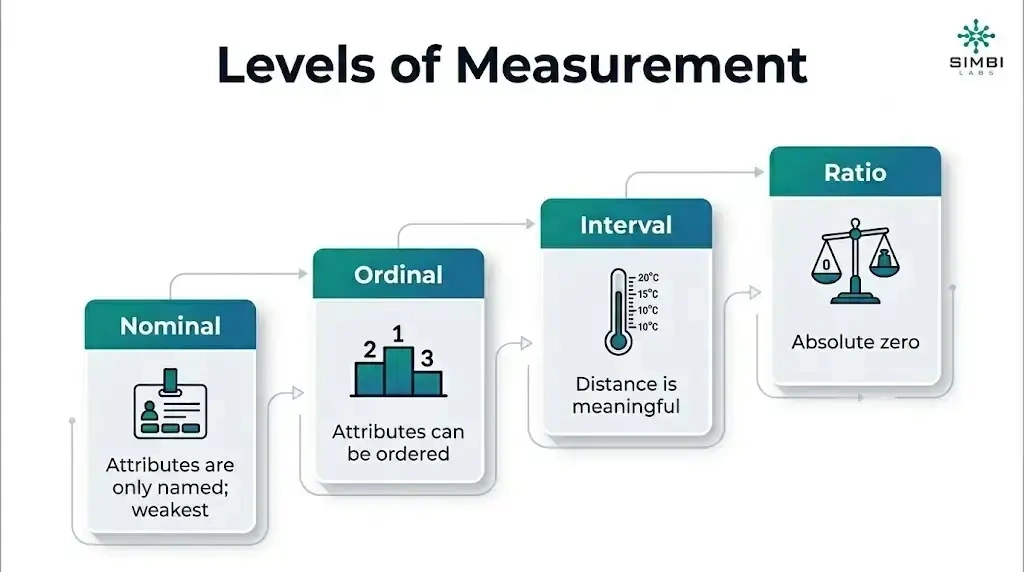
Choosing the mean, median or mode when using a ratio or interval level of measurement can make a huge difference to the interpretation.
Why it matters
Your scale dictates which summaries, charts, and statistical tests are valid. Get the scale wrong → get the conclusions wrong.
1. Nominal Scale – “Names Only”
Nominal data refers to data that are presented in categories that do not have any order, like cities, blood groups, and product types. Mode and percentages are appropriate ways to summarize it and it can be represented in bar or pie charts. Commonly used are the chi-square tests.
2. Ordinal Scale – “Ranked, but Gaps Unknown”
Ordinal data represents rank order data, but the differences between the ranks are not equal or known. These can include factors such as education levels, satisfaction ratings, and so on. These are typically ordered bar charts, medians, or percentiles, and non-parametric tests.
3. Interval Scale – “Equal Steps, No True Zero”
Interval data is data that does not have a meaningful zero but has equal intervals. Some examples are Celsius temperature and calendar years. RATIOS are not meaningful, differences are meaningful. Commonly used summary statistics are the mean, variance, and standard deviation.
4. Ratio Scale – “Equal Steps, True Zero”
Interval data has equal intervals and has a meaningful zero. These include things like distance, age, income, height and weight. Differences and ratios are meaningful and many kinds of statistical computations can be made.
| Feature | Nominal | Ordinal | Interval | Ratio |
| Categories | Yes | Yes | No | No |
| Order | No | Yes | Yes | Yes |
| Equal intervals | No | No | Yes | Yes |
| True zero | No | No | No | Yes |
| Example | Eye color | Satisfaction | °C temperature | Weight |
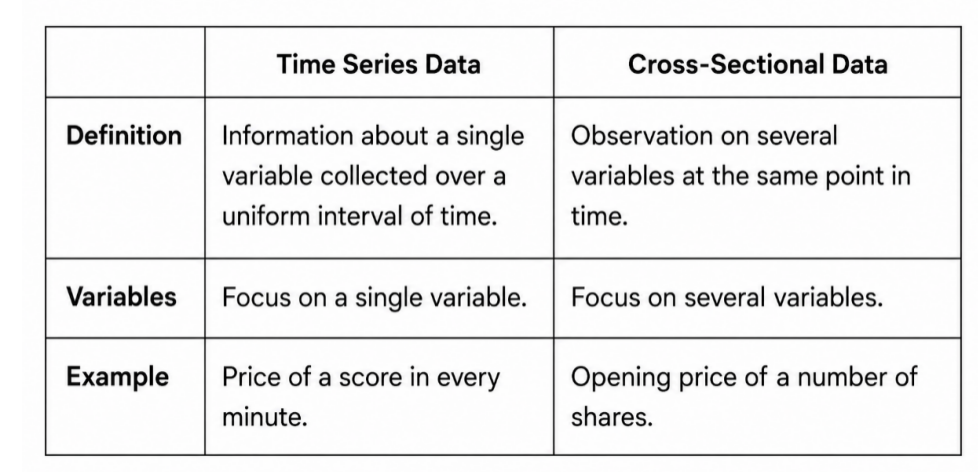
Cross-sectional and time-series data: Cross sectional data are measurements taken from individuals, groups, and/or organizations at one point in time. For instance, the family income data for 2025 is cross-sectional data. Time-series data is data that has been collected over a series of time measurements, like monthly changes in the price of a stock or monthly inflation rates, and is used to see if there are any trends or changes over time. For statistical analysis it is important that both types of data are classified and useful.
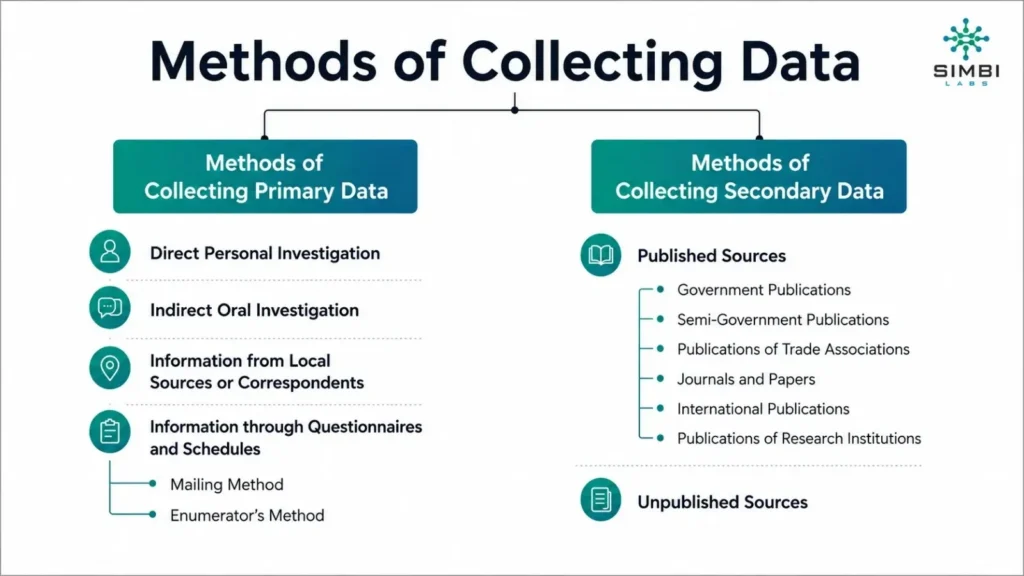
Primary vs. Secondary Data: Primary data is data that is gathered by the researcher themselves, such as data collected from surveys, interviews, experiments or observations that the researcher directly participates in, while secondary data is data that has already been gathered by someone else, such as data that is collected from a government report or data base
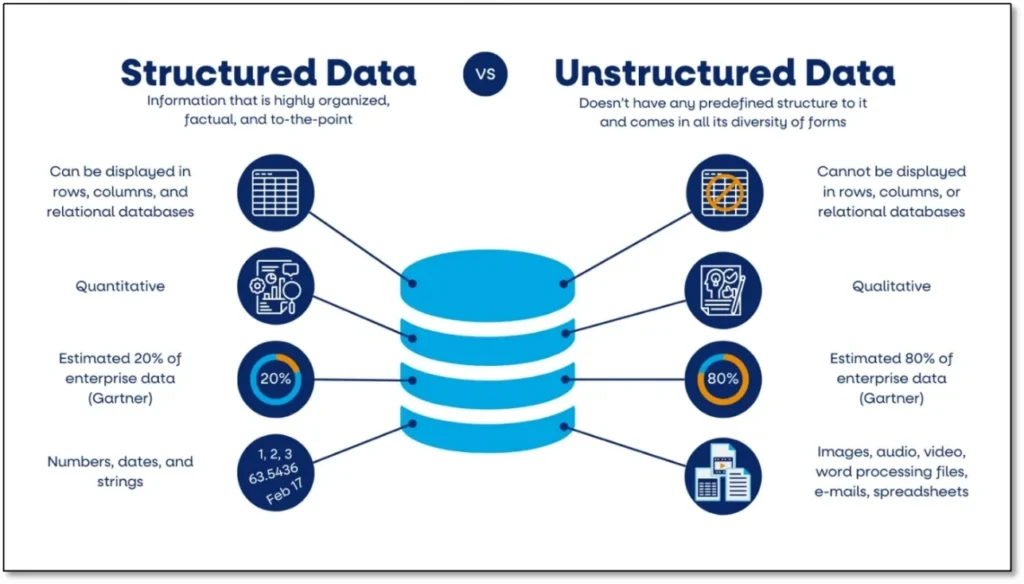
Structured and Unstructured Data Structured data is rows and columns, and can be readily analysed with standard database/stats tools. Unstructured data does not have a uniform format, and is generally not as easy to analyse. These include things like sales, employment records, financial transactions, etc. Unstructured data is information that does not follow a specific format, such as text, images, videos, social media posts, and customer feedback. Although structured data is more readily analyzed, unstructured data can also be helpful in deriving insights using machine learning and natural language processing.
Read More : How to Build a Reliable Data Collection Workflow for Medical Studies
The Use of Data Type in Business.
Knowledge of types of data is essential to a business since it dictates what type of analysis should be used, and what conclusions can be made. Most companies do use the services of professionals like Simbi Labs India, which have extensive experience and knowledge of statistical analysis, for the accuracy and clarity of insights for businesses.
1.Better Decision-Making
There are various types of data used for analyzing business data. Sales represents ratio data, customer satisfaction represents ordinal data, product categories represents nominal data. Accurate classification of these data types can enable businesses to choose the right statistical techniques, ensure more accurate data analysis, and make informed decisions for growth and productivity.
2. Efficient Data Collection & Organization
Discrete and continuous data, as well as nominal and ordinal data, can assist businesses in creating surveys, databases, and dashboards that are effective. For instance, the age of the customers is ratio data and the preference of the customers is nominal data. The classification enables data to be easier organized, analysed and applied for decision making.
3.Accurate Market Analysis
Ratio data are used to measure growth, earnings and return on investment and are used in business. It can be used to make sense of mathematical comparisons and to analyse finances or to make informed investments. Ordinal data is used to make businesses understand how customers prefer and how they are satisfied. While the magnitude of the differences can’t be measured precisely, ordinal data does show trends and opportunities for improvement. Interval data – temperature, calendar time, etc. – has equal intervals but no absolute zero. It can be used in various sectors like manufacturing, logistics, and hospitality to track conditions, enhance efficiency, and mitigate risks.
4.Choosing the Right Visualization & Tools
The right visualization enables businesses to gain insight from data and effectively communicate that insight. Use bar charts for nominal data, histograms for continuous and scatter plots for ratio data. Visualisations make complex data more accessible, show trends and facilitate decision making.
5.Risk Management & Forecasting
Appropriate classification of data and use of the right statistical tools increases the accuracy of forecasting and decreases uncertainty in business. Time-series ratio data, like sales revenue, can be used to help forecast demand, and categorical data can be used to help identify and manage risks.
6. Improving Customer Experience
Ordinal data can be used to determine preferences and areas of improvement, such as customer satisfaction ratings. Personalized marketing and customer engagement are made possible by nominal data, like gender, location, and interests.
Real-Life Applications of Data Types
| Field | Example of Data |
| Healthcare | Blood type, blood pressure |
| Business | Revenue, customer satisfaction |
| Education | Test scores, grades |
| Government | Census data |
| Companies | Purchase frequency, satisfaction ratings |
Interesting Fact
Did you know? The concept of levels of measurement was developed by psychologist Stanley Smith Stevens in 1946 and it has become an important component of modern statistics.
Question for Readers
Whenever you encounter a survey or dataset, be able to ask yourself: What kind of data is this? Then you will find we misclassify it so often!
Read Also : Types of Market Research: A Complete Guide to Making Smarter Business Decisions in 2026
How to Identify the Type of Data
Determine the type of data before choosing a statistical method:
Step 1: Identify if data is categorical or numerical. Categorical Data is qualitative, numerical Data is quantitative.
Step 2: If quantitative data, is it discrete or continuous? Discrete data is data that is countable, continuous is data that is measurable within a range.
Step 3: Determine the level of measurement. Categorical data can be nominal or ordinal, numerical data can be interval or ratio (equal intervals and a true zero).
Conclusion
To understand the nature of data in statistics is key to accurate statistical analysis. Qualitative, quantitative, discrete, continuous, nominal, ordinal, interval, and ratio data are all used to organize and interpret information appropriately by the researcher. Accurately determining data types enables researchers to choose appropriate statistical methods, ensure the accuracy of results, and make informed decisions. In the simplest of terms, the starting point for good statistical analysis is to know what the data is.

Need Help With Statistical Data Analysis?
Accurate data classification is essential for choosing the right statistical methods and making reliable decisions. If you need help with your research data, our experts at Simbi Labs can assist with statistical analysis, interpretation, and research support.
Book a free consultation for appointment
Email us at : grow@simbi.in