
Online vs Offline Data Collection: A Complete Guide for Research Projects
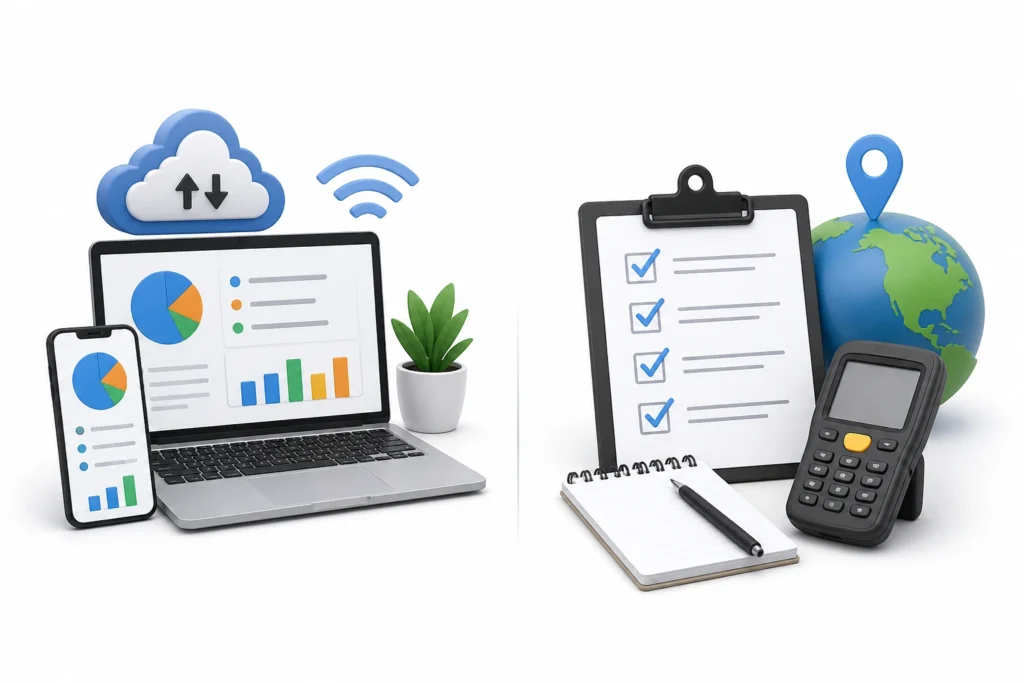
One of the most significant choices that can be made in any research project is Online vs Offline Data Collection. Data collection refers to the process of collecting information about respondents, users, customers, business, community or field locations to guide research and decision making. Digital tools used in data collection during the online method include forms, apps, emails and web surveys, and direct observation and field surveys are used in offline method. The selection of the appropriate methodology in India will be based on your target audience, location, budget, timeline, and the quality of data that you need.
What Is Online Data Collection?
The process of gathering the responses using internet-based platforms is the internet data collection. It can consist of Google Forms, Microsoft Forms, SurveyMonkey, KoboToolbox, email surveys, web-based forms, mobile applications, and questionnaires based on social media.
It is often employed in customer feedback, scholarly surveys, employee surveys, product reviews, market research and student research projects. Online approaches prove handy in situations where the respondents are computer and internet-savvy and comfortable using smartphones or computers.
Online vs Offline Data Collection In this comparison, online methods are generally faster, cheaper and easier to manage when dealing with large scale basic surveys.
What Is Offline Data Collection?
Offline data collection is a process of gathering information directly with the respondents through field visits, face-to-face interviews, using telephones to support the respondents, using paper questionnaires, using retail audit, using household survey, and using observation.
The technique is particularly effective in cases where the target market is not very active on the Internet or where the study involves physical confirmation. Offline surveys are still significant in the rural regions, semi-urban market, healthcare study, retail audit, social research, and community based projects in India.
In contrasting Online vs Offline Data Collection, offline data collection tends to be more interactive and provide more control over the respondent understanding.
Why the Choice Matters in India
India is very diverse in population. Access to internet, language ease, level of education, location and the behavior of respondents in the different regions are very diverse. A strategy that can be quite effective in major urban areas can be relatively ineffective in small town or countryside.
To illustrate, online surveys can be effective to urban youth, working professionals, students, and digital consumers. Online field surveys might be more effective with households, shopkeepers, patients, farmers, local communities, and those respondents who would prefer a face-to-face interview.
This is the reason why before commencing a study, businesses, researchers and students must critically assess Online vs Offline Data Collection.
How Online and Offline Data Collection Work
Both methods follow a structured research process, but the execution style is different.
Online Data Collection Process
In internet research, the questionnaire is digitally designed and sent out by link, email, WhatsApp, social media, websites, or respondent panels. The answers are automatically saved on spreadsheets or dashboards.
The key processes are the design of the questionnaire, creation of the survey link, targeting of the respondents, monitoring of the responses, cleaning of the data and analysis.
Offline Data Collection Process
In the offline research case, trained field researchers will obtain the responses first hand by the respondents. They can go to homes, shops, offices, institutions, hospitals, or any other public places.
It involves the following process, field planning, surveyor training, respondent selection, interviews, supervision, data entry, validation, and reporting.
A hybrid model involves the combination of online and offline approaches, which can be used in a professional data collection company in India.
Key Features of Online Data Collection
Data collection through online method is quick, convenient, and easily monitored. It enables the researcher to gather responses of various locations without necessarily having to move physically.
Key characteristics are digital questionnaires, automated data input, rapid response collection, reduced cost of operation, real time tracking and simple export to Excel or dashboards.
Online surveys can also have some limitations, including poor quality of response, duplication, lack of control over the identity of respondents, as well as lack of access to people with low digital access.
Key Features of Offline Data Collection
During offline data collection, there is direct contact, high response rate and high field validation. Field investigators are able to clarify questions, observe body language and help the respondents get the survey right.
Some of the key features are face to face interviews, support of local languages, physical verification, GPS tagging, photo evidence, supervisor checks, and respondent validation.
The primary constraint is that offline survey, typically takes longer time, planning, manpower and budget.
Benefits of Online vs Offline Data Collection
Online vs Offline Data Collection has its advantages that are relative to the objective of the research.
The online data collection can be advantageous in the study when the researcher requires expedient responses, low expenses, extensive coverage, and online reporting. It can be applied to students, online customers, employees, respondents in urban areas, and audiences that are friendly to technology.
Offline data collection is advantageous in cases where the study needs a high-quality interaction, local understanding, physical verification or access to the respondents who may not respond online.
In the case of significant business research, a mixed approach would be the preference of many companies as it enhances reach and reliability of the data.
Industry Use Cases
Market Research
Online surveys can be used in brand awareness research, online customer feedback research and product preference research. The offline surveys are superior in retail audits, shopkeeper interviews and local market research.
Healthcare Research
Patient surveys, hospital surveys, community health research, and awareness research are often the preferred methods of offline data collection due to the high quality of responses when personal contact is involved.
Academic Research
Online surveys can be used by students and researchers to conduct simple quantitative research. In case of social science, rural studies and field based research, the offline survey is more appropriate.
Business and B2B Research
Online strategies will be able to gather the feedback of professionals and businesses. Telephonic or offline interviews are more appropriate when decision-makers require a personal follow up.
Social and Development Studies
Offline field surveys are commonly used by NGOs and researchers of public policy due to the need of trust, support in a local language, and observation in a community-level research.
Tools and Technologies Used
A common online data collection tool is Google Forms, Microsoft Forms, KoboToolbox, SurveyMonkey, Typeform, CRM tools, and online survey panels.
Printed forms, mobile survey applications, GPS tracking, photo verification, excel data input, call-back checks, and supervisor monitoring may be used as offline methods of collecting data.
The digital field tools are becoming increasingly popular in modern research projects where surveyors are recording offline responses to mobile apps and uploading data afterwards.
Common Mistakes to Avoid
The most typical error is to select the method merely on the basis of cost. Online surveys can be inexpensive, yet they might not deliver the correct audience. The offline surveys can be elaborate although they can get costly should they not be planed properly.
The other error is that when using both methods the same questionnaire is used without changing its format. Online questions must be brief and straightforward and offline interviews can have more follow-up questions.
Other areas to be avoided by researchers are unclear sampling, leading questions, poor data validation and lack of respondent verification.
How to Choose the Right Method
In order to decide between Online vs Offline Data Collection, begin with your objective of the research. Online data collection can be superior should you need a fast response on digitally active respondents. In case you are in need of verified, location-based, or in-depth responses, offline data collection can be more appropriate.
Sample size, geography, respondent profile, budget, timeline, language requirements, and quality expectations of the data are also to be considered.
In the case of most Indian studies, a hybrid approach is the best option. It integrates the pace of online surveys with the richness and trustworthiness of offline fieldwork.
Future Trends in Data Collection
Online vs Offline Data Collection in India will be influenced in future by hybrid research models, mobile-based surveys, AI-assisted data cleaning, field monitoring using GPS, and real-time dashboards.
Fieldwork done by humans will still be significant in rural research, healthcare research, retail audit research, and community level survey research.
Conclusion
Online vs Offline Data Collection does not concern the selection of one method as one that is universally better. The correct option will be based on your study purpose, audience, geography, time, and the quality of data needed. Online techniques are quicker and less expensive whereas offline techniques offer more interaction and field validation.
To conduct accurate research in India, businesses, researchers and students ought to select the approach that most aptly fits its target respondents and objectives of the research project.
In need of professional assistance in data collection online and offline? Get a professional data collection team in India to design the right approach, gather correct data, validate data and transform your research into actionable insights.
Book a free consultation for appointment
Email us at : grow@simbi.in