
The Benefits of Outsourcing Clinical Research Support Services
Introduction
As the clinical research industry continues to change and evolve, with regulatory requirements growing, technology advancing, and clinical trials becoming increasingly global and complex, it is important to stay ahead of the curve. High quality research for pharmaceuticals, biotechnology firms and healthcare organizations is a challenge as they strive to control their running expenses.
That’s where outsourcing clinical research support services comes in. Specialists in the outside world could help to enhance efficiency, cut expenses and prioritize the core research aims of the organisation. Outsourcing has emerged as a vital practice for organisations aiming at speeding up clinical trial timelines and improving compliance standards.
This article will discuss the major advantages of outsourcing clinical research support services and why it is becoming a favoured option for clinical trial management in today’s times.
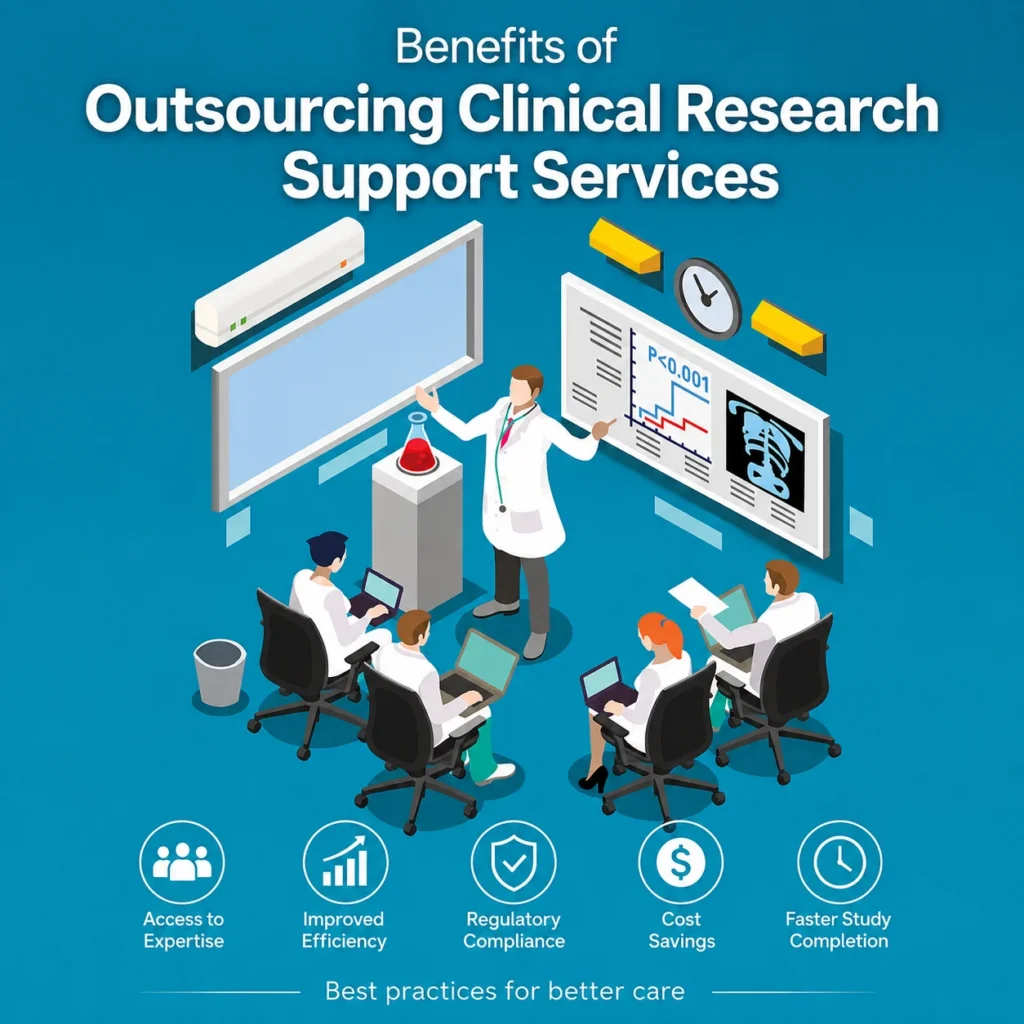
Access to Specialized Expertise
One of the primary advantages of outsourcing clinical research support services is access to highly skilled professionals with extensive industry knowledge.
Clinical research requires expertise in several critical areas, including:
- Regulatory compliance management
- Clinical data management
- Medical writing and documentation
- Site monitoring and auditing
- Statistical analysis and reporting
An affiliation with providers that have clinical research support expertise means that organizations have access to experts who are kept up to speed on industry changes and best practices. This skill set enhances the quality of trials and guarantees its efficient delivery, without the need to hire or train in-house resources.
Cost Efficiency and Reduced Operational Expenses
Running in-house clinical research operations can be expensive. Recruiting qualified professionals, investing in infrastructure, software systems, and continuous training significantly increases operational costs.
Clinical trial outsourcing helps organizations reduce these expenses by converting fixed costs into variable costs. Instead of maintaining a full internal team, businesses pay only for the services they require.
Cost-saving benefits include:
- Lower recruitment and onboarding expenses
- Reduced technology infrastructure costs
- Elimination of long-term staffing commitments
- Minimized training expenditures
This financial flexibility allows organizations to allocate resources toward innovation and research development.
Faster Clinical Trial Execution
Speed is critical in clinical research. Delays in trial initiation, patient recruitment, data processing, or regulatory submissions can lead to lost opportunities and increased costs.
Outsourced clinical research solutions streamline trial workflows through established systems and experienced project management teams.
External support providers often have:
- Predefined operational frameworks
- Efficient workflow automation tools
- Faster regulatory submission processes
- Dedicated monitoring resources
This accelerates timelines and helps organizations bring new treatments to market more quickly.
Improved Regulatory Compliance
Clinical research operates within strict regulatory frameworks governed by agencies such as the FDA, EMA, and ICH-GCP standards.
Failure to comply with these requirements can result in:
- Trial delays
- Regulatory penalties
- Data rejection
- Reputational damage
Professional research support services ensure compliance by maintaining accurate documentation, performing regular audits, and implementing robust quality assurance processes. Experienced outsourcing partners understand international regulations and help organizations navigate complex compliance landscapes effectively.
Enhanced Focus on Core Research Activities
Internal clinical teams often become overwhelmed with administrative tasks such as:
- Documentation management
- Data entry and validation
- Regulatory submissions
- Trial logistics coordination
By outsourcing clinical research support services, internal teams can focus on high-value scientific and strategic activities, including:
- Protocol design
- Scientific innovation
- Investigator collaboration
- Research strategy development
This improved focus leads to stronger research outcomes and increased organizational productivity.
Scalability and Operational Flexibility
Clinical trial requirements often fluctuate depending on trial phases, therapeutic focus, and geographic expansion.Maintaining internal capacity for every possible scenario is inefficient and costly.
Clinical trial outsourcing offers scalability, allowing organizations to:
- Expand support during peak trial phases
- Access global operational capabilities
- Adjust staffing based on project needs
- Enter new international markets quickly
This flexibility enables organizations to adapt to changing research demands without unnecessary long-term investments.
Access to Advanced Technology and Innovation
Modern clinical research support relies heavily on advanced technologies such as:
- Electronic data capture (EDC) systems
- Clinical trial management systems (CTMS)
- Artificial intelligence analytics
- Risk-based monitoring platforms
Outsourcing partners often invest heavily in these technologies, giving clients access without significant capital investment.
These tools improve:
- Data accuracy
- Trial transparency
- Real-time reporting
- Decision-making efficiency
Technology-driven outsourcing enhances overall trial performance and data integrity.
Better Risk Management
Clinical trials involve multiple risks, including operational delays, compliance issues, data inconsistencies, and patient recruitment challenges. Experienced providers of outsourced clinical research solutions use proactive risk management frameworks to identify and mitigate potential issues before they escalate.
Their expertise helps ensure:
- Early issue detection
- Faster corrective action implementation
- Consistent process oversight
- Improved project continuity
This reduces disruptions and enhances trial reliability.
Conclusion
The benefits of outsourcing clinical research support services extend far beyond cost reduction. Organizations gain access to specialized expertise, advanced technology, regulatory assurance, scalability, and faster execution timelines.
As clinical research becomes increasingly complex, outsourcing is no longer just a cost-saving tactic—it is a strategic approach to achieving operational excellence and accelerating innovation.For organizations seeking to improve efficiency, maintain compliance, and enhance research outcomes, investing in outsourcing clinical research support services is a smart and future-ready decision.
Book a free consultation for appointment
Email us at : grow@simbi.in