
How to Streamline Follow-Up Visit Data Collection in Clinical Studies
Clinical studies are the backbone of medical innovation, helping researchers evaluate new treatments, therapies and healthcare solutions. But most of what a trial actually proves rests on data gathered long after enrolment closes, at every scheduled follow-up visit that follows. Without an efficient system behind them, these visits become time-consuming, error-prone and difficult to manage at scale.
Follow-up visit data collection is the process of capturing patient outcomes, safety signals and protocol-required assessments at each scheduled visit after enrolment, then getting that information into a clean, analysable dataset. Accurate and timely follow-up data improves compliance, strengthens participant retention, and keeps a study within the boundaries regulators expect. It is also, in most trials, the single biggest determinant of whether the final results can be trusted.
READ THIS ALSO: Patient Follow-Up Data Collection for Better Research
Follow-Up in Clinical Trials Matters
Follow-up visits are central to clinical studies data collection because they provide the ongoing picture of patient health, treatment effectiveness and emerging side effects that a single baseline visit cannot capture. A poorly managed follow-up visit process tends to produce the same predictable list of problems:
- Missing or incomplete patient data at exactly the visits meant to confirm long-term outcomes.
- Delays in study timelines as sites chase down overdue assessments.
- Reduced participant engagement, which compounds over the life of a long-running trial.
- Regulatory compliance risks when required visit windows or assessments are missed.
- Higher operational costs from rework, re-contacting participants, and query resolution.
Understanding Follow-Up Loss in Clinical Research
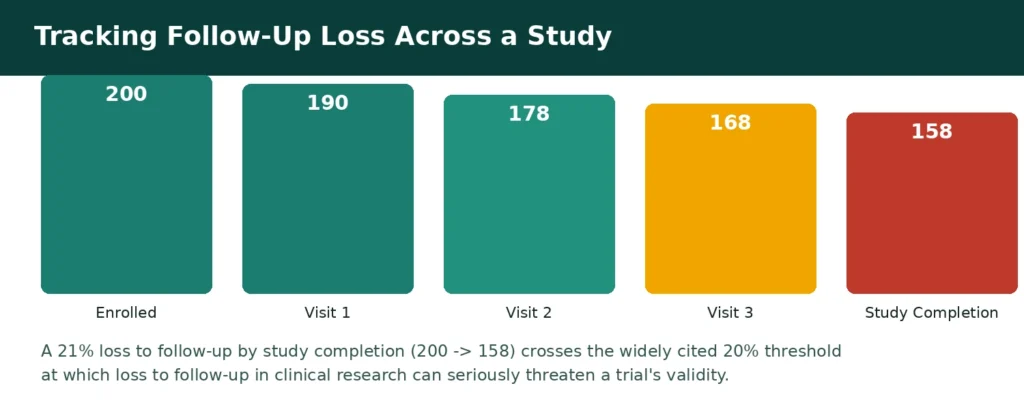
Follow-up loss, formally known as loss to follow-up (LTFU), refers to participants who stop attending scheduled study visits or become unreachable before the planned endpoint, without formally withdrawing from the study. Unlike participants who explicitly withdraw consent, those lost to follow-up may simply disappear from the dataset, with limited information available about the reasons.
The main concern with LTFU is its potential effect on the validity of the study, particularly when participants who leave differ systematically from those who remain. Commonly cited guidance suggests that LTFU below approximately 5% represents a low risk, 5–20% warrants investigation as a quality concern, and rates above 20% may pose a serious threat to internal validity. These values are practical benchmarks rather than strict thresholds, helping research teams identify when follow-up loss requires active
Common Causes of Follow-Up Loss
- Relocation or travel difficulty that makes attending scheduled visits impractical.
- Burden of the visit schedule itself, especially in trials with frequent or lengthy assessments.
- Adverse events or perceived lack of benefit that reduce a participant’s motivation to continue.
- Simple loss of contact, when phone numbers or addresses change without notice.
- Death or serious illness unrelated to the study, particularly in long-term or elderly cohorts.
Implement Digital Data Collection Tools
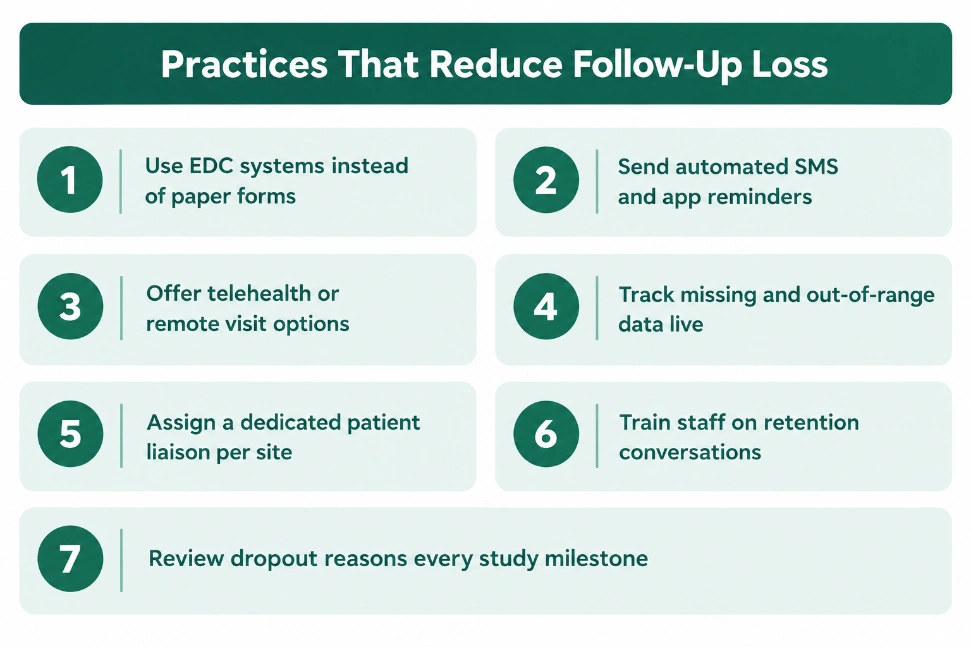
One of the most effective ways to streamline follow-up visit data collection is by adopting digital data collection in research. Electronic Data Capture (EDC) systems let researchers collect, store and analyse patient information in real time, replacing paper-based forms with automated entry and validation.
- Reduced manual errors through built-in validation rules.
- Faster access to patient records across the study team.
- Automated compliance tracking against the visit schedule.
- Improved reporting for sponsors and monitors.
- Easier collaboration across multiple study sites.
Standardize Follow-Up Visit Protocols
Standardisation is essential for follow-up visit management. When clinical teams follow consistent procedures, data collection becomes faster and more reliable, and every patient visit captures the same critical information regardless of which site or which coordinator runs it.
Create Structured Visit Templates
Digital templates for each follow-up stage ensure no required question or assessment is skipped.
Use Automated Checklists
Automated reminders guide staff through the required steps during each visit, rather than relying on memory or a printed protocol summary.
Maintain Consistent Data Fields
Uniform data fields across sites simplify analysis later and materially improve clinical studies data collection efficiency.
Leverage Automated Patient Reminders
Participant retention is essential for reliable follow-up visit data collection, and missed appointments are one of the most direct routes into follow-up loss. Automated reminder systems
Train Research Staff Effectively
Technology alone cannot streamline follow-up visit data collection if staff are not properly trained. Clinical teams need regular training on data entry best practices, compliance requirements, digital platform usage, patient communication strategies, and error detection procedures. Ongoing refresher sessions keep teams current as protocols evolve and regulatory expectations shift.
| Area | Approach / Method | Key Benefits |
| Remote Follow-Up Data Collection | Secure patient portals for self-reported outcomes | Enables participants to provide health updates remotely |
| Telehealth consultations instead of routine in-person visits | Reduces travel and visit-related burden | |
| Wearable health monitoring devices | Enables continuous data collection between visits | |
| Online survey tools | Supports structured patient-reported outcome measures | |
| Real-Time Data Quality Monitoring | EDC dashboards for missing fields, duplicate entries, out-of-range values and delayed submissions | Identifies data issues early and improves clinical trial data accuracy |
| Team Communication | Centralised collaboration platforms with shared calendars, protocol updates, secure messaging and unified patient tracking | Improves coordination and speeds up follow-up management |
| Overall Approach | Combine technology, standardisation, staff training and participant-focused communication | Helps streamline data collection and reduce loss to follow-up |
Reducing Follow-Up Loss With Better Study Systems
Managing follow-up in clinical trials well is as much an operational challenge as a scientific one. Simbi Labs works with clinical research teams to design follow-up visit protocols, set up digital data collection systems, and put retention monitoring in place that keeps studies within safe follow-up loss margins from enrolment through to close-out.
Need Reliable Follow-Up Visit Data Collection for Clinical Studies?
Accurate and timely follow-up data is essential for tracking patient outcomes, maintaining study quality, and supporting reliable clinical research results. Simbi Labs provides professional clinical data collection and research support to help manage follow-up visits, patient records, data quality, and study requirements efficiently.
Get expert support for your clinical study today. Request a free consultation with Simbi Labs.
Book a free consultation for appointment
Call Now : +91 99505 66669
Email : grow@simbi.in
FAQs
Why is follow-up in clinical trials so important?
Follow-up visits are usually the only source of long-term safety and effectiveness data, and poor follow-up management directly threatens data completeness, participant retention and regulatory compliance.
What is follow-up loss in clinical research?
It refers to participants who stop attending scheduled visits or become uncontactable before the study’s endpoint without a formal withdrawal being recorded, which risks biasing the trial’s results if the dropouts are not random.
What loss to follow-up rate is considered acceptable?
Widely cited guidance treats rates under roughly 5% as low risk, 5% to 20% as warranting closer review, and rates above 20% as a serious threat to a study’s validity, though the right threshold depends on the specific trial design.
How can clinical follow up studies reduce dropout?
Automated reminders, remote or telehealth visit options, dedicated patient liaisons, and regular review of dropout reasons all reduce the burden that typically drives participants away from a study.
What tools help streamline follow-up visit data collection?
Electronic Data Capture systems, automated reminder platforms, telehealth tools and real-time data quality dashboards together cover most of what modern follow-up visit management requires.