
Hire Dedicated Clinical Research Coordinators (CRC) for Your Study

In the era of clinical research, operational efficiency has become a critical component of the success of clinical studies, affecting study quality, participant safety, and regulatory compliance. Operational needs are growing at research sites as sponsors and Contract Research Organizations (CROs) continue to leverage decentralized, adaptive and multi-center clinical trials. Recruitment, informed consent, protocol adherence, regulatory documents and reporting adverse events and ensuring data quality are all complex operations to manage simultaneously.
As a result, many institutions are opting to employ a Dedicated Clinical Research Coordinator (DRCC) in addition to a shared site resource. Dedicated Clinical Research Coordinators (CRCs) work as an embedded clinical research specialist and stay on board with a study from start to finish. They promote effective communication, promote protocol adherence, streamline participant management and allow Principal Investigators (PIs) to focus more on patient care and scientific oversight.
As opposed to general staffing which allocates coordinators to several projects, the dedicated CRCs will ensure continuity and accountability for each milestone of the operation. Dedicated coordination has gone from being a supplement to a strategic investment as modern clinical trials are increasingly data driven and spread around the world.
Why Sponsors Are Investing in Dedicated CRC Resources
Designing a clinical trial is only part of the equation – there are many other operational variables that impact clinical trial execution. Continuous attention is needed for recruitment targets, participant retention, protocol amendments, monitoring schedules and regulatory documentation. Delays and inconsistencies can occur when the administrative workload is split between several studies at the same time, resulting in administrative issues taking precedence over clinical work.
Organizations that Hire Dedicated Clinical Research Coordinators gain access to professionals whose sole responsibility is to manage the operational requirements of a defined clinical study. They are consistently present to improve the continuity of the work, communication among stakeholders, and the continuity of the study activities with the expectations of the study protocol.
Dedicated CRCs typically contribute to:
- Coordinating participant recruitment and follow-up
- Managing informed consent documentation
- Scheduling protocol-defined study visits
- Maintaining regulatory and source documentation
- Supporting monitoring visits and sponsor communication
- Facilitating timely safety event reporting
- Resolving operational issues before they affect study timelines
- Improving participant retention through consistent engagement
Rather than responding to operational challenges after they occur, dedicated coordinators establish structured workflows that proactively reduce study risks.
Aligning CRC Expertise with Study Complexity
The decision to Hire Dedicated Clinical Research Coordinators should reflect the operational complexity of the clinical trial. Oncology, rare disease, biologics, vaccines, and medical device studies may need oncology coordinators who are knowledgeable in the therapeutic-specific procedures, scheduling, and all the regulatory documentation involved.
Likewise, there’s a need for CRCs adept at telemedicine platforms, electronic informed consent, patient monitoring in the home, wearable technology, and participant engagement via digital methods in decentralized clinical trials.
By choosing professionals who have relevant therapeutic experience and expertise, onboarding can be streamlined and operations become consistent across the study lifecycle.
Clinical Studies That Benefit Most from Dedicated CRC Support
| Study Type | Why Dedicated CRCs Add Value |
| High-enrolling studies | Continuous participant screening and scheduling |
| Oncology trials | Complex protocol coordination and safety monitoring |
| Multi-center trials | Standardized operational practices across sites |
| Long-term studies | Consistent participant engagement and documentation |
| Decentralized trials | Management of virtual visits and digital technologies |
| Medical device studies | Device accountability and protocol adherence |
Sponsors that match CRC expertise with study requirements often experience faster recruitment, improved compliance, and fewer protocol deviations.
Building an Embedded CRC Operating Model
Dedicated Clinical Research Coordinators create the greatest value when they function as an integrated part of the sponsor’s clinical operations rather than as temporary administrative resources. Developing effective integration starts as the study is being set up, when the CRCs are trained in the protocol, operational planning is reviewed, study objectives for recruitment are discussed, and communications are started with investigators and the sponsor teams.
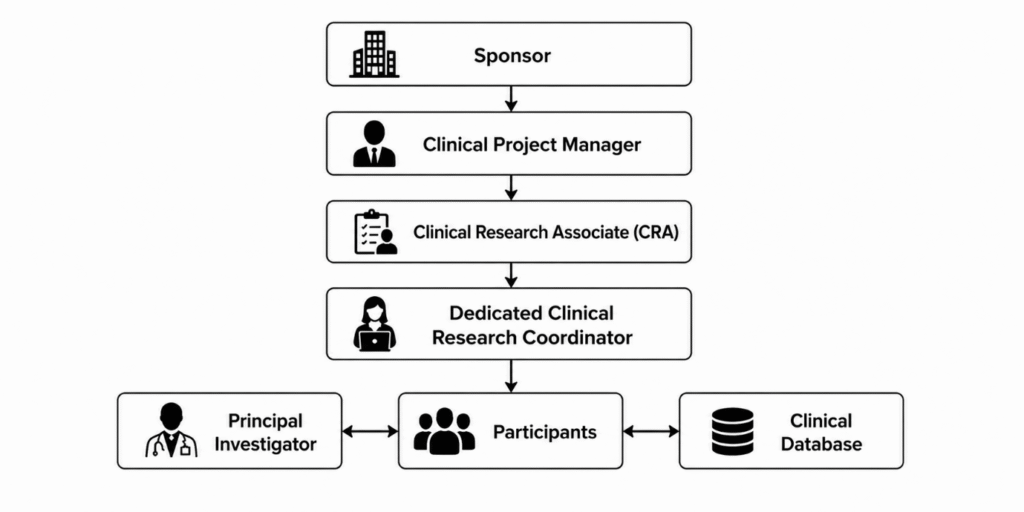
Embedded within the study, CRCs organize activities between Principal Investigators, Clinical Research Associates (CRAs), laboratories, pharmacies, ethics committees, imaging centres and participants. By being engaged in their process, it facilitates easier flow of information, and it guarantees that all operational activities are recorded properly and that they proceed according to the correct timelines.
A transparent operating model is also provided by an embedded CRC. Sponsors get effective operational updates, investigators have fewer administrative tasks and participants have more uniform communication during the trial.

Dedicated CRCs Drive Operational Consistency Across Every Milestone
One of the biggest benefits of having specific CRCs is their consistency in operation. Numerous time sensitive activities that need to be performed in a precise and uniform manner across all clinical trial sites are involved in clinical trials. A dedicated coordinator is assigned as the central point of operation that ensures that each milestone is fulfilled without unnecessary delays.
Dedicated CRCs ensure continuity from recruitment onwards including monitoring recruitment progress, coordinating study visits, reconciling source documents, preparing monitoring visits, undertaking protocol amendments and supporting data quality initiatives. This uniform supervision helps minimize the variability in running the study and allows sponsors to ensure consistent running of the study in different research settings.
Dedicated CRCs also strengthen collaboration by:
- Acting as the primary operational liaison between sponsors and research sites
- Coordinating communication with CRAs and Principal Investigators
- Tracking recruitment and retention metrics
- Managing protocol amendments efficiently
- Supporting inspection readiness through continuous documentation review
- Facilitating timely issue escalation and resolution
As studies increase in complexity, this structured operational oversight becomes essential for maintaining study quality and regulatory compliance.
Selecting the Right Dedicated Clinical Research Coordinator Profile
Choosing to Hire Dedicated Clinical Research Coordinators is only the first step; selecting professionals with the right competencies is equally important. Each clinical trial presents distinctive operational challenges depending on the therapeutic area, complexity of the protocol, the number of participants, the length of the study, and the expectations of the regulators. Whenever coordinators are assigned with the right skills, the process of onboard and the implementation of the study goes well.
The sponsor should assess CRCs for their years of experience. Knowing about the technologies, regulatory documentation, patient interactions, and cross-functional collaboration involved in clinical trials can be more important in the performance of the study than the experience of doing it. The dedicated CRCs should be able to collaborate closely with Principal Investigators, Clinical Research Associates (CRAs), ethics committees, laboratories and sponsors and should be able to provide operational accuracy throughout the study lifecycle.
When organizations hire dedicated CRCs, they should prioritize professionals with:
- Strong knowledge of ICH-GCP guidelines and regulatory requirements
- Experience in the relevant therapeutic area
- Proficiency in Electronic Data Capture (EDC) systems
- Hands-on experience with CTMS and eTMF platforms
- Excellent participant communication and coordination skills
- Ability to manage protocol amendments and documentation updates
- Strong organizational and problem-solving capabilities
- Experience supporting monitoring visits and regulatory inspections
Selecting the right coordinator profile improves operational consistency while reducing risks associated with protocol deviations and documentation errors.
Core Competencies of Dedicated Clinical Research Coordinators
| Competency | Operational Contribution |
| ICH-GCP & Regulatory Knowledge | Ensures protocol compliance and inspection readiness |
| Therapeutic Area Expertise | Reduces onboarding time and improves study execution |
| EDC & Clinical Systems | Supports accurate and timely clinical data management |
| CTMS & eTMF Management | Streamlines study tracking and document control |
| Patient Communication | Enhances recruitment, retention, and participant satisfaction |
| Monitoring Visit Support | Facilitates efficient CRA visits and issue resolution |
| Documentation Accuracy | Maintains audit-ready regulatory records |
| Cross-Functional Coordination | Improves communication across all study stakeholders |
Dedicated CRCs as a Strategic Extension of Sponsor Operations
Modern clinical trials require continuous coordination between sponsors, CROs, investigators, vendors, laboratories, pharmacies, and participants. Dedicated CRCs function as the operational bridge connecting these stakeholders, ensuring that study activities progress according to predefined timelines while maintaining complete documentation and regulatory compliance.
Instead of responding to operational issues after they occur, dedicated CRCs proactively monitor recruitment progress, identify scheduling conflicts, track protocol amendments, and coordinate corrective actions before delays affect study milestones. Their continuous oversight provides sponsors with greater operational visibility while reducing administrative workload at research sites.
Dedicated CRCs support sponsor operations by:
- Providing regular recruitment and enrollment updates
- Coordinating communication between investigators and CRAs
- Tracking protocol amendments and implementation timelines
- Maintaining accurate regulatory documentation
- Supporting database cleaning through timely query resolution
- Preparing sites for monitoring visits and regulatory inspections
- Ensuring operational consistency across participating sites
This integrated approach improves study quality while enabling sponsors to make informed operational decisions throughout the clinical trial.
Dedicated CRC Integration Framework
About Simbi Labs India
The success of clinical trials relies on the expertise of professionals who can easily fit into research projects while ensuring that the processes are run smoothly and in compliance with regulatory standards. Simbi Labs India works with the pharmaceutical companies, biotechnology companies, Contract Research Organizations (CROs), hospitals, and research institutes by providing them with specialized clinical research staffing and operational support solutions. Its clinical trial coordination and management expertise, combined with its experience in participant engagement, regulatory documentation, project management, and execution, enables it to partner with research team members to enhance study performance and efficiency in various therapeutic areas. Simbi Labs India partners with experienced professionals, standardised processes and technology-driven workflows, to enable efficiency, quality and compliance in execution of clinical studies.
Conclusion
Dedicated Clinical Research Coordinators have evolved from a functional role to a strategic function in today’s complex clinical trial landscape. Organizations that Hire Dedicated Clinical Research Coordinators benefit from improved workflow continuity, stronger regulatory compliance, better participant management, and enhanced collaboration across every stage of the clinical trial lifecycle. Operational inefficiencies and increased risks of protocol deviations and missing documentation and communication delays can be overcome by having experienced CRC professionals embedded in the study teams, while sponsors and research sites can increase efficiency. Having dedicated CRC expertise ultimately means faster, better, and inspection ready clinical trial execution.
Looking to Hire Dedicated Clinical Research Coordinators for Your Next Study?
Whether you’re initiating a new clinical trial, expanding into multiple research sites, or strengthening existing study operations, experienced Clinical Research Coordinators can make a measurable difference in operational performance and study quality. Simbi Labs India provides dedicated CRC professionals who integrate seamlessly with sponsor and site teams, delivering reliable clinical trial coordination, regulatory support, and participant-focused operational excellence. Connect with our team to explore flexible clinical research staffing solutions tailored to your research goals.
Book a free consultation for appointment
Email us at : grow@simbi.in
Frequently Asked Questions
1. Why should organizations hire dedicated Clinical Research Coordinators?
Dedicated CRCs provide focused operational support, improve protocol compliance, reduce administrative burden on investigators, and ensure consistent study execution from start-up to close-out.
2. Which types of clinical trials benefit most from dedicated CRCs?
High-enrollment studies, oncology trials, medical device research, decentralized clinical trials, vaccine studies, and multi-center global trials benefit significantly from dedicated CRC support.
3. What qualifications should a dedicated Clinical Research Coordinator possess?
Sponsors should prioritize candidates with ICH-GCP knowledge, therapeutic area expertise, experience using EDC, CTMS, and eTMF systems, strong communication skills, and regulatory documentation experience.
4. Can dedicated CRCs support decentralized clinical trials?
Yes. Dedicated CRCs routinely coordinate telemedicine visits, electronic informed consent (eConsent), remote patient monitoring, wearable device integration, and electronic patient-reported outcomes (ePRO).
5. How do dedicated CRCs improve participant retention?
Dedicated coordinators maintain regular communication, schedule participant visits efficiently, address concerns promptly, and ensure participants remain engaged throughout the clinical trial.
6. How quickly can dedicated Clinical Research Coordinators be deployed?
Deployment timelines vary depending on therapeutic area, study location, and project requirements. Experienced clinical research staffing providers can rapidly identify and deploy qualified CRC professionals to support study start-up and ongoing operations.