
Patient Data Collection: Methods and Best Practices

Patient data is the foundation of many hospital-based studies. Collecting information is only one part of the research process. Patient data collection must be planned so that the information is relevant, consistently recorded, ethically obtained, appropriately protected, and suitable for analysis.
For researchers and healthcare institutions, effective data collection in healthcare therefore requires a combination of research planning, standardised procedures, trained personnel, suitable technology, and continuous quality control.
Begin With a Clear Research Question
The quality of medical data collection depends largely on what the study is designed to investigate.
Before collecting information, researchers should establish the research question, define the study population, identify the variables required, and determine how those variables will be analysed.
For example, a hospital studying factors associated with prolonged patient stays may need information on age, diagnosis, treatment characteristics, comorbidities, admission details, and length of stay. Collecting unrelated information would increase workload without necessarily improving the study.
A useful principle is:
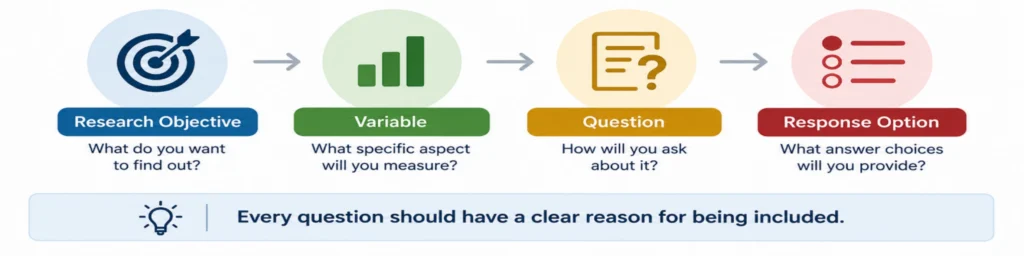
This keeps collecting patient data in hospital focused and reduces unnecessary data collection.
Choose the Appropriate Data Collection Method
There is no single method suitable for every healthcare study. The choice depends on the research objective, study design, available resources, and type of information required.
| Method | Typical Data | Potential Application |
| Medical record review | Diagnoses, treatments, laboratory results | Retrospective hospital studies |
| Electronic health records | Clinical and administrative information | Longitudinal research |
| Patient questionnaires | Experiences, perceptions, symptoms | Patient-reported outcomes |
| Interviews | Detailed experiences and perspectives | Qualitative studies |
| Clinical examination | Physical or clinical measurements | Prospective clinical research |
| Laboratory investigations | Biochemical or physiological measurements | Clinical and epidemiological studies |
| Observation | Behaviour or care processes | Healthcare service research |
The strongest approach may sometimes involve more than one method. For example, clinical records can provide objective medical information while questionnaires capture the patient’s perspective.
Standardise the Collection Process
Two researchers should ideally record the same type of information in the same way. This is why standardisation is central to healthcare data collection methods. A study protocol should specify definitions, units of measurement, coding procedures, collection time points, and acceptable data formats.
Consider blood pressure. If one data collector records the first reading and another records an average of multiple readings, the resulting dataset may not be fully comparable. Similarly, terms such as “current smoker,” “former smoker,” or “hypertension” should have clearly defined criteria within the study.
Use Digital Systems Carefully
Electronic health records and digital research platforms can make patient data collection faster and more structured. Researchers may also use electronic case report forms, mobile data collection systems, clinical databases, and automated validation features.
A digital form can, for example, flag an impossible value, identify a required field that has been left blank, or prevent inconsistent date formats.
However, technology does not automatically guarantee high-quality data. A poorly designed digital form can still collect poorly defined variables. Digital systems should therefore support a sound data-collection protocol rather than replace one.
Protect Patient Privacy from the Start
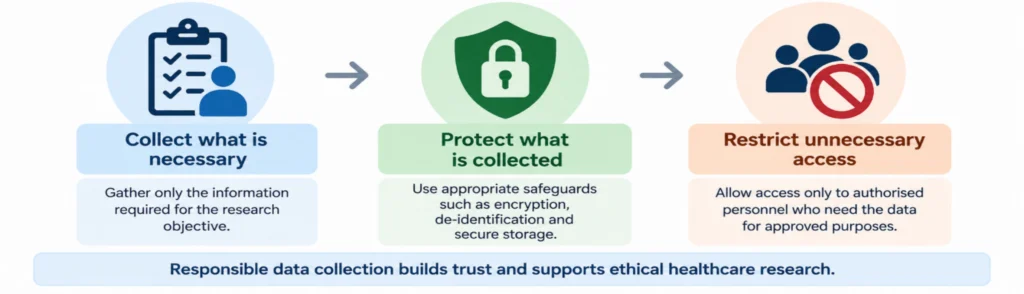
Healthcare research involves information that can be highly sensitive. Privacy should therefore be considered during study design, not added as an afterthought.
Researchers should determine what identifying information is genuinely necessary and apply appropriate safeguards to information that is collected. Depending on the study and jurisdiction, these may include controlled access, secure storage, encryption, de-identification or pseudonymisation, and documented data-handling procedures.
The applicable ethical and legal requirements should always be determined according to the country, institution, study type, and data involved.
A useful principle is:
Train the People Collecting the Data
Even a carefully designed protocol can produce inconsistent results if data collectors interpret it differently. Training should therefore cover the study protocol, variable definitions, interview or measurement procedures, data-entry rules, handling of unusual cases, and procedures for correcting errors.
For example, if several researchers are collecting patient-reported information, they should understand the same instructions and use the same approach when presenting questions to participants.
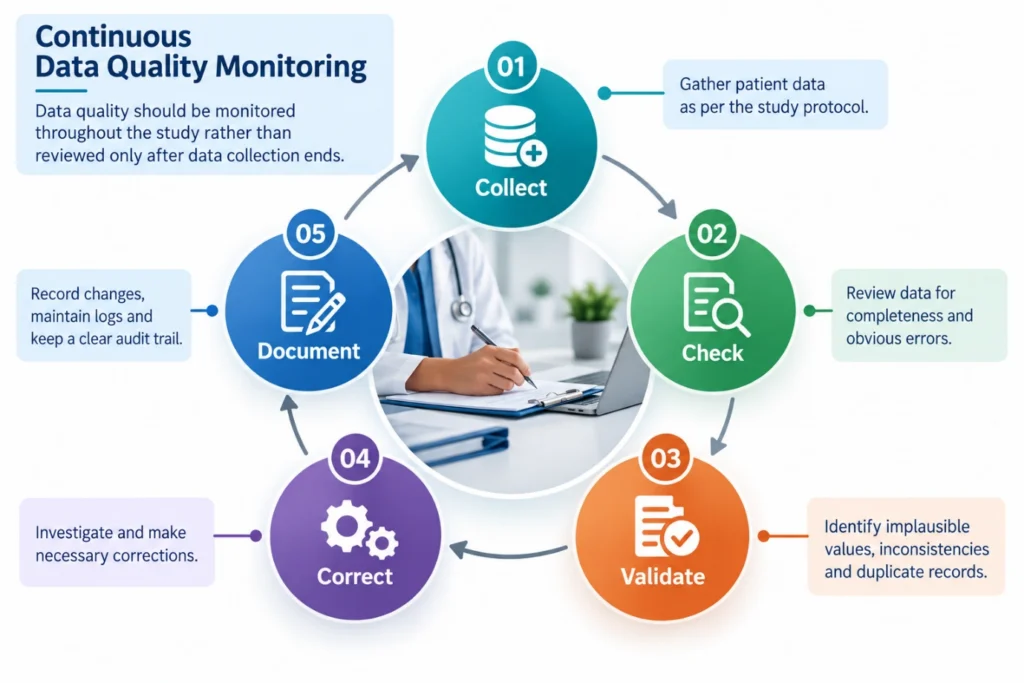
Build Quality Checks Into the Workflow
Data quality should be monitored throughout the study rather than reviewed only after data collection ends.
Combine Clinical and Patient-Reported Information When Appropriate
Healthcare research increasingly recognises that clinical measurements alone may not capture the complete patient experience. For some studies, information from medical records can be complemented by patient-reported outcomes, satisfaction measures, symptom assessments, or quality-of-life questionnaires.
For example:
Clinical data: Treatment received, laboratory results, length of stay
Patient-reported data: Pain, perceived recovery, treatment experience
Maintain a Clear Data Management System
Collecting data is followed by another important responsibility: keeping it organised and usable.A healthcare research database should have clearly defined variables, consistent coding, version control, appropriate access arrangements, and documented changes.
Researchers should also maintain information about where the data came from, when it was collected, and how variables were defined. This documentation becomes particularly important when datasets are reviewed, analysed again, or used in subsequent research. Good data collection in healthcare therefore extends beyond the initial collection period.
Conduct Quality Audits During the Study
Periodic audits can identify problems before they affect a large proportion of the dataset. For instance, an audit may reveal that one department is using an outdated form, that a variable is being interpreted differently, or that a substantial number of records are missing a required field.
Early identification allows researchers to correct the process while data collection is still underway. This is considerably more useful than discovering the same problem after the study has been completed.
A Practical Hospital Data Collection Workflow
A well-planned study can follow a straightforward sequence:
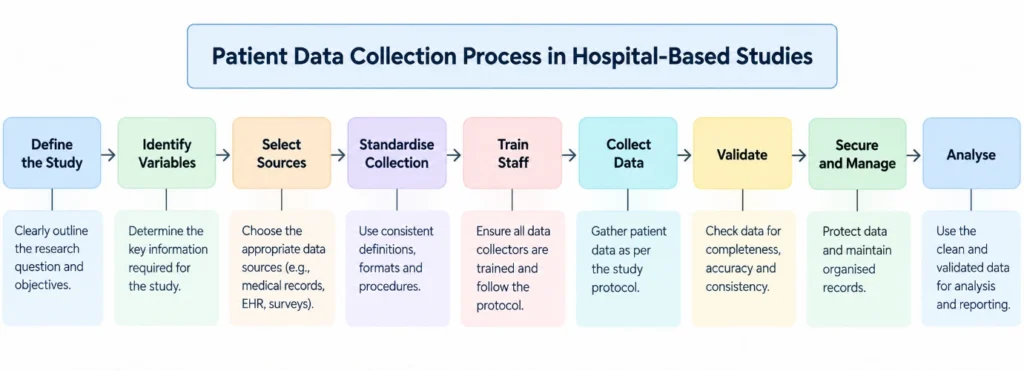
The exact workflow will differ between retrospective studies, prospective clinical studies, observational research, surveys, and mixed-methods projects. The underlying principle remains the same: data collection should be designed around the research question and anticipated analysis.
Conclusion
High-quality patient data collection is not simply a matter of recording more information. It is a structured research process in which every stage—from defining variables to protecting records and checking data quality—contributes to the reliability of the final findings.
Effective healthcare data collection methods combine clear objectives, standardised procedures, appropriate data sources, trained personnel, secure technology, and continuous quality control.
For hospitals and researchers, the goal should be straightforward: collect relevant information consistently, protect it responsibly, and preserve its quality throughout the research process. When these principles are incorporated into collecting patient data in hospital, the resulting dataset becomes more useful for statistical analysis, scientific interpretation, and evidence-based healthcare research.
Get in touch with our experts today.
Book a free consultation for appointment
Email us at :grow@simbi.in
Frequently Asked Questions
1. What is patient data collection?
Patient data collection is the systematic process of obtaining information about patients for clinical care, healthcare research, monitoring, or other approved purposes. Depending on the study, this may include demographic, clinical, laboratory, treatment, behavioural, or patient-reported information.
2.What are the main healthcare data collection methods?
Common healthcare data collection methods include medical record reviews, electronic health records, questionnaires, interviews, clinical examinations, laboratory investigations, and structured observations. The appropriate method depends on the research question and study design.
3.How can hospitals improve the quality of patient data?
Hospitals can improve data quality by defining variables clearly, standardising collection procedures, training research staff, using appropriate validation checks, conducting periodic audits, and documenting data-handling procedures. Quality control should continue throughout the study rather than being performed only at the end.
4.How should patient information be protected during research?
Researchers should collect only information necessary for the approved purpose and apply appropriate safeguards to protect it. Depending on the study and applicable regulations, safeguards may include access controls, secure storage, encryption, and de-identification or pseudonymisation.
5.Why is standardisation important when collecting patient data?
Standardisation ensures that information is collected and recorded consistently across researchers, departments, and time periods. Without common definitions and procedures, differences in data recording can introduce inconsistencies that affect the reliability and comparability of research findings.