
Data Accuracy in Healthcare: Importance and Solutions
A clinical trial can run for two years, enroll hundreds of patients and still fail at the audit stage because a handful of fields were entered wrong. That is the blunt reality behind data accuracy in healthcare: it is rarely the big dramatic error that causes damage, it is the small, repeated, unnoticed one. A mistyped dosage, a duplicate patient ID, a consent form dated after the procedure it covers. Each one looks minor until a regulator; a co-investigator or a patient’s safety depends on it.
This piece breaks down what data accuracy in healthcare actually means on the ground, why it carries so much weight, where it typically breaks down, and the data accuracy solutions that research teams and hospitals in India are putting to use right now.
Defining Accurate Data in a Healthcare Study
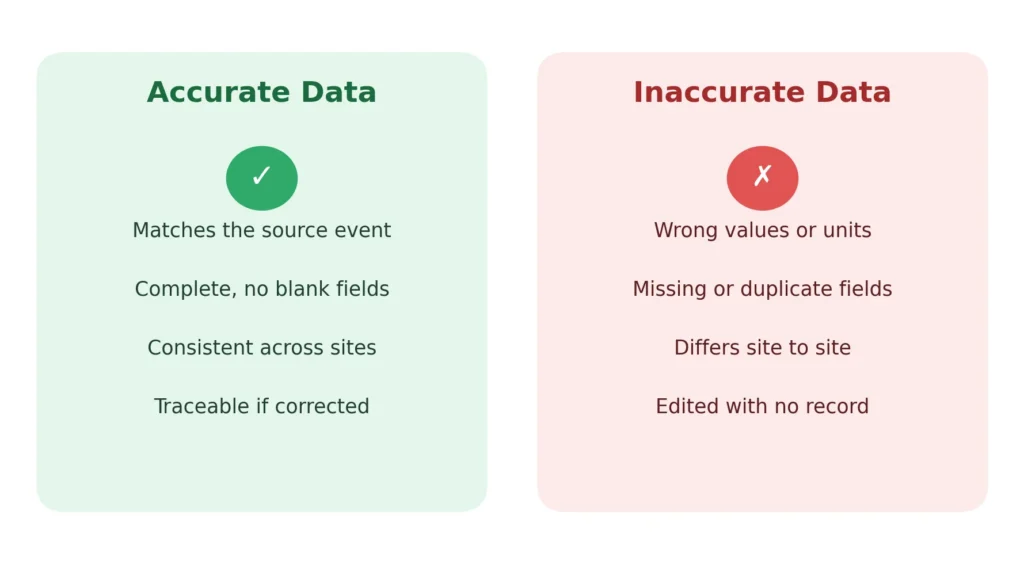
So, what is data accuracy in healthcare in practical terms? It means every recorded value, a lab result, a dosage, a vital sign, a consent timestamp, genuinely matches what happened to the patient or participant. Not approximately. Not close enough. The number in the system has to be the number from the source event, free of transcription slips, unit mismatches or duplicate entries.
This is different from data completeness or data security, though the three overlap. A field can be filled in, encrypted and backed up, and still be wrong. Accuracy is specifically about correctness against the real-world event, which is why it needs its own checks rather than being assumed alongside other quality measures.
READ MORE: Why Accurate Medical Data Entry Is Critical for Research
The Real Cost of Inaccurate Healthcare Data
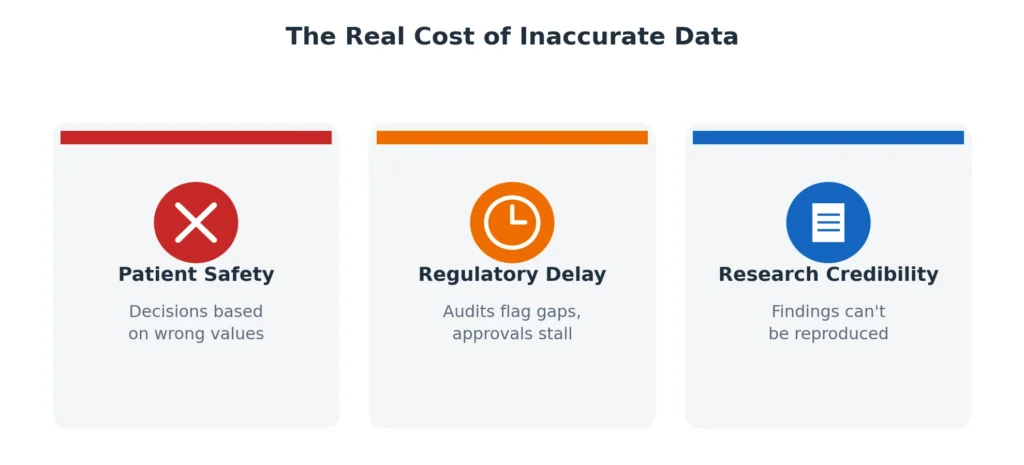
Why is data accuracy important in healthcare? Because the downstream cost of getting it wrong is rarely limited to a spreadsheet correction. Flawed data can shift a trial’s safety signal, delay a drug approval by months, or trigger a full re-audit of a site’s records. In a hospital setting, it can mean a clinician acting on a lab value that was never actually recorded correctly.
Three consequences tend to show up repeatedly in healthcare research: patient safety gets compromised when decisions rely on wrong figures, regulatory submissions get rejected or delayed when auditors find unexplained discrepancies, and research credibility takes a hit when published findings can’t be reproduced because the underlying data was never solid to begin with. None of these are abstract risks.
Where Healthcare Data Quality Breaks Down
Most accuracy problems in healthcare research trace back to a small set of recurring failure points, not exotic one-off mistakes.
- Manual transcription: values copied from paper charts or legacy systems into a digital form, with no automatic check against the source.
- Duplicate patient records: the same participant entered twice under slightly different spellings or ID formats, especially across multiple sites.
- Unit and range mismatches: a weight entered in pounds where the system expects kilograms, or an age of 250 slipping through an unvalidated field.
- Inconsistent coding across sites: two investigators classifying the same adverse event under different terms because the coding dictionary wasn’t enforced consistently.
- Undocumented corrections: a value gets changed after the fact with no record of who changed it, when, or why, which turns a simple fix into an audit flag.
READ MORE: How On-Site Healthcare Data Collection Works in Practice
Data Accuracy Solutions for Healthcare Research Teams
Fixing these issues consistently comes down to a short list of practical measures, applied the same way every time rather than left to individual judgment.
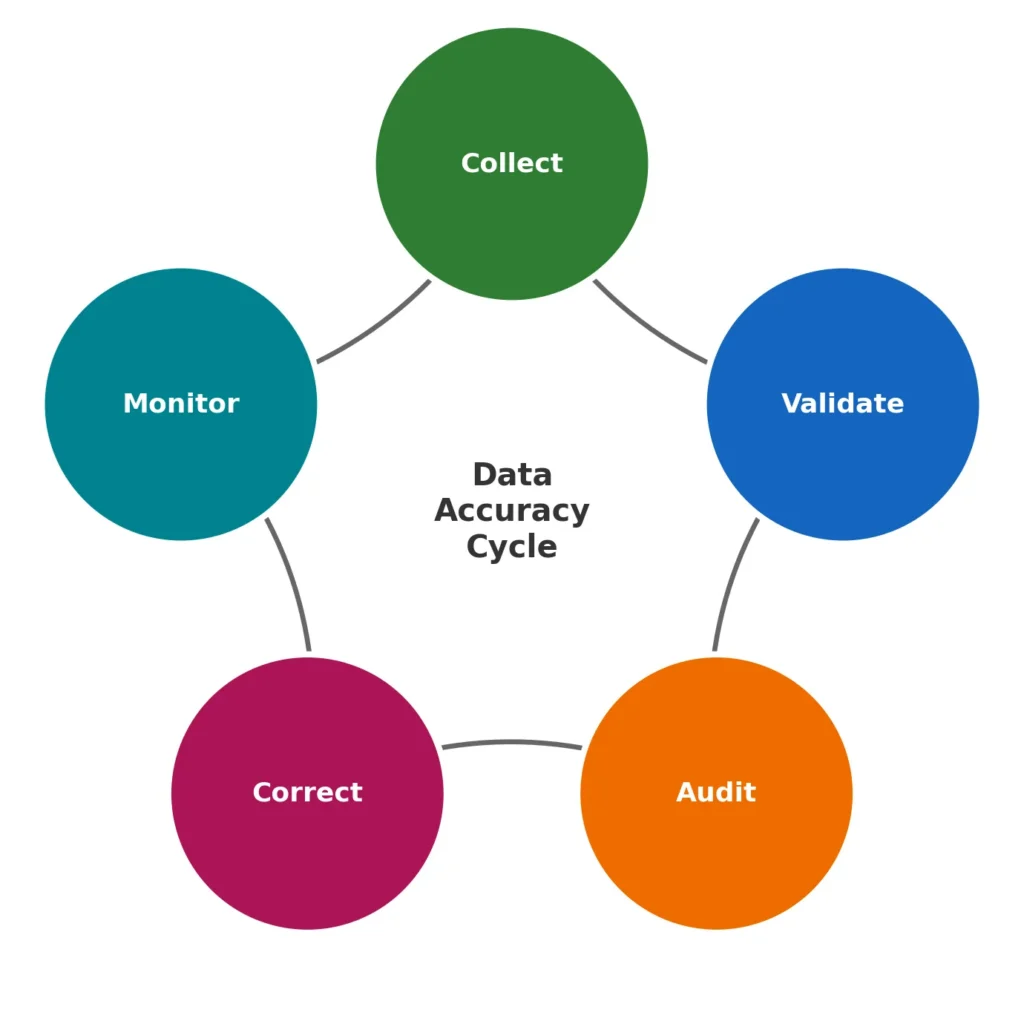
- Standardise collection protocols: use fixed forms and templates that define exactly what gets recorded, in what format, by whom, so entries don’t vary from one researcher to the next.
- Deploy electronic data capture with built-in validation: range checks, mandatory fields and duplicate alerts catch errors the moment they’re entered, not weeks later.
- Run audits on a schedule, not just at the end: periodic checks during the study catch problems while they’re still cheap to fix.
- Keep training current: refresh staff on entry standards and any new system every time a protocol or platform changes, not just at onboarding.
- Lock down storage with role-based access: limit who can edit which fields, and keep a version history so every change is traceable.
- Document every correction: log what changed, who changed it, and why, so the audit trail tells a complete story rather than leaving gaps.
Where Technology Actually Helps
Software won’t fix a bad protocol, but it does remove a large share of human error once the protocol is sound. Automated range checks catch an implausible lab value before it ever reaches the database. Duplicate-detection algorithms flag a patient who’s been registered twice under a slightly different name. Interoperability standards like HL7 and FHIR cut down the mismatches that happen when data moves between a hospital’s electronic health record and a separate research database. None of this replaces human review, but it narrows down what a reviewer actually needs to look at, instead of forcing a manual check of every single field.
Common Data Errors and the Fix That Works
The table below lines up the errors research teams run into most often against the data accuracy solution that actually addresses each one.
| Error Type | Why It Happens | Data Accuracy Solution |
| Duplicate patient records | Same participant registered under slightly different IDs or spellings | Automated duplicate-detection checks at entry |
| Missing or blank fields | Forms submitted without mandatory values completed | Mandatory-field validation before submission is accepted |
| Range or unit errors | Values entered in the wrong unit or outside plausible limits | Automated range checks tied to the expected unit |
| Inconsistent coding | Different sites classify the same event under different terms | A shared coding dictionary enforced across all sites |
| Undocumented corrections | A value is edited after entry with no record of the change | Mandatory change logs with reviewer sign-off |
Build Accuracy Into the Study, Not Just the Audit
Data accuracy in healthcare research works best when it’s designed into the study from the first form, not bolted on before submission. Simbi Labs supports hospitals, CROs and research teams with clinical data collection services built around validated entry, scheduled audits and traceable correction logs, so the data holds up from the first patient enrolled to the final report.
Explore Clinical Research Data Collection Services
Book a free consultation for appointment
Call Now : +91 99505 66669
Email : grow@simbi.in
Frequently Asked Questions
1. What is data accuracy in healthcare?
It means every recorded data point, a lab value, a dosage, a consent date, correctly reflects what actually happened to the patient or participant, with no transcription errors, duplicates or unit mismatches.
2. Why is data accuracy important in healthcare?
Because clinical decisions, regulatory approvals and published research findings are all built on it. Inaccurate data can compromise patient safety, delay approvals and undermine the credibility of a study’s conclusions.
3. What are the most effective data accuracy solutions for a clinical study?
Standardised collection protocols, electronic data capture with built-in validation, scheduled audits, ongoing staff training, access-controlled storage and a documented change log for every correction.
4. How often should healthcare research data be audited?
On a set schedule throughout the study rather than only at the end, so errors are caught and corrected while they’re still inexpensive to fix.
5. Can automated tools fully replace manual data accuracy checks?
No. Automated validation catches a large share of entry errors immediately, but human review is still needed for judgment calls, like whether an unusual but plausible value is genuinely correct.