
How to Reduce Downtime in Manufacturing: 7 Ways
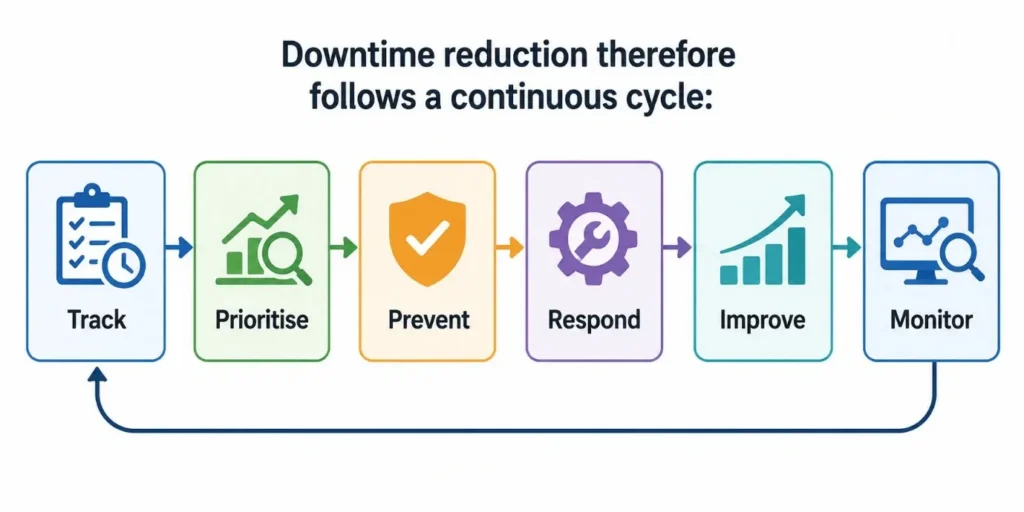
Different ways of reducing downtime in manufacturing are discussed in this article. This article will discuss 7 proven ways of reducing downtime in manufacturing.
Production downtime may impact production capacity, operating expenses, delivery timeliness, and customer satisfaction. Although some downtime is scheduled, if there is unexpected machine failure or production interruption, there will be losses in operation.
In this guide, we will discuss 7 practical methods to decrease manufacturing downtime, enhance equipment reliability, and decrease manufacturing interruptions.

What is Manufacturing Downtime?
Manufacturing downtime is the time a machine, production line or process is not able to produce as it should.
There are two general types of downtime:
Planned Downtime
Planned downtime is scheduled in advance for activities such as:
- Preventive maintenance
- Equipment inspection
- Cleaning
- Machine changeovers
- Upgrades
- Calibration
- Scheduled repairs
Production is temporarily suspended but planned downtime can help prevent more serious equipment failures.
Unplanned Downtime
Unplanned downtime is downtime that happens unexpectedly and can cause disruption of production without warning.
Common causes include:
- Machine breakdowns
- Electrical failures
- Mechanical wear
- Material shortages
- Utility interruptions
- Operator errors
- Quality problems
- Software or control-system failures
These are caused by software or control-system failures.
One of the most effective ways for manufacturers to increase production reliability is to minimize downtime.
Read Also : Transform Your Workplace with 5S: The Lean Secret to Efficiency and Growth
7 Ways to Reduce Downtime in Manufacturing
1. Measure and Track Every Downtime Event
You cannot effectively reduce downtime if you do not know where and why it occurs.
Start by recording every significant downtime event. Your downtime tracking system should capture:
- Machine or production line
- Start and end time
- Duration
- Cause of downtime
- Product being manufactured
- Shift or operator
- Error code or machine condition
- Corrective action taken
This information is used to help manufacturing teams identify reoccurring issues and decide which downtime events are the most critical to their operation.
Instead of asking “How much downtime did we have?”:
“Which machines are responsible for the most downtime, how frequently do failures occur, and what causes them?”
Accurate equipment and downtime data also aids in determining patterns and making better maintenance decisions.
2. Identify the Biggest Causes of Downtime
Not every downtime event deserves the same level of attention.
For instance, machine A could stop 20 times for 40 minutes a time, machine B could stop 10 times for 10 minutes each. This second problem results in over 13 hours of downtime.
Therefore, analyze downtime using:
Frequency x Duration x Production Impact
A Pareto analysis can be used to determine which machines, processes or failure causes are causing the most downtime.
For example:
| Downtime Cause | Frequency | Total Lost Time | Priority |
| Machine breakdown | High | High | Very High |
| Material shortage | Medium | High | High |
| Changeover delay | High | Medium | High |
| Quality issue | Medium | Medium | Medium |
| Minor stoppage | Very High | Low | Medium |
This helps to target the resources manufacturers need to improve where it can make the biggest difference.
3. Improve Preventive Maintenance
One of the most effective ways to minimize machine downtime is through preventive maintenance.
Rather than waiting for equipment to fail, manufacturers plan maintenance tasks ahead of the occurrence of serious problems.
Preventive maintenance can consist of:
- Equipment inspection
- Lubrication
- Cleaning
- Calibration
- Component replacement
- Belt and bearing inspection
- Electrical checks
- Filter replacement
- Safety inspections
The preventive maintenance schedule should be established according to equipment needs, operating conditions, manufacturer guidelines and failure history.
Preventive maintenance should not be the same maintenance action at the same time indefinitely, however. Actual equipment performance and failure history should be used to review maintenance schedules.
Read Also : When Just In Time Manufacturing Fails: Risks, Lessons, and Smarter Strategies
4. Use Predictive Maintenance to Detect Problems Early
Predictive maintenance is based on equipment condition data to detect indications of potential issues before they become a significant failure.
Depending on the equipment, manufacturers can measure:
- Vibration
- Temperature
- Pressure
- Electrical current
- Oil condition
- Acoustic signals
- Machine performance
- Alarm patterns
An example of this is when the vibration level of rotating equipment increases, it can mean that mechanical issues are starting to develop. Identifying the abnormal condition early will allow the maintenance team to inspect and correct the problem before an unexpected failure can occur.
Predictive maintenance is especially useful for critical equipment because if it fails unexpectedly then there are potentially production losses to overcome. The industry has recently emphasized condition monitoring and analytics as key components to minimize unexpected downtime.
5. Reduce Machine Recovery and Repair Time
It is impractical to prevent all the failures. Hence, it is also important for manufacturers to pay attention to how fast production can bounce back when downtime takes place.
A practical recovery process should include:
Detect → Diagnose → Repair → Test → Restart
In order to minimize recovery time:
- Establish typical troubleshooting protocols
- Train maintenance personnel
- Maintain critical spare parts
- Keep technical documentation accessible
- Have clear escalation procedures in place
- List past solutions that have not worked
- Ensure use of standardized restart procedures.
This is particularly important when the objective is to minimise machine downtime.
For instance, if the mean repair time for a machine is 2 hours, with technicians taking 30 minutes to diagnose the problem and 45 minutes to locate a spare part, improving the ability to diagnose the problem and have spare parts available can decrease repair times by a significant amount without replacing the machine being repaired.
6. Eliminate Recurring Problems with Root-Cause Analysis
Fixing a machine is not the same as taking away the cause of the failure.
Manufacturers should ask themselves if the same machine continues to stop due to the same issue:
Where is the failure going wrong?
Several techniques of the RCA may help here.
5 Whys
The 5 Whys technique involves asking the question “why” five times or more to gain clarity on the cause of the problem.
Fishbone Diagram
A Fishbone Diagram can list potential causes in categories, such as:
- People
- Machines
- Methods
- Materials
- Measurement
- Environment
FMEA
Failure Mode and Effects Analysis can be used to help a team uncover potential failure modes, assess the risk of those modes, and determine what to do to improve.
Root Cause Analysis transforms “emergencies” into “process improvements.”
7. Monitor MTBF, MTTR and OEE
Manufacturers need to determine the outcome of their efforts to reduce downtime.
There are 3 important metrics:
MTBF — Mean Time Between Failures
MTBF helps indicate equipment reliability.
MTBF = Operating Time ÷ Number of Failures
Typically, the higher the MTBF, the longer an item of equipment is expected to run between failures.
MTTR — Mean Time to Repair
MTTR measures the average time required to restore equipment after a failure.
MTTR = Total Repair Time ÷ Number of Repairs
A lower MTTR generally indicates faster recovery.
OEE — Overall Equipment Effectiveness
OEE combines three major dimensions:
OEE = Availability × Performance × Quality
By examining the OEE, a manufacturer can gain insight into production time’s effectiveness and plan accordingly. It should be considered as a diagnostic tool and not as a number to improve without knowing what’s behind the losses.
How to Reduce Unplanned Downtime in Manufacturing
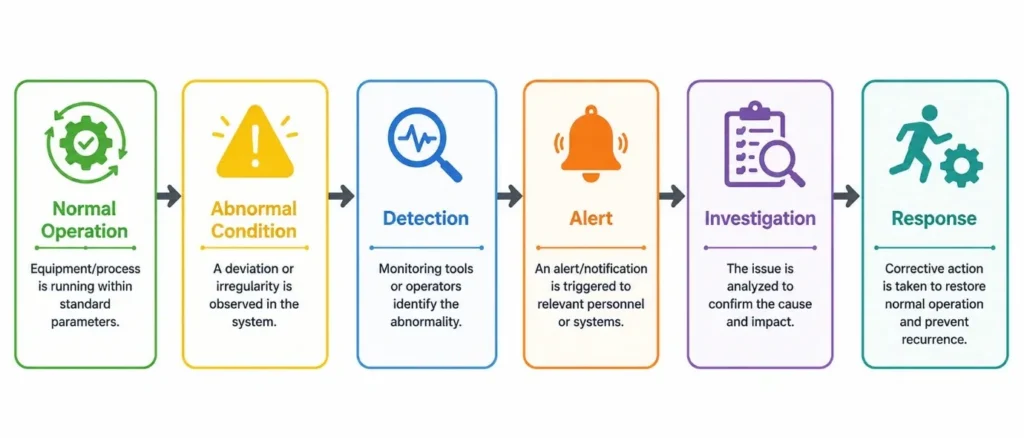
If downtime is your main worry, take a systematic approach:
- Track every unexpected stoppage.
- Categorize failures by cause.
- Identify recurring problems.
- Prioritize high-impact equipment.
- Strengthen preventive maintenance.
- Introduce predictive monitoring where appropriate.
- Improve spare-parts availability.
- Standardize troubleshooting.
- Train operators to identify abnormal conditions.
- Perform root-cause analysis after recurring failures.
The aim should not just be to get the machine running as soon as possible.
The goal is to be accomplished in the long term:
Detect → Respond → Recover → Analyze → Prevent recurrence
Read Also : Reducing Food Waste: Lean Strategies for Better Yield Management
How to Reduce Downtime in Production
Machine breakdowns are not always a cause of production downtime.
Manufacturers should also consider:
Material Problems
- Material shortages
- Late deliveries
- Poor-quality raw materials
- Incorrect material specifications
Process Problems
- Long changeovers
- Poor production scheduling
- Bottlenecks
- Inefficient workflows
Quality Problems
- Defective products
- Rework
- Process deviations
- Quality inspection delays
Utility Problems
- Power interruptions
- Compressed-air failures
- Water supply interruptions
- The environmental problems and HVAC.
So, optimising production downtime needs to consider not only the production machine but also the whole production system.
Statistical Techniques for Downtime Reduction
Data analysis can take manufacturers from “assume” to “know” and make sound decisions.
Useful techniques include:
| Technique | Application |
| Pareto Analysis | Identify major downtime contributors |
| Time-Series Analysis | Identify downtime trends |
| Control Charts | Detect unusual process changes |
| Regression Analysis | Examine relationships between variables |
| FMEA | Prioritize potential failure risks |
| MTBF Analysis | Measure equipment reliability |
| MTTR Analysis | Evaluate recovery performance |
For instance, if downtime in a specific shift is increasing, regression or time-based analysis may be used to examine if there is any relationship between the downtime and machine condition, workload, operator factors, or other factors.
The appropriate analytical method should be chosen depending on the operational question(s) and data available.
Downtime Reduction Checklist
Have a look at your existing manufacturing process and assess it with this checklist.
Are all downtime events recorded?
- Are all downtime events recorded?
- Do the causes of downtime get classified in a uniform manner?
- Do you know which machines cause the most downtime?
- Is preventive maintenance scheduled?
Is predictive maintenance appropriate for critical equipment?
Are critical spare parts available?
Do operators have troubleshooting procedures?
Are maintenance response times measured?
Are MTBF and MTTR monitored?
Is OEE used to identify production losses?
Are root causes eliminated rather than repeatedly repaired?
If multiple boxes are not checked, there could be substantial potential for manufacturing downtime reduction.
Read More : Cutting Downtime with SMED in Food Production
Final Thoughts
The best method of minimizing downtime in manufacturing is to not depend on one maintenance technique. Manufacturers require a system that integrates accurate downtime measurement, preventive maintenance, predictive monitoring, quicker recovery, root cause analysis, operator capability, and continuous improvement.
First, identify the problem areas for downtime. After that, the most significant causes are identified, equipment reliability is enhanced, recovery time is reduced, and MTBF, MTTR and OEE is monitored.
Most importantly, don’t consider each breakdown as if it were a one-time occurrence. Take advantage of downtime data to uncover recurring issues and to remove the underlying cause of problems forever.
Book a free consultation for appointment
Email us at : grow@simbi.in