
Clinical Data Management: The Foundation of Reliable Clinical Research

Introduction
In the modern healthcare and pharmaceutical industry, data plays a critical role in determining the success of clinical trials. Every decision regarding the safety and effectiveness of a new drug, medical device, or treatment depends on accurate and reliable data. This is where clinical data management becomes essential.
As clinical research continues to expand globally, organizations are investing heavily in robust clinical research data management systems to improve data quality, reduce errors, and accelerate study timelines. This article explores the fundamentals of clinical data management, its importance, processes, challenges, best practices, and future trends.
What is Clinical Data Management?
Clinical data management (CDM) refers to the collection, integration, verification, and storage of data obtained during clinical trials. The primary goal is to ensure that the data used for analysis is accurate, consistent, and reliable.
Clinical data managers work closely with investigators, clinical research associates, biostatisticians, and regulatory teams to maintain data integrity throughout the study lifecycle.
The key objectives of clinical data management include:
- Ensuring data accuracy and consistency
- Maintaining regulatory compliance
- Supporting patient safety
- Reducing data errors
- Preparing datasets for statistical analysis
- Facilitating faster clinical trial completion
Why Clinical Data Management is Important?
The quality of clinical trial results depends directly on the quality of the collected data.
Effective clinical data management helps organizations:
1. Improve Data Quality: Accurate data leads to reliable conclusions regarding treatment effectiveness and patient safety.
2. Ensure Regulatory Compliance: Regulatory authorities require high-quality data for drug approvals and clinical study evaluations.
3. Reduce Study Delays: Efficient data management minimizes errors and reduces the need for extensive corrections later.
4. Enhance Patient Safety: Timely identification of data discrepancies helps researchers monitor participant safety more effectively.
5. Support Decision-Making: Reliable data allows researchers and sponsors to make informed clinical and business decisions.
Key Components of Clinical Research Data Management
Successful clinical research data management involves several interconnected activities.
Study Design and Database Development
Before patient enrollment begins, a database is designed according to the study protocol.
This includes:
- Defining study variables
- Designing electronic case report forms (eCRFs)
- Establishing validation rules
- Creating data collection workflows
Data Collection
Clinical trial data is collected from multiple sources such as:
- Hospitals
- Research centers
- Laboratories
- Medical devices
- Patient-reported outcomes
Data Entry
Collected information is entered into the study database using standardized formats to maintain consistency.
Data Validation
Data validation is a critical step in ensuring data accuracy and completeness.
Validation checks help identify:
- Missing values
- Duplicate records
- Inconsistent entries
- Out-of-range values
- Logical discrepancies
Data Cleaning
After validation, identified issues are reviewed and corrected through a systematic data cleaning process.
Data cleaning activities include:
Resolving queries
- Correcting inconsistencies
- Verifying source documents
- Updating records when necessary
Database Lock
Once all issues are resolved and the data is considered complete, the database is locked to prevent further modifications.
The locked dataset becomes the official source for statistical analysis.
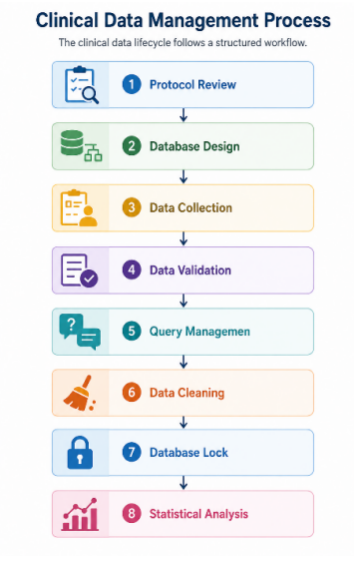
Clinical Data Management Process
The clinical data lifecycle follows a structured workflow.
Understanding the Clinical Data Review Process
The clinical data review process is a systematic evaluation of collected data to ensure quality and reliability.This process involves:
- Reviewing incoming data regularly
- Identifying inconsistencies
- Monitoring protocol compliance
- Resolving data queries
- Performing trend analysis
- Verifying critical variables
Case Study: How Clinical Data Review Prevents Errors
Scenario
A participant enrolled in a clinical trial had a weight of 75 kg recorded during Visit 1. At the next scheduled visit, the weight was entered as 25 kg in the study database.
| Visit | Recorded Weight |
| Visit 1 | 75 kg |
| Visit 2 | 25 kg |
Problem Detected
A sudden weight loss of 50 kg within a short period is highly unlikely. During routine data validation, the Clinical Data Management (CDM) team identified this unusual value and flagged it for review.
Investigation Process
- The system automatically generated a query.
- The query was sent to the study site for verification.
- Site staff checked the participant’s original medical records.
- The review revealed a data entry error—the correct weight was 72.5 kg, not 25 kg.
Resolution
The incorrect value was corrected in the database, ensuring that the participant’s data accurately reflected their actual weight.
Manual vs Electronic Clinical Data Management
| Feature | Manual Data Management | Electronic Data Management |
| Data Entry Speed | Slow | Fast |
| Error Detection | Manual | Automated |
| Data Accessibility | Limited | Real-time |
| Query Resolution | Time-consuming | Faster |
| Regulatory Compliance | More challenging | Easier |
| Data Security | Moderate | High |
| Reporting Capability | Limited | Advanced |
| Overall Efficiency | Lower | Higher |
Common Challenges in Clinical Data Management
Despite technological advancements, several challenges remain.
Data Quality Issues: Incomplete or inaccurate entries can affect study outcomes.
Missing Data: Patient dropouts and incomplete forms often result in missing information.
Regulatory Requirements: Maintaining compliance with evolving regulations requires continuous monitoring.
Multiple Data Sources: Integrating information from laboratories, devices, and clinical sites can be complex.
Query Backlogs: Large numbers of unresolved queries may delay study completion.
Data Security Risks: Clinical data contains sensitive patient information that must be protected.
Best Practices for Effective Clinical Data Management
Organizations can improve outcomes by following these best practices.
Develop Clear Data Standards: Standardized data collection reduces variability and improves consistency.
Use Automated Validation Rules: Automated checks identify issues early and reduce manual effort.
Conduct Regular Data Reviews: Routine monitoring helps detect problems before they become significant.
Train Study Personnel: Well-trained staff produce higher-quality data and fewer errors.
Maintain Audit Trails: Every modification should be documented to ensure transparency.
Implement Strong Security Measures: Protect patient information through secure systems and controlled access.
Promote Cross-Functional Collaboration: Data managers, statisticians, and clinical teams should communicate regularly.
Practical Example of Clinical Data Management in Action
Consider a pharmaceutical company conducting a clinical trial for a new diabetes medication.
The study involves:
- 500 participants
- 20 research sites
- Multiple laboratory tests
- Patient-reported outcomes
Without proper clinical data management:
- Data may be inconsistent
- Errors may remain unnoticed
- Regulatory approval could be delayed
With a structured clinical research data management system:
- Data is collected electronically
- Automated data validation checks identify errors
- The clinical data review process ensures quality
- Clean datasets are delivered for analysis
Emerging Trends in Clinical Data Management
The field continues to evolve rapidly.
Artificial Intelligence: AI-powered tools help identify anomalies and improve data quality monitoring.
Risk-Based Data Review: Organizations focus resources on high-risk data areas instead of reviewing everything equally.
Real-Time Data Monitoring: Modern systems provide instant visibility into study progress and data quality.
Cloud-Based Platforms: Cloud technologies improve collaboration across global research teams.
Integration with Wearable Devices: Smartwatches and health trackers generate continuous patient data for analysis.
Advanced Analytics: Predictive analytics helps detect potential issues before they impact study outcomes.
Career Opportunities in Clinical Data Management
Growing clinical research activities have increased demand for skilled professionals, students and professionals with backgrounds in life sciences, statistics, healthcare, or clinical research can build rewarding careers in this field
Popular roles include:
- Clinical Data Manager
- Data Coordinator
- Clinical Database Programmer
- Data Validation Specialist
- Clinical Research Associate
- Clinical Operations Manager
- Regulatory Affairs Specialist
Actionable Tips for Researchers and Organizations
To maximize the benefits of clinical data management:
- Start data planning early.
- Design user-friendly eCRFs.
- Use automated validation checks.
- Review data continuously rather than at the end.
- Maintain detailed documentation.
- Monitor data quality metrics regularly.
- Invest in staff training.
- Use secure and compliant data management system.
Conclusion:
Clinical data management is the backbone of successful clinical research. It ensures that trial data is accurate, reliable, and ready for meaningful analysis. Through effective data collection, data validation, and a structured clinical data review process, organizations can improve data quality, protect patient safety, and meet regulatory requirements. As clinical research continues to evolve, strong clinical data management practices will remain essential for delivering trustworthy results and advancing healthcare innovation.
Schedule a free consultation today.
For inquiries, contact us at: grow@simbi.in