
Analyzing Crowd Mismanagement Tragedies: A Critical Perspective
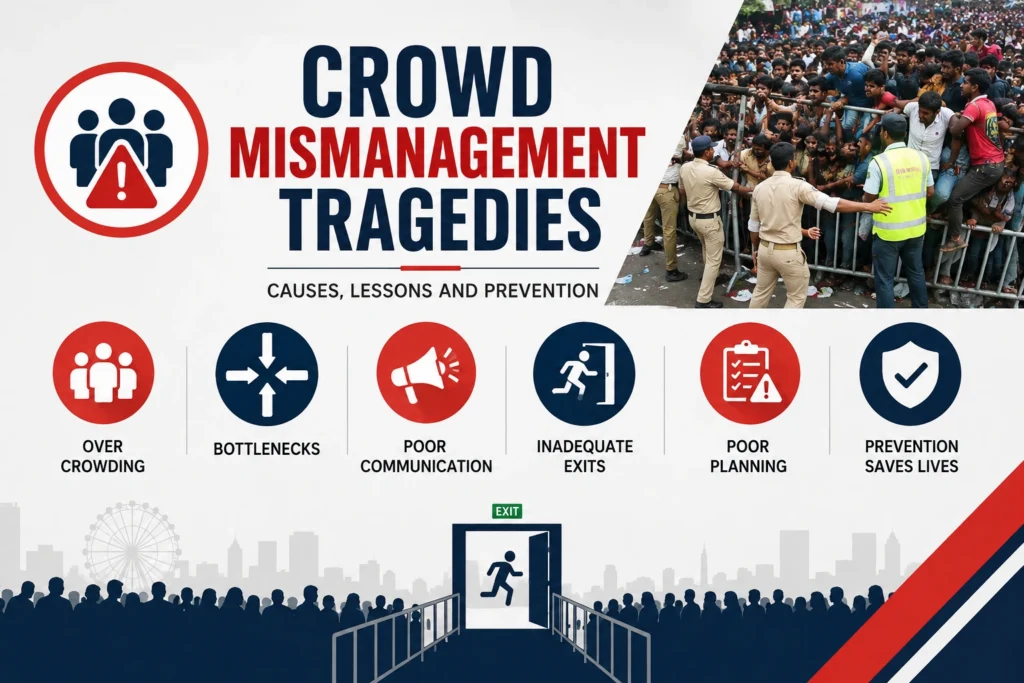
Large public gatherings such as concerts, festivals, religious events, sporting activities, exhibitions, and public celebrations bring large numbers of people into shared spaces. Most gatherings are completed safely, but poor planning, excessive crowd density, restricted movement, inadequate communication, and delayed emergency response can create dangerous conditions.
Analysing Crowd Mismanagement Tragedies helps organizations understand how crowd-related incidents develop and how similar risks can be prevented. A crowd disaster is rarely caused by one factor. Operational, environmental, behavioral, and infrastructural problems can interact until normal movement becomes unstable.
READ THIS: Crowd Management in Events
Understanding Crowd Mismanagement
Crowd mismanagement occurs when the movement, density, organization, or safety requirements of a crowd are inadequately planned or controlled. It may involve poor venue design, insufficient entry and exit capacity, ineffective barriers, weak communication, inadequate staffing, or failure to recognize changing crowd conditions.
Effective crowd management should begin before an event. Organizers need to assess expected attendance, venue capacity, pedestrian routes, bottlenecks, emergency exits, responder access, and possible crowd accumulation points.
Major Causes of Crowd Disasters
Overcrowding and Excessive Density
When too many people occupy a limited area, individual movement becomes increasingly restricted. High density can make it difficult to change direction, leave an area, or respond independently during an emergency. Capacity planning should consider not only total venue capacity but also how people move through entrances, corridors, stairs, gathering areas, and exits.
Bottlenecks and Restricted Movement
Narrow gates, corridors, stairs, bridges, barriers, and poorly positioned entrances can create bottlenecks. When many people are directed toward a small passage, density can increase rapidly. Pedestrian-flow planning should identify these pressure points and consider alternative routes, controlled entry, one-way movement, and emergency access.
Poor Entry and Exit Management
Uncontrolled entry can create sudden increases in crowd density, while inadequate exit capacity can cause accumulation inside a venue. Arrival and departure patterns should be planned separately because movement after an event can differ significantly from entry.
Inadequate Communication
Confusing or delayed information can increase uncertainty. If people do not know where to move or which exit is available, movement may become unpredictable. Clear announcements, visible signage, trained staff, and coordinated emergency communication can reduce confusion.
Poor Emergency Preparedness
An emergency plan should define staff responsibilities, communication channels, evacuation routes, assembly areas, and procedures for contacting emergency services. Drills and scenario-based planning can reveal weaknesses before an actual emergency.
How Crowd Disasters Develop
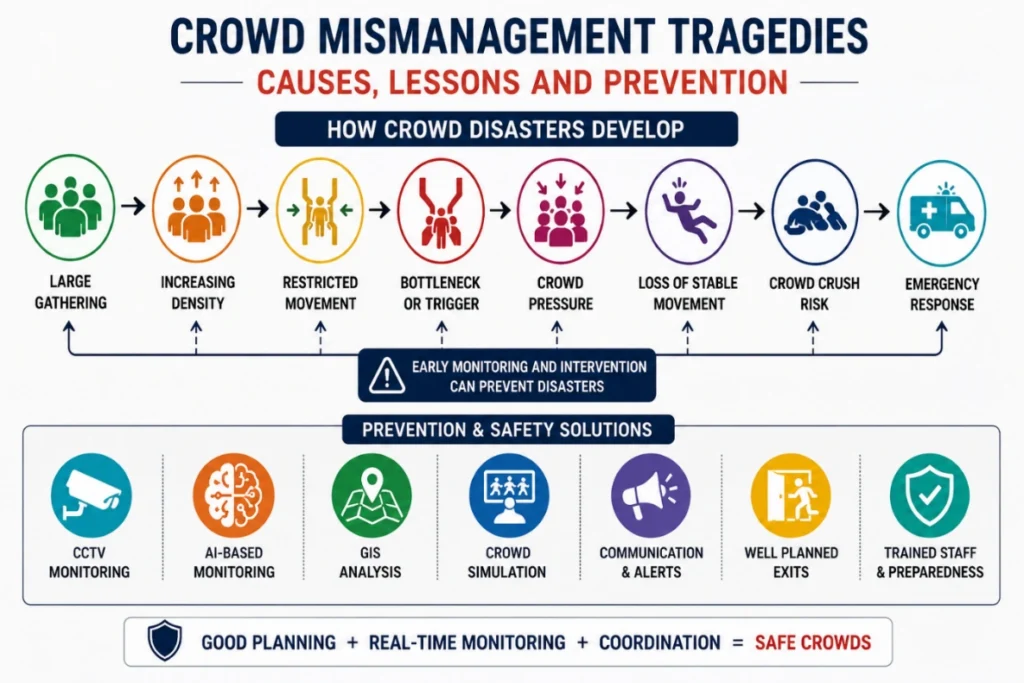
Crowd disasters generally develop through changing conditions rather than appearing without warning.
Large Gathering → Increasing Density → Restricted Movement → Bottleneck or Trigger → Crowd Pressure → Loss of Stable Movement → Crowd Crush Risk → Emergency Response
Intervention is possible at several stages. Monitoring crowd density and movement can help identify increasing risk before conditions become critical. A crowd crush is particularly dangerous because people may lose the ability to control their movement independently. Pressure can propagate through a crowd, causing falls and creating additional obstacles. Prevention and early intervention are therefore safer than waiting for conditions to deteriorate.
Common Crowd Management Mistakes That Lead to Tragedies
Recurring management failures include:
- Ignoring expected crowd density and capacity.
- Allowing uncontrolled entry into crowded areas.
- Creating narrow or poorly planned pedestrian routes.
- Blocking or inadequately marking emergency exits.
- Using insufficiently trained crowd-management personnel.
- Failing to monitor crowd movement in real time.
- Providing unclear or delayed emergency instructions.
- Poor coordination among organizers, security, police, medical teams, and emergency responders.
- Failing to prepare alternative routes.
- Assuming crowd behaviour will remain predictable during emergencies.
Key Lessons from Crowd Mismanagement Tragedies
Historical crowd disasters can have different triggers, but several lessons recur.
| Risk Factor | Potential Problem | Preventive Approach |
| Overcrowding | Restricted movement and crowd pressure | Capacity and density monitoring |
| Bottlenecks | Rapid accumulation of people | Pedestrian-flow planning |
| Poor communication | Confusion and unpredictable movement | Clear announcements and signage |
| Blocked exits | Delayed evacuation | Multiple accessible exits |
| Weak monitoring | Delayed recognition of risk | Real-time surveillance |
| Poor coordination | Slow emergency response | Integrated command structure |
Case Study: Major Religious Gatherings
Religious gatherings can involve very large numbers of participants arriving within limited periods. Temples, pilgrimage sites, and other religious locations may also involve narrow access routes, temporary structures, uneven terrain, queues, and intense movement toward particular locations.
The lesson is not simply to increase security personnel. The complete pedestrian journey should be assessed, from transportation arrival and entry queues to internal circulation, congregation areas, emergency exits, and departure routes.
Technology for Crowd Safety and Risk Management
CCTV and Video Analytics
CCTV systems provide visibility across entrances, exits, gathering areas, corridors, and other critical locations. Video analytics can help identify unusual density, movement patterns, or developing congestion.
AI-Based Crowd Monitoring
AI can support crowd-density estimation, movement analysis, congestion detection, and real-time alerts. These systems can provide information that may be difficult to obtain through manual observation alone.
GIS-Based Crowd Analysis
GIS tools can map entrances, exits, pedestrian routes, barriers, emergency access points, and crowd accumulation zones. Spatial analysis can support safer event layouts and emergency planning.
Crowd Simulation Software
Crowd simulation platforms can model pedestrian movement before an event. Tools such as MassMotion, Legion, Pathfinder, AnyLogic, GAMA, and NetLogo can support pedestrian, evacuation, and crowd-behavior analysis. Planners can compare normal operations, peak attendance, blocked routes, evacuation, and alternative entrance or exit arrangements.
Survive a Stampede or Crowd Crush
People often search for “how to survive a stampede,” but the safest strategy is to avoid dangerous crowd density whenever possible. Before entering a large gathering, identify multiple exits and note the location of security and medical assistance. Avoid unnecessarily dense areas when less crowded routes are available.
If density begins increasing, remain calm and gradually move toward an area with more space when safe. Avoid pushing against the direction of a tightly moving crowd. Maintain balance and protect your chest and breathing space if pressure becomes significant. If you fall, try to get up when safely possible. If you cannot immediately stand, protect your head and neck and make yourself as compact as possible while waiting for an opportunity to rise.
Avoid climbing barriers or unstable structures unless there is an immediate safer route. Do not spread rumors or create panic. Follow verified instructions from trained event personnel and emergency responders.
Improving Crowd Safety Through Better Planning
A comprehensive crowd management plan should consider:
- Expected attendance and venue capacity
- Entry and exit arrangements
- Pedestrian routes and bottlenecks
- Crowd density and movement
- Emergency evacuation routes
- Security and medical resources
- Communication systems
- Weather and environmental conditions
- Transportation interfaces
- Emergency response procedures
- Real-time monitoring requirements
The Role of Crowd Simulation in Prevention
Crowd simulation allows planners to test event layouts before people enter a venue. A virtual model can represent buildings, routes, gates, stairs, corridors, barriers, and exits.
Planners can evaluate different scenarios and identify congestion zones or evacuation challenges. A simulation may show that an exit becomes overloaded during evacuation or that two pedestrian flows conflict at an intersection.
This information can support route redesign, barrier repositioning, staffing adjustments, access changes, and alternative evacuation strategies.
This approach helps organizers move from reactive emergency response toward proactive risk identification, safer design, and informed decisions across public events.
Conclusion
Analysing Crowd Mismanagement Tragedies provides important lessons for designing safer public gatherings. Crowd disasters rarely result from one isolated problem. Overcrowding, bottlenecks, poor communication, inadequate planning, restricted exits, insufficient monitoring, and delayed emergency response can interact and create dangerous conditions.
Effective prevention requires capacity planning, pedestrian-flow analysis, trained personnel, emergency preparedness, clear communication, real-time monitoring, and technology-supported decision-making.
For organizers and public authorities, the objective should be to identify risks before an event, simulate possible scenarios, monitor crowd conditions continuously, and establish clear intervention procedures. For individuals, understanding how to survive a stampede can provide safety awareness, but personal precautions should complement—not replace—professional crowd management.
With better planning, data-driven analysis, crowd simulation, and coordinated emergency management, crowd-related risks can be identified earlier and managed more effectively.
Book a free consultation for appointment
Email us at : grow@simbi.in