
Crowd Management Plan for Events: Complete Safety Guide
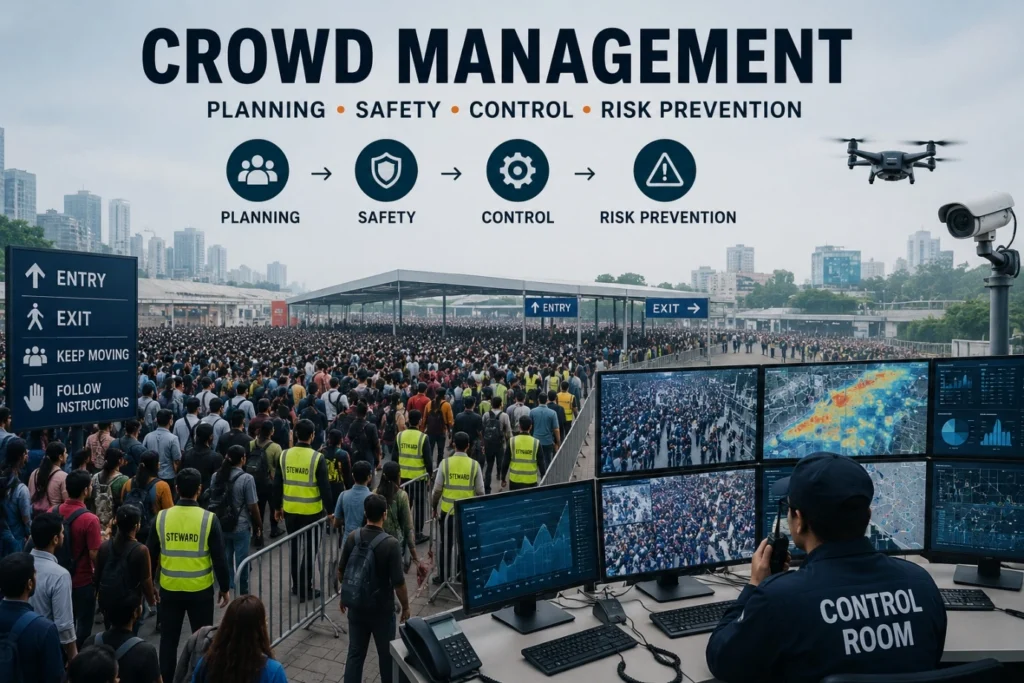
Crowd management is the systematic planning of how people enter, move, gather, queue and disperse while maintaining safety and operational efficiency. It is not restricted to the security staff or emergency response. It includes the knowledge of foot traffic, the identification of hot spots and the planning of interventions in advance of unsafe situations.
Big events can turn around very quickly. A place that operates nicely at 25% capacity could get extremely crowded when a large group of people arrives all at once, walkways all converge, lines grow or a situation suddenly alters. This blog outlines the benefits of effective crowd management through the four elements of planning, risk assessment, pedestrian analysis, technology and operational control and emergency preparedness.
Crowd Risk Depends on Movement and Density
The total number of people is only one part of crowd risk. The safety of a location may depend on local density, pedestrian speed, movement direction and interaction between other flows.
A venue can be overcrowded except for a staircase, gate, corridor or viewing area that gets extremely crowded. That is why, assessment should consider the number of people, as well as the distribution of the people across the site.
In practice, the crowd analysis should consider density in conjunction with the velocity of the footfall, the flow and the available area. Once the rate of inflow into the corridor or stairs exceeds the rate of discharge, it starts to fill up and form queues and high-density areas. For instance, if the capacity of the venue is not exceeded, an entrance may become congested if the downstream route cannot process the people at the rate at which they are arriving. These changes can be monitored to allow the operators to control entry or redirect traffic before it reaches a critical point.
READ ALSO : Top 10 Common Crowd Management Mistakes That Lead to Congestion
Table 1. Key Crowd Risks and Management Priorities
| Crowd risk | Management priority |
| High local density | Monitor density and movement speed |
| Bottlenecks | Increase capacity or regulate inflow |
| Conflicting pedestrian flows | Separate or stagger movement |
| Queue spillback | Provide controlled holding areas |
| Sudden crowd surges | Detect and intervene early |
| Poor route visibility | Improve signs and communication |
| Emergency congestion | Protect alternative routes |
Planning Pedestrian Flow Before the Event
Effective crowd management begins before visitors arrive. Organisers should examine expected arrival rates, transport connections, entrances, exits, queues, pedestrian routes and areas where people are likely to stop.
The analysis should identify:
- Expected peak arrival and departure periods.
- Pedestrian routes between transport and venue areas.
- Narrow corridors, stairs, gates and other bottlenecks.
- Locations where opposing pedestrian streams may meet.
- Emergency routes and alternative movement paths.
Pedestrian simulation can add another layer of planning. Physical changes are unnecessary as models can test various layouts, arrival patterns and emergency situations. This enables planners to understand where congestion might arise, assess potential congestion management measures, and without putting real visitors at risk.
READ ALSO : Crowd Management in Events: Strategies for Safe and SuccessfulEvent Management
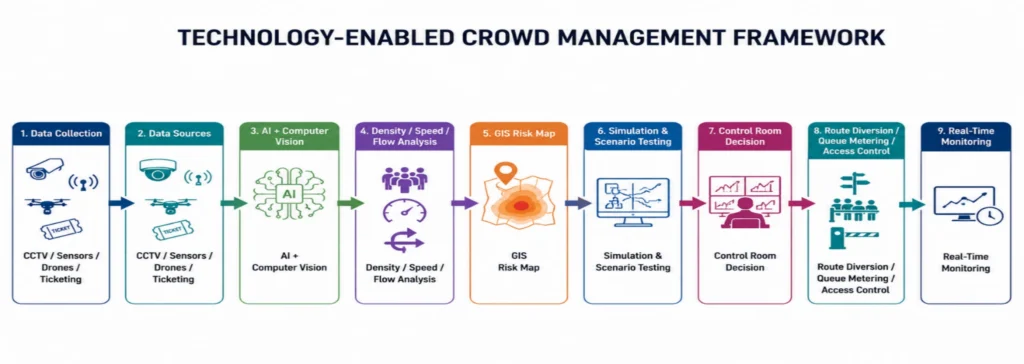
Figure 1. Technology-enabled crowd management framework showing the progression from data collection and AI analysis to GIS, simulation, operational decisions and real-time monitoring.
Real-Time Monitoring During Crowd Operations
Planning must continue with live monitoring during the event. CCTV, people-counting systems, thermal sensors, drones, ticketing data and staff observations can help identify changing crowd conditions. Teams should monitor crowd density, pedestrian speed, queue growth and changes in movement direction, as rising density combined with slowing movement can indicate developing congestion. A control room should convert these signals into timely actions such as additional stewarding, controlled entry, route diversion or temporary access restrictions before congestion becomes critical.
Maha Kumbh 2025: Technology at Exceptional Scale
The Maha Kumbh 2025 in Prayagraj demonstrated how AI-enabled CCTV, drones, real-time monitoring, control rooms and coordinated transport can support crowd management at exceptional scale. Technology was combined with controlled access, pedestrian routing, surveillance and trained personnel to monitor changing crowd conditions and coordinate timely interventions. [Press Information Bureau]
The key lesson is that technology is effective only when connected to action. Real-time density and movement data can help teams regulate entry, redirect pedestrians, deploy personnel and prevent congestion before it becomes critical.
Technology That Strengthens Crowd Safety
Modern technology helps detect and understand crowd conditions faster. AI-based video analytics, GIS, drones, simulation platforms and digital models can support density monitoring, movement analysis, congestion prediction and evacuation planning.
Key considerations include:
- Detection accuracy
- Response time
- Coverage limitations
- Data privacy
- Control-room communication
- Clear intervention thresholds
Technology is most effective when detected conditions are linked to predefined operational actions rather than simply being displayed for observation.
Controlling Movement Without Creating New Bottlenecks
The objective of crowd control measures should be to enhance movement and not to redistribute the congestion. Flow can be controlled with controlled entry, queue metering, one-way systems, route segregation, timed release and temporary diversions, while maintaining the usability of pedestrian routes.
Communication also shapes movement. Clear signage, multilingual announcements, digital displays and trained stewards can guide people towards alternative routes and reduce unnecessary crowd pressure before congestion becomes severe.
Emergency Preparedness and Evacuation
Emergency planning should take into account the way people may react rather than assuming everyone will take the closest exit.
People can go down the same route, be unsure of what to do when instructions are not clear, or approach others. A lack of mobility, unfamiliarity with the venue and changing conditions can also impact evacuation.
A strong emergency plan should therefore assess:
- Primary and alternative evacuation routes.
- Emergency vehicle access.
- Medical response locations.
- Communication procedures.
- Staff responsibilities.
- Assembly and dispersal areas.
- Scenarios involving blocked or unavailable routes.
Simulation and exercises can test whether these arrangements remain effective under changing crowd conditions.
READ ALSO : Temple and Pilgrimage Crowd Management: Using Simulation to Prevent Stampedes
From Event-Day Control to Preventive Planning
The best strategy is to make crowd safety a continuous process. Initial assessment can be based on historical attendance, venue geometry, transport patterns and previous incidents.
Actual conditions can be compared to the expected patterns during the event. Then the queue length, density, numbers of arrivals, incidents and interventions in the queue can be checked for future plans. This establishes a loop of learning that enables each major event to feed into the next to be improved.
Moving from Reactive Control to Preventive Crowd Management
Effective crowd management is not simply about controlling people after congestion appears. It is about understanding movement before the event, identifying vulnerable locations, testing scenarios, monitoring changing conditions and preparing interventions that can be activated quickly.
The combination of pedestrian analysis, simulation, GIS, surveillance, communication and trained personnel allows organisations to move from reactive control towards preventive safety planning.
Build a Safer, Data-Driven Crowd Strategy
Don’t wait for congestion to become a crisis. Get expert crowd-flow analysis, simulation, GIS and risk assessment from SIMBI Labs.
Explore Our Crowd Management Services →
Book a free consultation for appointment
Email us at : grow@simbi.in