
Crowd Control Solutions for Safer Events and Public Spaces

Large public gatherings create a unique operational challenge: thousands of people must move through the same environment while maintaining safety, accessibility, and efficiency. Concerts, stadiums, airports, shopping centres, exhibitions, transportation hubs, and religious gatherings can experience sudden changes in crowd density within minutes.
A good crowd control solution is more than just barriers around an event. It utilizes physical amenities, trained staff, communication, monitoring, surveillance, and movement planning to manage the ways in which people enter, move, queue, assemble and exit a space.
The objective is not to restrict movement. It is to provide predictable, organised and safe pedestrian movement, and for operators to react fast to changes in the conditions.
READ THIS: What Is Crowd Simulation Public Safety? Ultimate Guide
Crowd Control as a Safety Engineering Requirement
Crowd-related incidents rarely result from a single failure. They tend to be caused by a combination of multiple minor issues. Dangerous congestion can be caused by a combination of narrow passages, unexpected arrival surges, inadequate signage and staff positioning.
A good solution for crowd control solutions must take both into account, normal and abnormal conditions. This is because a venue can run for many hours without incident, and then suddenly get a lot of people off at the same time.
Professional planning evaluates:
- Expected and peak occupancy
- Arrival and departure patterns
- Pedestrian density
- Queue formation and discharge
- Entry and exit capacity
- Emergency access routes
- Staff deployment
- Accessibility requirements
- Communication and response procedures
This approach shifts crowd management from reactive security to proactive risk management.
Crowd Control Challenges Across High-Density Environments
Different environments produce different crowd behaviours. An airport passenger queue behaves differently from a stadium audience or a pilgrimage crowd.
Table 1. Crowd Management Challenges, Potential Consequences, and Recommended Controls
| Challenge | Potential Consequence | Required Control |
| Sudden arrival surge | Rapid density increase | Controlled entry and metering |
| Narrow circulation route | Pedestrian bottleneck | Flow optimisation |
| Poor signage | Wrong-way movement | Clear directional communication |
| Counterflow | Increased friction and delay | Segregated movement |
| Exit concentration | High-density discharge | Multiple exit strategies |
| Emergency panic | Unpredictable movement | Predefined emergency procedures |
| Staff mispositioning | Delayed intervention | Dynamic staff deployment |
The important point is that barriers alone cannot solve these conditions. The layout, capacity, human behaviour, and operational strategy must work together.
The Four Layers of an Effective Crowd Control Solution
A robust system normally combines four interconnected layers: physical control, human control, information control, and technology-enabled control.
1. Physical Crowd Control Infrastructure
Physical infrastructure sets up boundaries and informs pedestrian movement. These may be barricades, pedestrian fencing, queue barriers, gates, turnstiles, cones and temporary access control structures all of which will depend on the environment.
The goal is to provide distinct movement paths and not give people free rein to choose uncontrolled paths.
2. Trained Personnel and Operational Control
Human beings make up the human layer of the system, including security personnel, stewards, volunteers, and event management teams. Their duties are in directing passage, monitoring lines, controlling access, communicating directions, and escalating events.
The positioning of staff is especially critical at decision points, where individuals select between alternate routes, or where two pedestrian streams cross paths.
3. Communication and Wayfinding
Even a technically well-designed facility can experience congestion if visitors do not understand where they should go.
Effective communication may include:
- Directional signage
- Digital displays
- Public-address announcements
- Colour-coded routes
- Mobile notifications
- Staff-led instructions
- Emergency messaging
The information should remain simple enough to understand immediately, particularly during high-stress situations.
4. Monitoring and Intelligent Crowd Control
Today, CCTV analytics, occupancy monitoring, sensors, dashboards, and AI-based density detection are also becoming a part of modern crowd control solutions.
These technologies enable operators to detect crowd conditions changes before they reach critical levels. Control-room teams can be notified of the growth of the queue or unusual movement rather than having to physically view a problem.
Selecting the Right Crowd Control Equipment
There is no one size fits all solution. The choice of equipment depends on the size of the crowd, the type of movement required, the duration of the event, the climate and the emergency needs.
Table 2. Crowd Control Equipment and Their Primary Applications
| Equipment | Primary Application |
| Metal barricades | Events and high-density pedestrian separation |
| Queue barriers | Ticketing, registration, and waiting areas |
| Temporary fencing | Restricted or controlled zones |
| Portable gates | Controlled access and emergency intervention |
| Turnstiles | High-volume entry and exit management |
| Traffic barriers | Vehicle–pedestrian separation |
| Modular barriers | Flexible event layouts |
The critical consideration is not simply which equipment is installed, but whether the equipment supports the intended pedestrian flow.
Crowd Control Applications Across Different Environments
1. Events and Stadiums
Concerts and sporting events have three major peaks of attendance: arrival, internal circulation, and departure. For each phase, there is a different operation strategy.
Entry areas may need to be segregated and ticket validated, whilst internal circulation must be controlled between seating, concessions, toilets and other areas. Routes out of an event shall not result in undue pinching at certain gates at the end of the event.
2.Airports and Transportation Hubs
Transportation facilities experience continuously changing passenger volumes. Effective crowd control solutions help separate security queues, boarding flows, arriving passengers, departing passengers, and restricted areas.
Real-time monitoring becomes particularly important during flight delays or service disruptions, when passenger volumes can accumulate unexpectedly.
3.Shopping Centres and Commercial Spaces
Retail environments typically experience predictable peaks during weekends, holidays, sales, and product launches. Queue management, controlled access, pedestrian circulation, and emergency route protection can prevent localised congestion.
4.Religious and Pilgrimage Sites
Pilgrimage environments can involve exceptionally large pedestrian volumes and complex movement patterns. Queue design, holding areas, controlled release, barricading, route segregation, and emergency access become essential components of crowd safety planning.
Identifying and Mitigating Crowd Bottlenecks
Imagine a exhibition centre that is expecting 20,000 people for a single day’s event. The main entrance is wide enough, but registration counter staff are set directly across from the entrance which becomes a potential bottleneck. Registration may line up into the main circulation area if a surge of visitors occurs suddenly and in a short amount of time. This can then allow for people to flow around the lines, creating opposing pedestrian queues, further building up lines of people and slowing down movement. The following is an example of how bad placement of queues and instant crowd surges can create a big problem for safety.
Crowd Bottleneck Mitigation Measures
A professional crowd control solution could address the problem through:
- Moving registration queues away from the main circulation route.
- Creating dedicated entry and registration channels.
- Introducing queue barriers to control expansion.
- Deploying staff at the main decision points.
- Using real-time occupancy monitoring.
- Temporarily opening additional registration counters.
- Redirecting incoming visitors to alternative processing areas.
The key lesson is that the problem was not insufficient building capacity alone. The interaction between arrival patterns, queue placement, and pedestrian circulation created the risk.
SOP for Developing a Crowd Control Plan
A Standard Operating Procedure (SOP) that is structured is a framework that can be planned, implemented and reviewed in a consistent way to ensure the safety of the crowd. A good SOP should cover normal, peak-demand and emergency situations, including people, infrastructure, communication systems and response procedures.
Figure 1. Crowd Control Plan Development Process
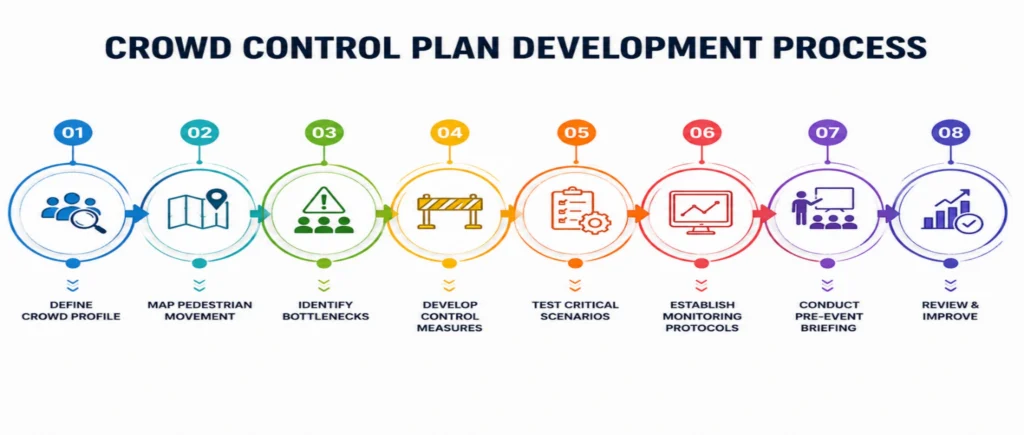
The goal of a well-designed crowd control plan should not be to create a static document, but rather a process that is continually operating. Whether it’s setting the crowd profile and modelling the pedestrians’ movement, testing critical situations, monitoring conditions, briefing personnel or reviewing the performance, each step plays a role in making the movement of the crowd safer and more efficient. The regular assessment and post-event evaluation can also enable organisations to adapt the control measures as the nature of the crowd, infrastructure and operational needs evolve.
Technology Is Changing Modern Crowd Control
Traditional crowd management was primarily accomplished by physical barriers and people. In today’s world, a combination of these methods and intelligent technologies can be integrated to provide more responsive systems.
Modern solutions may incorporate:
- AI-based crowd density analysis
- Computer vision
- Real-time occupancy dashboards
- IoT-based sensors
- Digital access-control systems
- Crowd simulation and modelling
- Predictive congestion analysis
- Integrated command-and-control platforms
The greatest value comes from combining prediction, monitoring, and intervention. For example, if a monitoring platform identifies rapidly increasing density near an exit, operators can redirect pedestrians before the area becomes critically congested.
Measuring the Performance of Crowd Control
Crowd management should not be evaluated only by whether an incident occurred. Operational performance can be measured using defined indicators.
Table 3. Crowd Control Performance Indicators and Their Measurement Objectives
| Performance Indicator | What It Measures |
| Maximum crowd density | Peak concentration |
| Queue length | Effectiveness of processing areas |
| Waiting time | Visitor experience |
| Flow rate | People processed per minute |
| Evacuation time | Emergency performance |
| Incident response time | Operational responsiveness |
| Exit utilisation | Distribution of pedestrian load |
These metrics provide organisations with objective evidence for improving future events and facilities.
Common Crowd Management Mistakes to Avoid
Even well-funded events can experience problems when planning is based on assumptions rather than actual movement behaviour.
Common mistakes include:
- Underestimating peak arrival periods
- Designing only for average occupancy
- Blocking emergency access with temporary infrastructure
- Creating conflicting pedestrian routes
- Relying entirely on security personnel
- Failing to establish escalation thresholds
- Ignoring accessibility requirements
- Not testing emergency scenarios
- Treating crowd control as an event-day activity rather than a planning process
A professional approach considers these issues before the crowd arrives.
The Future of Crowd Control Solutions
The next generation of crowd control solutions is now on the road to predictive and increasingly automated. A more comprehensive understanding of crowd behaviour can be gained with digital twins, AI-based monitoring, crowd simulations, IoT sensors, computer vision and real-time analytics.
The goal over the long-term is not just to pick up congestion once it has happened. It is to predict where congestion will occur and take action to prevent significant loss of safety margins.
As cities, venues and transport systems and public spaces become more dynamic and accommodating of larger populations, this shift toward proactive instead of reactive crowd management will become increasingly relevant.
Conclusion
Effective crowd management requires much more than barricades and security personnel. It requires an integrated understanding of people, space, infrastructure, communication, technology, and emergency response.
Well-designed crowd control solutions help organisations manage pedestrian movement, reduce congestion, protect emergency routes, improve visitor experience, and respond more effectively to unexpected situations.
For large events and high-occupancy public environments, the most effective strategy is to plan before problems occur. By combining physical infrastructure, trained personnel, intelligent monitoring, simulation, and clearly defined operating procedures, organisations can create safer and more resilient environments for everyone.
Book a free consultation for appointment
Email us at :grow@simbi.in