
Methods of GIS in Surveying and Mapping: Techniques, Analysis and Applications
Modern GIS in surveying is not limited to collecting coordinates or creating digital maps. Its real value lies in the methods used to process, connect, analyse, and validate spatial information. A survey may begin with field measurements, but GIS provides the analytical environment through which those measurements are converted into structured geographic knowledge.
The methods of GIS in surveying and mapping include spatial data modelling, georeferencing, topology, geoprocessing, spatial analysis, interpolation, terrain analysis, network analysis, and multi-criteria evaluation. Each method answers a different geographic question, allowing survey data to be used for more than simple representation.
A modern GIS survey map, therefore, is not simply a visual output. It can function as an analytical model of the real-world environment.
Spatial Data Modelling: Representing the Real World Digitally
The first methodological decision in GIS involves determining how real-world features should be represented.
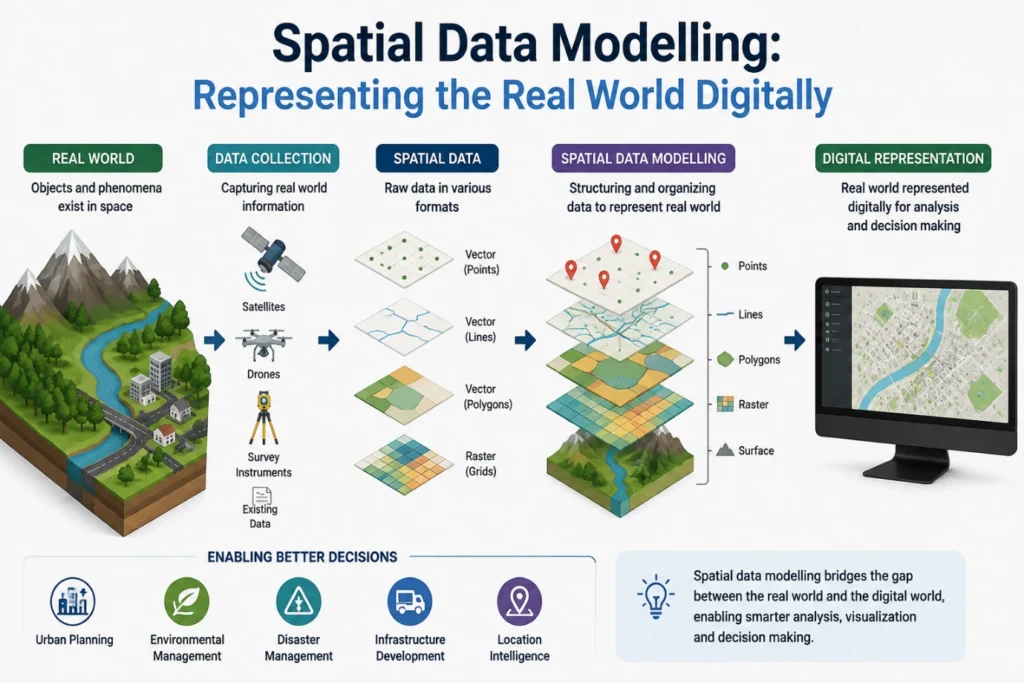
GIS commonly uses three vector-based spatial forms:
Points → Individual locations
Survey control points, wells, poles, trees, or monitoring stations.
Lines → Linear features
Roads, pipelines, rivers, boundaries, and utility networks.
Polygons → Geographic areas
Land parcels, buildings, administrative areas, and land-use zones.
Raster data provides a different representation. Instead of using individual points, lines, or polygons, it divides an area into a grid of cells. Satellite imagery, elevation surfaces, temperature maps, and interpolated groundwater surfaces are common examples.
The choice between vector and raster data is an important GIS mapping technique because it affects how information can be analysed.
Coordinate Integration and Georeferencing
Survey data cannot be meaningfully combined unless different datasets use compatible spatial reference systems. A GIS project may contain:
- GPS or GNSS survey coordinates
- CAD drawings
- Satellite imagery
- Historical maps
- Property records
- Drone imagery
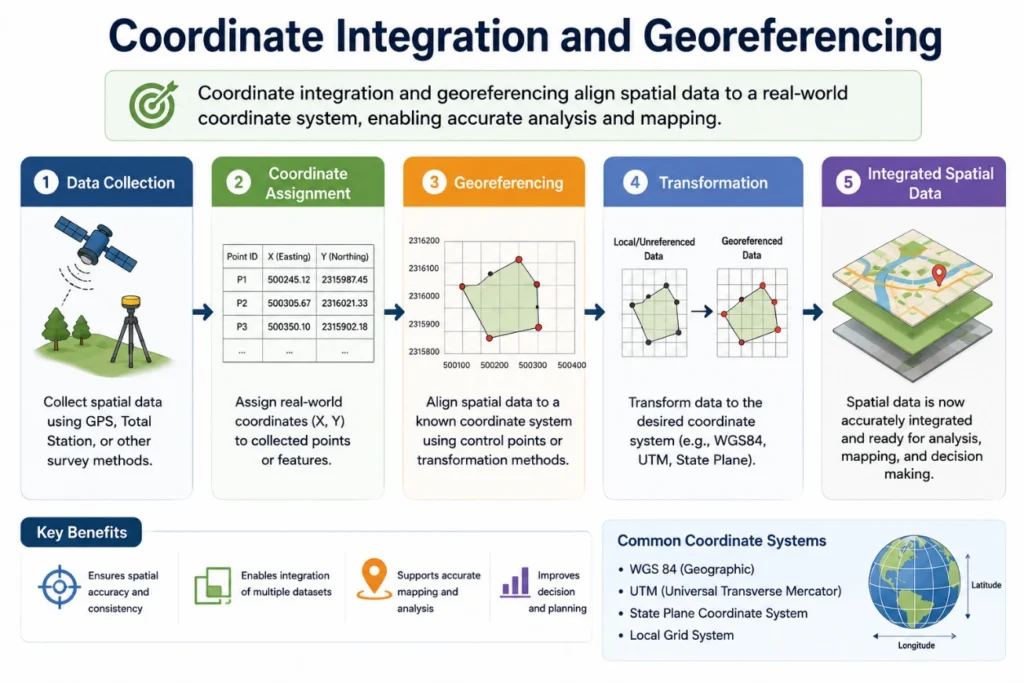
These datasets may originate from different coordinate systems. Coordinate transformation and georeferencing bring them into a common geographic framework.
For example, an old scanned land map can be aligned with known control points and transformed into a geographically referenced dataset. Property boundaries can then be digitised and compared with current survey information. This method is particularly important when historical, field-based, and digital datasets must be examined together.
Topology: Maintaining Geographic Relationships
One of the most important but often overlooked GIS survey methods is topology.
Topology focuses on the logical relationships between geographic features. A technically correct dataset should not only contain accurate coordinates; its features should also relate to each other correctly.
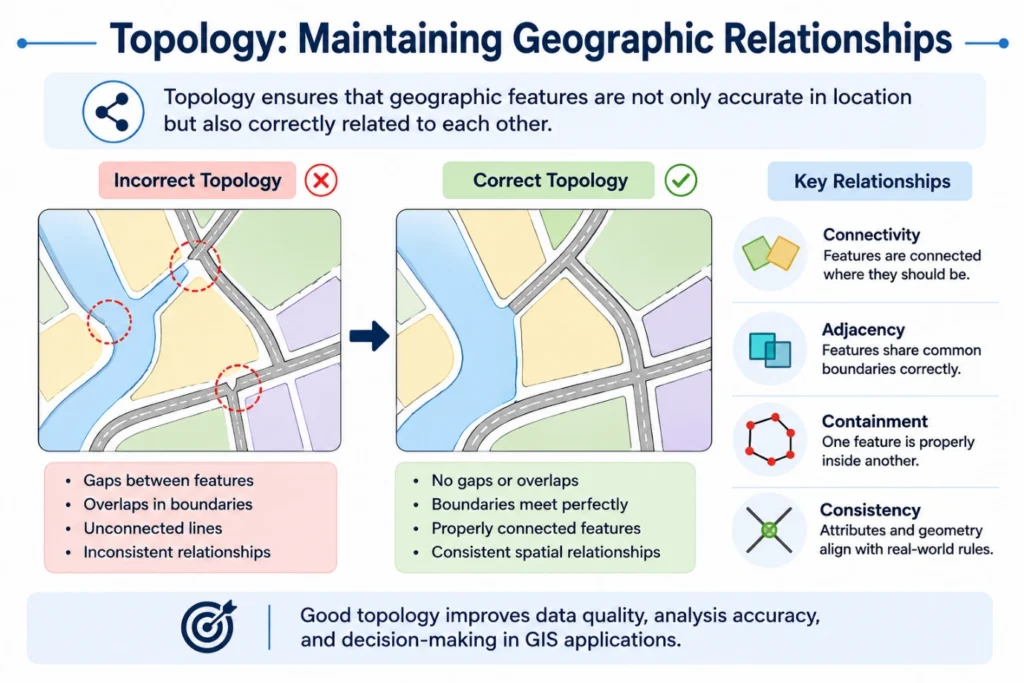
For example:
Land parcels should not unintentionally overlap.
Adjacent boundaries should not leave unexplained gaps.
Road networks should connect at valid intersections.
Pipeline lines should not contain unintended breaks.
Imagine a utility network containing hundreds of pipeline segments. Even if each segment has accurate coordinates, disconnected lines could produce incorrect results during network analysis. Topology validation identifies these structural problems. This makes topology particularly important in cadastral mapping, utilities, transportation, and infrastructure surveys.
Geoprocessing: Transforming Raw Spatial Data
Geoprocessing refers to a group of GIS operations used to modify, combine, or extract information from spatial datasets.
Several common operations include:
| GIS Method | Purpose | Example |
| Clip | Extract data within a boundary | Roads inside a project area |
| Dissolve | Combine features with common attributes | Individual land parcels by zone |
| Merge | Combine similar datasets | Multiple survey layers |
| Intersect | Retain overlapping geographic areas | Development areas within a permitted zone |
| Union | Combine polygon boundaries and attributes | Comparing multiple land classifications |
| Spatial Join | Transfer information based on location | Assigning facility information to administrative areas |
These methods are essential when raw survey information must be prepared for analysis.
A project team, for instance, may receive a regional land-use dataset but require information only for a proposed development site. The Clip method can isolate the relevant geographic area, reducing unnecessary data and improving analytical focus.
Overlay Analysis: Combining Multiple Spatial Conditions
Overlay analysis is used when one geographic decision depends on several factors. Consider a site-selection project for a new facility. The analysis may require:
Available Land
- Road Accessibility
- Population Distribution
- Environmental Restrictions
- Terrain Conditions
The purpose is not merely to display these layers together. GIS examines where selected conditions overlap. The resulting output can identify areas that satisfy multiple criteria. This method is widely used in land suitability assessment, infrastructure planning, environmental analysis, and development management.
Proximity and Network Analysis: Two Different Questions
Although both methods involve location relationships, proximity and network analysis are not the same.
Proximity Analysis
Proximity analysis examines straight-line or defined geographic distance. Typical questions include:
- Which buildings are within 500 metres of a river?
- Which properties are located near a proposed highway?
- Which facilities fall inside a restricted zone?
Buffer analysis is commonly used for this purpose. GIS creates a defined zone around a feature and identifies locations within or outside that area.
Network Analysis
Network analysis examines movement through connected features such as roads, railways, pipelines, or utility systems. For example, the shortest straight-line distance to a hospital may not represent the actual travel distance. A network-based analysis can use road connections and travel paths to identify:
Shortest route → Service area → Travel distance → Accessibility
This distinction is important when selecting an appropriate method for GIS in surveying. Proximity answers “How close?” while network analysis answers “How can a location be reached?”
Terrain and Surface Analysis
Surveying frequently involves elevation, slope, drainage, and landform analysis. GIS converts elevation data into surfaces that can be interpreted in different ways.
A Digital Elevation Model (DEM) generally represents ground elevation, while related surface models may include vegetation, buildings, or other above-ground features depending on the dataset.
From elevation data, GIS can derive:
Slope → Steepness of the terrain
Aspect → Direction a slope faces
Hillshade → Visual representation of terrain
Contours → Lines connecting equal elevations
Viewshed → Areas visible from a selected location
Consider a communication tower project. A viewshed analysis can help identify which surrounding areas may be visible from the proposed location. Similarly, slope analysis can help assess terrain conditions before infrastructure development.
The same elevation dataset can therefore produce several analytical outputs, depending on the geographic question.
Interpolation: Estimating Conditions Between Survey Points
Surveyors and researchers often collect measurements at specific locations. However, decision-makers may need to understand conditions across an entire geographic area. Interpolation is used to estimate values between known points.
For example:
41 groundwater sampling locations → Interpolation → Continuous groundwater quality surface
Common interpolation methods include Inverse Distance Weighting (IDW), Kriging, and Spline.
IDW generally estimates unknown values by giving greater influence to nearby observations. Kriging uses statistical relationships within the spatial data and can model spatial variation. Spline produces a smooth surface through known observations.
Method selection depends on the data structure, sampling pattern, assumptions, and purpose of the analysis. This is why interpolation should not be treated as a simple automatic GIS operation.
Multi-Criteria Evaluation for Complex Decisions
Many surveying and planning decisions cannot be based on a single geographic variable.
Multi-criteria evaluation allows different factors to be standardised, weighted, and combined.
For example, a land-suitability assessment may use:
| Criterion | Analytical Role |
| Road access | Accessibility |
| Slope | Construction suitability |
| Land availability | Development potential |
| Environmental restrictions | Constraint |
| Distance from utilities | Infrastructure feasibility |
Each criterion can be converted into a comparable suitability scale. Weights can then be assigned according to project priorities.
The final output may classify the study area into:
High suitability → Moderate suitability → Low suitability → Unsuitable
This is one of the most advanced applications of GIS methods because it creates a transparent framework for evaluating multiple geographic conditions simultaneously.
Accuracy, Uncertainty and Data Validation
A GIS analysis is only as reliable as the data and methods used to produce it. Survey and mapping projects should consider several aspects of data quality:
Positional accuracy: Is the feature correctly located?
Attribute accuracy: Is the associated information correct?
Completeness: Are important features missing?
Consistency: Do datasets follow the required structure and standards?
Currency: Does the dataset represent current conditions?
Metadata: Can users understand the data source, date, accuracy, and methodology?
Errors can also propagate through analysis. A positional error in an input layer may influence buffers, overlays, route analysis, or suitability assessments.
Selecting the Appropriate Method
Different objectives require different GIS mapping techniques.
| Survey Objective | Appropriate GIS Method | Expected Output |
| Land boundary management | Topology and spatial editing | Validated parcel dataset |
| Site selection | Multi-criteria and overlay analysis | Suitability map |
| Route planning | Network analysis | Route alternatives |
| Terrain assessment | DEM, slope and aspect analysis | Terrain model |
| Groundwater assessment | Spatial interpolation | Continuous surface |
| Environmental constraints | Buffer and overlay analysis | Constraint map |
| Historical map integration | Georeferencing | Spatially aligned map |
| Infrastructure relationships | Spatial query and topology | Analysed network dataset |
This demonstrates an important principle: the method should be selected according to the geographic problem, not simply according to the available GIS tool
.
A Practical GIS Survey Scenario
Consider a project to identify a suitable route for a new utility corridor.
The process may begin with surveyed control points and existing infrastructure data. After coordinate validation, the GIS team can georeference relevant drawings and integrate land-use, terrain, environmental, and property datasets.
The analysis can then follow:
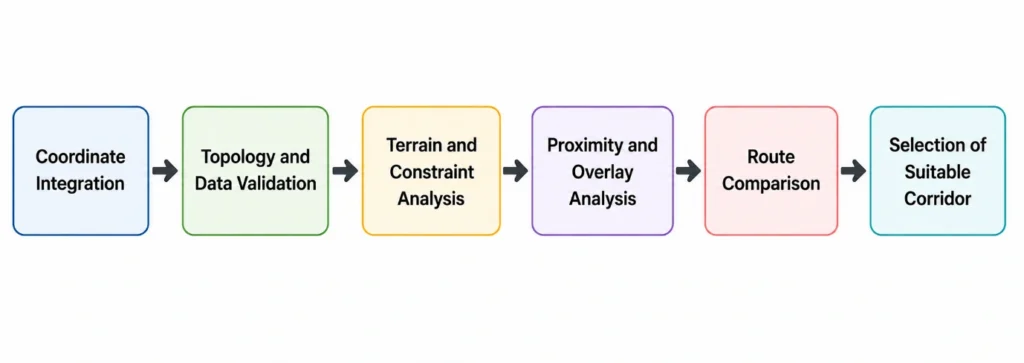
Rather than relying on a single map, this approach uses several GIS survey methods to examine the project from different analytical perspectives.
The methods of GIS in surveying and mapping provide a framework for moving from measured geographic data to reliable spatial interpretation. Georeferencing connects datasets, topology validates relationships, geoprocessing prepares information, interpolation estimates spatial conditions, terrain analysis examines physical surfaces, and multi-criteria evaluation supports complex decisions.
Frequently Asked Questions
1. What are the main methods of GIS in surveying and mapping?
The main methods include spatial data modelling, georeferencing, topology, geoprocessing, overlay analysis, buffer and proximity analysis, network analysis, interpolation, terrain analysis, and multi-criteria evaluation. Each method is used to solve a different type of geographic problem.
2. What is topology in GIS surveying?
Topology defines and validates spatial relationships between geographic features. It helps identify problems such as overlapping land parcels, gaps between boundaries, disconnected roads, or broken utility networks. This is important because accurate coordinates alone do not guarantee a logically correct spatial dataset.
3. How is interpolation used in GIS?
Interpolation estimates values at locations where direct measurements are unavailable. It is commonly used to create continuous surfaces from sampled point data, such as groundwater levels, rainfall, soil conditions, or pollution measurements.
4. What is the difference between buffer analysis and network analysis?
Buffer analysis measures geographic proximity by creating a defined area around a feature. Network analysis examines movement through connected routes or systems. A buffer may identify areas within 500 metres of a facility, while network analysis can determine the actual travel route to that facility.
5. Which GIS method is suitable for site selection?
Multi-criteria evaluation and overlay analysis are commonly used for site selection. Different factors, such as accessibility, slope, land availability, infrastructure, and environmental constraints, can be combined to identify and compare suitable locations.
6. How does GIS improve a survey map?
GIS improves a GIS survey map by connecting geographic features with attributes and analytical methods. This allows the map to be queried, updated, validated, and analysed instead of functioning only as a static visual representation.
Book a free consultation for appointment
Email us at : grow@simbi.in