
Implementing Kanban for Inventory Control in Textile Manufacturing

In today’s textile industry, competition is fierce, customer expectations are high, and production cycles are getting shorter. Whether you’re manufacturing yarn, fabric, or finished garments, one challenge remains constant—managing inventory efficiently. Too much stock eats into profits and storage space, while too little causes production delays and missed delivery deadlines.
Kanban, a core Lean manufacturing tool, offers a practical, visual, and highly adaptable solution. Its principle is simple: supply only what is needed, when it is needed, and in the exact quantity required. This is especially valuable in textile manufacturing, where multiple raw materials and production stages must work in perfect coordination.
Read Also : Problem Solving Through Value Stream Mapping (VSM): A Lean Approach to Process Optimization
Understanding Kanban in the Textile Context
The word “Kanban” means signboard in Japanese. In an industrial setting, it refers to a visual signaling system that triggers material replenishment or movement in response to actual consumption. Unlike traditional forecasting methods, which predict demand weeks or months ahead, Kanban is based on real-time usage data.
In textile production, Kanban can manage:
Raw materials such as cotton, polyester, dyes, and finishing chemicals.
In-process inventory like greige fabric waiting for dyeing.
Finished goods ready for packaging or dispatch.
Why Kanban is Ideal for Textile Inventory Management
1. Balances Supply and Demand
Kanban ensures that production inputs—like yarn cones, color chemicals, or packaging materials—arrive exactly when needed. This prevents situations where certain materials pile up while others run short.
2. Visual Clarity
With Kanban boards, colored bins, or tags, everyone in the plant—from the storekeeper to the machine operator—can see the exact status of stock levels at a glance.
3. Prevents Overstocking
Stocking excess fabric rolls or chemicals not only blocks space but also risks quality deterioration over time (fading dyes, moisture damage). Kanban minimizes such risks.
4. Reduces Waste
When you only order or produce in response to actual consumption, you avoid surplus production and obsolete stock.
5. Supports Continuous Flow
Materials flow smoothly from spinning to weaving to dyeing and finishing without the stop-start delays that come from stockouts.
What are the Steps to Implement Kanban in a Textile Unit
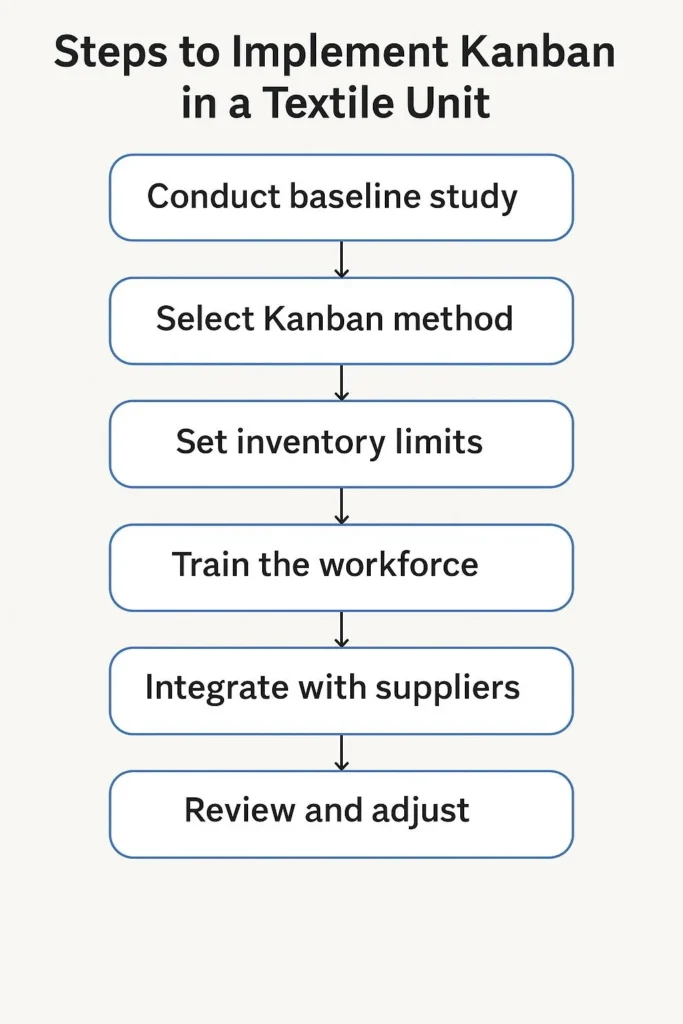
Step 1: Analyse Current Inventory
Conduct a baseline study of your current stock levels, lead times, and usage rates. Identify high-value and frequently used items.
Step 2: Select Kanban Method
Choose between:
Two-Bin System – One bin in use, one bin in reserve. When the first empties, it triggers a reorder.
Kanban Cards – Physical cards attached to pallets or boxes that signal when to reorder.
Electronic Kanban – Software or digital dashboards integrated with ERP systems for real-time tracking.
Step 3: Set Stock Limits
For each material, decide:
Minimum Stock Level (Reorder Point)
Maximum Stock Level
This ensures the right balance between availability and storage efficiency.
Step 4: Integrate with Suppliers
Communicate Kanban requirements to your vendors so they can respond quickly when a signal is triggered.
Step 5: Train the Workforce
Everyone—from store operators to supervisors—must understand how the Kanban system works and what actions to take when a signal appears.
Step 6: Review and Improve
Monitor performance, identify bottlenecks, and fine-tune stock levels. Seasonal demand shifts in textiles mean these limits may need adjustments.
Example: Implementing Kanban in a Textile Dyeing & Finishing Unit
Company Profile:
Shree Colors Pvt. Ltd., a medium-sized knit fabric dyeing and finishing unit in Ludhiana, Punjab, producing 12 tons of dyed fabric daily for export markets.
Problem Before Kanban:
i. The dye kitchen often ran out of specific reactive dyes mid-shift, causing production stoppages.
ii. Overstock of rarely used shades led to expiry and wastage.
iii. Storekeepers relied on manual ledger checks, which caused delays in replenishment.
Step-by-Step Kanban Implementation:
1. Baseline Study:
The team mapped usage data for all dyes and auxiliaries over 3 months. They found that 20% of the chemicals were responsible for 80% of consumption.
2. Selecting the Kanban Method:
They chose a two-bin Kanban system for the top 15 frequently used dyes. Each bin was labeled with:
i. Material name
ii. Batch size requirement
iii. Minimum reorder level
3. Setting Inventory Limits:
Based on supplier lead time (3 days) and daily usage, they calculated:
i. Minimum stock: 3 days’ worth of consumption
ii. Maximum stock: 7 days’ worth to avoid overstocking
4. Visual Signals:
Each bin had a bright red Kanban card. When the first bin was emptied, the red card was moved to a Kanban board in the dye store, signaling procurement.
5. Supplier Integration:
Key suppliers were informed about the new Kanban system and agreed to deliver smaller batches more frequently.
6. Team Training:
Storekeepers, dyeing operators, and purchase officers were trained on:
i. How to trigger replenishment
ii. How to update the Kanban board
iii. How to track chemical expiry dates
7. Review & Adjust:
After the first month, the reorder points for two fast-moving dyes were adjusted upward because consumption was higher than expected.
Results After 3 Months:
i. Chemical waste reduced by 28% due to better stock rotation.
ii. Machine idle time from dye shortages dropped from 6 hours/month to less than 1 hour/month.
iii. Storage space in the dye kitchen increased by 15%, making handling safer and more organized.
iv. Procurement lead time was reduced by 2 days because suppliers adapted to the Kanban-driven order frequency.
Best Practices for Kanban in Textile Manufacturing
1. Start Small – Apply Kanban to one department (e.g., dye kitchen) before expanding plant-wide.
2. Use Clear Visuals – Large, easy-to-read tags or colored cards make it easy for workers to spot when stock is low.
3. Align with Production Scheduling – Ensure Kanban signals are in sync with your daily and weekly production plans.
4. Audit Regularly – Kanban is not “set and forget.” Regular checks maintain accuracy.
5. Leverage Technology – Barcode scanning and digital Kanban boards improve speed and reduce human error.
Tangible Benefits of Kanban in Textile Inventory Control
| Benefit | Impact Area | Typical Improvement |
| Lower inventory carrying costs | Financial savings | 15–30% |
| Fewer stockouts | Production flow | 20–40% reduction |
| Less waste | Material efficiency | 10–25% |
| Faster supplier response | Procurement efficiency | 15–20% |
| Improved storage utilization | Space optimization | 20–35% |
Future Goals for Kanban in Textile Inventory Control
After successfully implementing Kanban for high-consumption dyes, the next steps for continuous improvement could include:
1. Expand Kanban to All Critical Materials
After successfully using Kanban for dyes, the next goal is to apply the same system to other important materials such as auxiliaries, finishing chemicals, yarn cones, and packaging items. By expanding Kanban across all critical supplies, the entire unit will have a uniform method of inventory control, reducing confusion and improving efficiency.
2. Shift to Digital Kanban
Instead of using physical cards, Kanban can be moved to a digital format with barcode scanning and ERP software. This will make tracking much faster and more accurate, as every movement of materials can be recorded instantly. It will also reduce the chance of lost or misplaced cards and make reporting easier.
3. Supplier Integration with Live Data
To further improve the system, Kanban data can be shared directly with suppliers. This way, suppliers know exactly when stock is being consumed and can arrange automatic replenishment. This “vendor-managed inventory” reduces delays and ensures that materials are always available when needed.
4. Link Kanban with Production Planning
Kanban should not work in isolation. By connecting Kanban triggers with the production plan, the system can prepare for changes in demand. For example, during peak export seasons, the Kanban system can signal higher requirements so production is not slowed down by material shortages.
5. Introduce Color-Coded Safety Levels
Visual signals can make the Kanban system more effective. By using color codes such as green for safe levels, yellow for caution, and red for critical shortage, workers can quickly see the stock status. This avoids confusion and allows quick action before problems occur.
6. Sustain Lean Culture
Kanban works best when the workforce is engaged and committed to lean practices. Regular audits and refresher training can help maintain discipline. Operators should also be encouraged to share feedback and suggestions, making the system more practical and effective over time.
7. Measure & Benchmark Performance
To know if Kanban is delivering results, performance must be measured. Key indicators such as stock turnover rate, amount of chemical waste, and downtime caused by shortages should be tracked regularly. Comparing these results with industry standards will show where improvements are needed and how competitive the unit is.
Read Also : Reducing Textile Waste with Lean Manufacturing Principles
Conclusion
Implementing Kanban in textile manufacturing is more than a change in how inventory is managed—it’s a shift in mindset. By focusing on actual consumption rather than forecasts, Kanban keeps materials flowing smoothly, prevents costly stock imbalances, and improves overall efficiency. The simplicity of its visual signals makes it easy for every team member to understand and act on, while its flexibility allows it to adapt to different departments, from dye kitchens to finishing lines. As competition in the textile industry intensifies, adopting proven Lean tools like Kanban can help manufacturers deliver quality products on time, control costs, and stay ahead in both local and global markets. It’s not just a system—it’s a practical pathway to a more organized, responsive, and sustainable production environment.
For an in-depth understanding, please refer to our book, “Academic Research Fundamentals: Research Writing and Data Analysis”. It is available as an eBook here, or you may purchase the hardcopy here .