
How Lean Transforms Textile Dyeing & Finishing Processes
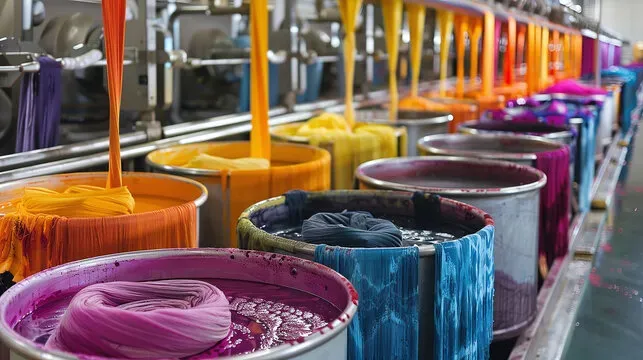
In today’s textile industry, meeting customer demands means more than just producing attractive fabrics—it’s about delivering consistent quality, on time, at a competitive cost. Dyeing and finishing departments, often the heart of fabric value addition, face intense pressure to perform. Unfortunately, these operations are prone to inefficiencies such as long changeovers, excess inventory, and frequent rework due to color inconsistencies.
To overcome these challenges, adopting Lean Textile Dyeing Finishing Processes has become essential for modern textile manufacturers. By applying lean principles, mills can streamline workflows, minimize waste, and standardize procedures across dyeing and finishing lines. This approach not only reduces downtime and operational costs but also improves shade consistency, resource utilization, and overall production efficiency. Ultimately, integrating Lean Textile Dyeing Finishing Processes helps textile businesses stay competitive by delivering high-quality fabrics faster and more reliably.
This is where Lean manufacturing comes in—not as a trend, but as a proven strategy to streamline every stage from pre-treatment to finishing, reducing waste while improving productivity and sustainability.
Why Lean Matters in Dyeing & Finishing
Unlike weaving or knitting, dyeing and finishing involve chemical and thermal processes where small errors can cause large losses. Traditional approaches often lead to:
Excess Waiting Time: Machines idle while batches queue up.
Over-processing: Extra washing or finishing to correct earlier mistakes.
Defects: Shade variations, streaks, or uneven finishing requiring re-dyeing.
Wasted Resources: High water, energy, and chemical consumption.
Lean principles directly tackle these issues by removing non-value-adding activities and ensuring every step adds measurable customer value.
What are the Lean Tools & Their Role in Textile Processing
Implementing 5S workplace practices ensures organized chemical storage, clear labeling, and cleaner production floors, directly reducing errors in dyeing and finishing.
1. Value Stream Mapping (VSM)
A visual mapping of every step in the process helps identify bottlenecks. For example, if fabric waits 12 hours between dyeing and finishing, Lean analysis can pinpoint why and how to eliminate that delay.
2. 5S Workplace Organization
Sorting, setting in order, shining, standardizing, and sustaining ensures that dyes, chemicals, and tools are always available in the right place, reducing setup and changeover times.
3. Standardized Work Procedures
Defining exact machine settings, dye recipes, and process sequences minimizes variation and improves first-time-right production rates.
4. Just-in-Time (JIT)
Producing only what is required avoids overproduction and reduces fabric or chemical storage costs.
5. Kanban Systems
Visual cards or boards signal when materials or chemicals need replenishment, avoiding both shortages and overstocking.
Indian Textile Industry Example
A dyeing plant in Tiruppur, Tamil Nadu faced delays due to frequent shade mismatches. By implementing Lean tools—especially standardized color recipes and real-time monitoring dashboards—they cut rework by 40% and reduced lead time from 5 days to 3 days. Their water consumption dropped by 18% due to better batch size control and optimized rinsing.
Measurable Benefits of Lean in Dyeing & Finishing
| Benefit | Impact Area | Typical Improvement |
| Reduced Lead Time | Scheduling & changeovers | 20–40% faster delivery |
| Lower Resource Usage | Water, energy, chemicals | 15–25% savings |
| Higher Quality | Shade accuracy, finish consistency | 30–50% fewer defects |
| Better Utilization | Machine uptime | 10–20% more productive hours |
What are the Statistical Techniques to Support Lean
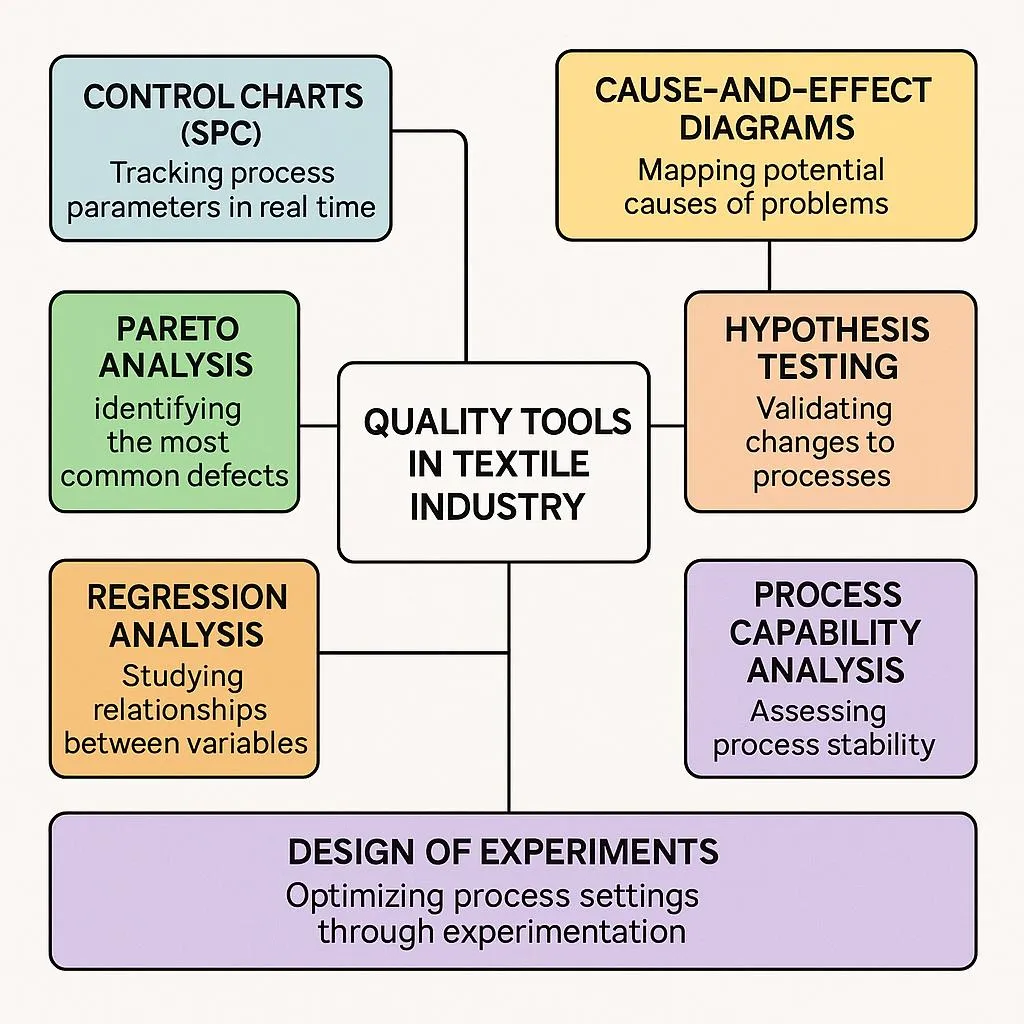
1. Control Charts (SPC – Statistical Process Control)
Control charts track process parameters in real time and show whether variations are within acceptable limits.
Application in dyeing: Monitoring dye bath temperature, pH, or liquor ratio throughout the process.
Benefit: Detects deviations early, preventing batch rework due to shade variation.
Example: If pH trends show gradual drift beyond control limits, operators can correct it before the fabric develops off-shades.
2. Pareto Analysis
This tool is based on the 80/20 rule—80% of problems often come from 20% of causes.
Application in finishing: Identifying which defects—such as uneven coating, excessive shrinkage, or surface streaks—are most common.
Benefit: Focuses improvement efforts on the defects causing the most rework and losses.
Example: If 70% of rework is due to shade mismatch, priority can be given to improving recipe accuracy and machine calibration.
3. Regression Analysis
Regression analysis helps understand how changes in process variables affect output quality.
Application in dyeing: Studying the relationship between temperature, dye concentration, and resulting shade depth.
Benefit: Helps set optimal process parameters for consistent results.
Example: A regression model might reveal that increasing dye concentration beyond a certain point has no effect on shade depth but increases cost and water usage.
4. Cause-and-Effect (Fishbone) Diagrams
Also called Ishikawa diagrams, these help map possible causes of a problem.
Application in finishing: Tracing root causes of fabric stiffness or uneven finish.
Benefit: Encourages team-based brainstorming and ensures no potential cause is overlooked.
Example: A shade mismatch issue might be linked to raw material variability, dye quality, operator skill, or machine calibration—all mapped visually for resolution.
5. Hypothesis Testing
Used to check whether a process change has a statistically significant effect on output.
Application: Comparing two dyeing methods to see if a new recipe reduces rework.
Benefit: Confirms changes are truly beneficial and not just random variation.
Example: Testing whether switching to a shorter rinse cycle affects shade quality.
6. Process Capability Analysis (Cp, Cpk)
Determines whether a process can consistently produce output within specification limits.
Application: Assessing whether temperature control in dyeing consistently stays within ±2°C.
Benefit: Quantifies process stability and reliability.
Example: A low Cpk might indicate frequent temperature deviations that risk shade defects.
7. Design of Experiments (DOE)
DOE is used to test multiple process variables at once to find the best combination.
Application: Experimenting with different drying temperatures, fabric speeds, and chemical concentrations to optimize finishing.
Benefit: Saves time by identifying the most effective settings in fewer trials.
Example: A DOE study might reveal that adjusting drying speed is more effective than changing chemical dosage for achieving desired softness.
How to Implement
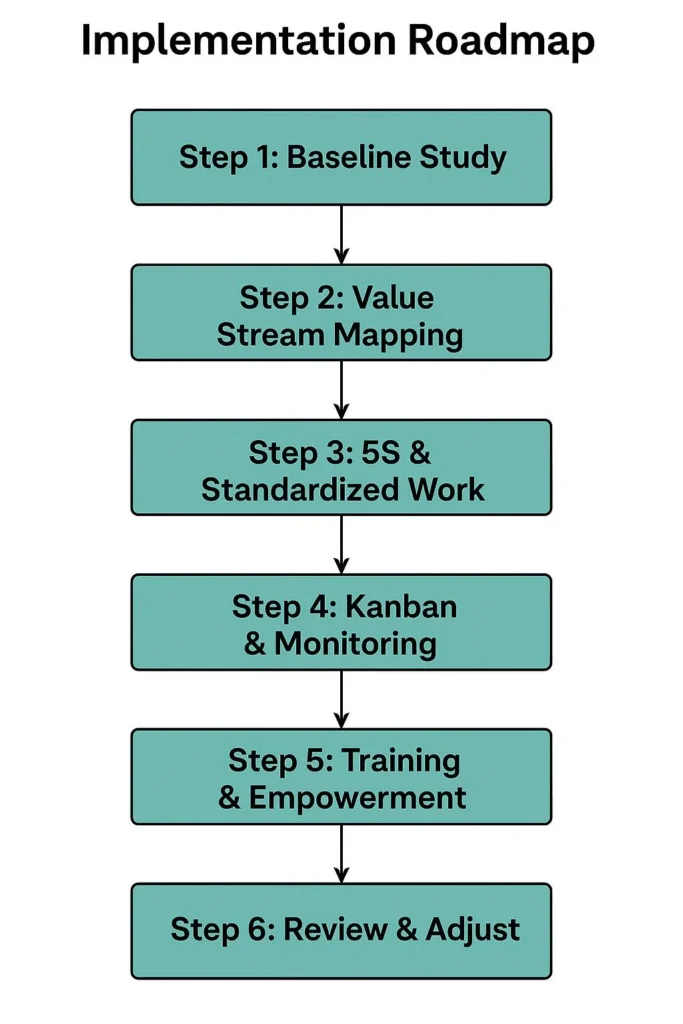
Step 1: Conduct a baseline study of current processes and resource consumption.
Step 2: Use Value Stream Mapping to spot bottlenecks.
Step 3: Apply 5S and standardize machine settings and recipes.
Step 4: Introduce Kanban for chemical replenishment and production tracking.
Step 5: Train operators in Lean concepts and empower them to suggest improvements.
Step 6: Review progress using statistical KPIs and adjust strategies.
Sustainable Impact of Lean in Textile Dyeing & Finishing
Lean principles also contribute to sustainability by reducing textile waste with lean manufacturing, cutting down excess water use, chemicals, and defective batches.
1. Reduced Water Usage
How: Optimized batch sizes, liquor ratios, and rinsing cycles.
Benefit: Cuts water consumption by 20–40%, easing pressure on local water sources.
2. Lower Energy Consumption
How: Efficient machine scheduling, temperature optimization, and reduced idle time.
Benefit: Reduces fuel and electricity use, lowering carbon footprint.
3. Chemical Efficiency
How: Standardized recipes and automated dosing systems.
Benefit: Less chemical waste, cleaner effluent, and reduced treatment costs.
4. Waste Reduction
How: First-time-right production and defect prevention.
Benefit: Minimizes fabric scrap and resource wastage.
5. Compliance with Global Standards
How: Consistent processes meeting OEKO-TEX®, ZDHC, and GOTS requirements.
Benefit: Opens access to eco-conscious markets and enhances brand reputation.
6. Safer Work Environment
How: 5S workplace organization and reduced chemical exposure.
Benefit: Healthier, safer conditions for workers.
Future of Lean in Textile Dyeing & Finishing
1. Integration with Industry 4.0
The future of lean in textile dyeing and finishing lies in combining it with smart technologies. IoT sensors can provide real-time monitoring of machines and processes, allowing instant corrections when issues occur. Digital twin models can also be used to test and simulate process changes before actual production, reducing risks and saving costs.
2. Data-Driven Decision Making
With advanced analytics and machine learning, mills will be able to predict defects before they happen. Instead of reacting to problems, managers can take preventive action. Continuous tracking of key performance indicators (KPIs) will also make improvements faster and more reliable.
3. Sustainable Lean Practices
Lean in the future will strongly focus on sustainability. Zero-liquid-discharge systems can recycle and reuse wastewater, reducing environmental impact. Similarly, low-temperature dyeing methods can save significant amounts of energy while still ensuring fabric quality.
4. Automation and Robotics
Automation will become a bigger part of textile operations. Robotic systems can handle heavy fabric rolls or manage chemical dosing with high precision. This not only improves accuracy but also enhances worker safety by reducing exposure to chemicals and repetitive tasks.
5. Supply Chain Alignment
Future lean systems will extend beyond the factory floor. By connecting suppliers and buyers in real-time, the entire supply chain can work on just-in-time deliveries. This reduces excess inventory, prevents overproduction, and creates a more responsive network.
6. Workforce Upskilling
Lean will only succeed if people are trained to use it effectively. Workers will need to learn both lean methods and digital tools. By developing cross-functional skills, operators can solve problems faster and adapt more easily to new technologies.
Conclusion:
Lean transforms textile dyeing and finishing by streamlining processes, reducing waste, and improving quality. It not only boosts productivity and cost efficiency but also drives sustainability, making textile units more competitive in a demanding global market. Contact Us for expert textile process solutions and business support.
Book a free consultation for appointment
Email us at : grow@simbi.in
Learn more about our consulting framework, specialized tools, and sector-specific experience by exploring our Lean Six Sigma Consulting Services, designed to deliver structured and impactful process transformation.