
Market Research Methods: Techniques and Emerging Tech
A business may have a good product idea, but that does not automatically mean customers will buy it. Before investing in production, advertising, or expansion, businesses need to understand what customers actually need, what they are willing to pay, and what competitors are already offering. This is where market research methods and techniques become practical decision-making tools.
For example, a company planning to launch a new healthy snack should not begin by producing thousands of units. It can first research customer preferences, acceptable pricing, preferred flavours, packaging expectations, and buying habits. The findings can then be used to refine the product before launch. The most effective market research is therefore not simply about collecting information. It is about collecting the right information for a specific business decision.
READ THIS ALSO: Types of Market Research: Methods, Examples And Uses

Start With a Clear Business Decision
The first step in any research project is to define what the business needs to decide. A question such as “What do customers think about our brand?” is too broad to produce focused results.
A better research objective could be: “Why are first-time visitors not completing their purchase?” or “Which price point is most acceptable to customers aged 25–40?”
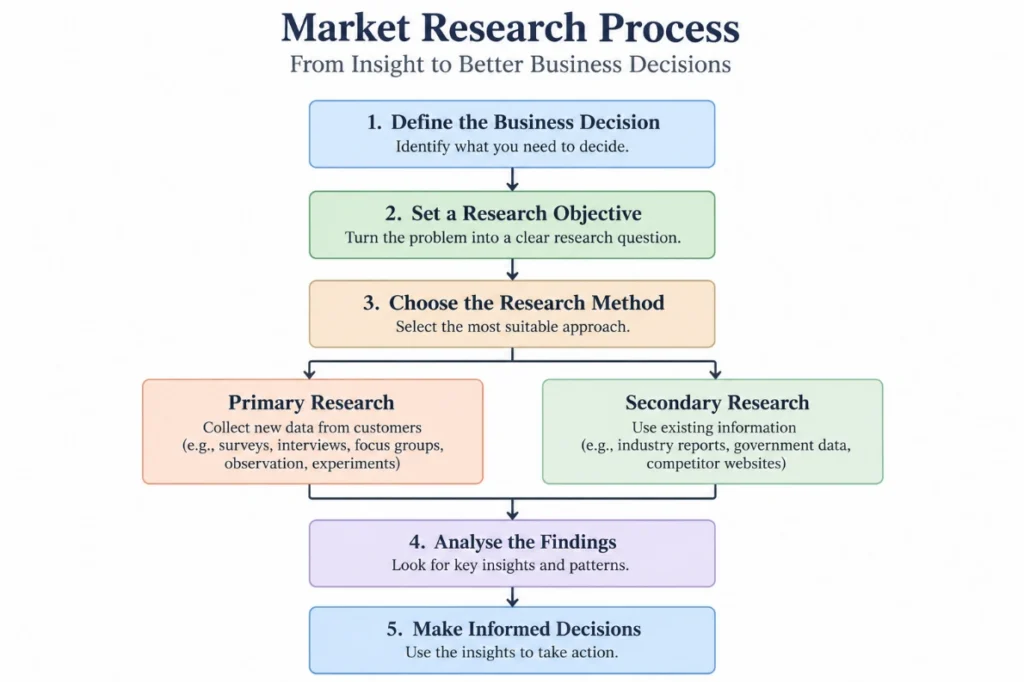
This distinction matters because the objective determines the research method. If a company wants to measure customer satisfaction across 1,000 customers, a survey may be appropriate. If it wants to understand why customers are dissatisfied, interviews may provide deeper answers.A practical research project should therefore move through three stages: business problem → research question → appropriate method.
Select the Right Market Research Method
Market research methods are generally divided into primary and secondary research. Primary research involves collecting fresh information directly from customers or other relevant participants. Surveys, interviews, focus groups, observations, and experiments are common examples. Secondary research uses information that already exists. Industry reports, government statistics, competitor websites, academic research, market databases, and published studies can provide useful background information.
Suppose an online clothing retailer wants to introduce a premium collection. It could survey existing customers about their preferred materials, colours, price ranges, and purchase frequency. The company could then use the results to decide which products to develop.Before entering a new city, the same company could use secondary research to examine population characteristics, income levels, competitor presence, consumer trends, and market conditions. This can help determine whether the market is commercially attractive before spending money on primary research.
Read Also : Market Research Data Analysis: From Survey to Strategy for Better Business Decisions
| Research approach | Best used for | Practical business example |
| Surveys | Measuring preferences and opinions | Identifying preferred product features |
| Interviews | Understanding motivations | Finding reasons behind customer complaints |
| Focus groups | Testing concepts and perceptions | Comparing packaging or advertising concepts |
| Observation | Understanding actual behaviour | Identifying problems in a store or website |
| Experiments/A-B testing | Comparing alternatives | Testing two landing pages |
| Secondary research | Understanding the wider market | Assessing competitors and industry trends |
Use Surveys to Measure Customer Preferences
Surveys are particularly useful when a business needs measurable information from a larger audience. A company can ask customers to rate satisfaction, select preferred products, indicate purchasing frequency, or evaluate different features.However, simply creating a questionnaire does not guarantee useful results. Questions should directly support the research objective.
For instance, instead of asking, “Do you like our product?”, a business could ask customers to rate product quality, price, packaging, usability, and customer service separately. This makes it easier to identify the factor that requires improvement. Businesses can also use survey results to compare customer segments. First-time buyers may value price, while repeat customers may place greater importance on product quality or service.
Practical Market Research Techniques
- Use Interviews: Interviews explain why customers behave in certain ways. For example, e-commerce interviews can identify cart-abandonment reasons such as high delivery charges or complicated checkout.
- Apply Focus Groups: Focus groups help test products, packaging, advertisements, or concepts by gathering reactions from potential customers before launch.
- Observe Customers: Observation shows what customers actually do. For example, online retailers can track clicks, page exits, and time spent to better understand the customer journey.
Test Business Decisions Through Experiments
Businesses often need to choose between two alternatives. Instead of relying entirely on opinions, they can test both options. An e-commerce company could show half of its visitors one product-page design and the other half a different design. It can then compare conversion rates, add-to-cart rates, or completed purchases. This approach can be applied to headlines, advertisements, landing pages, product descriptions, pricing displays, and website layouts. The important principle is to define the success metric before conducting the test.
READ MORE: Market Research,Turning Data into Smarter Business Decisions
Match Research Techniques to Business Objectives
Choosing a method becomes easier when the business objective is clearly defined. Different situations require different types of evidence.
| Business objective | Recommended technique | Useful outcome |
| Understand customer needs | Interviews or focus groups | Customer motivations and pain points |
| Measure customer satisfaction | Survey | Satisfaction scores and key problem areas |
| Test a new product concept | Focus group + survey | Initial acceptance and preferences |
| Improve website conversion | Observation + A/B testing | Behaviour and conversion differences |
| Enter a new market | Secondary research + survey | Market opportunity and customer demand |
| Understand competitors | Competitive analysis | Positioning, pricing and market gaps |
This approach prevents a common research problem: collecting large amounts of data that do not answer the actual business question.
Combine Multiple Methods for Stronger Insights
Using one method is not always enough. A business launching a new product could first conduct interviews to discover customer needs, then run a survey to measure how widespread those preferences are, and finally conduct an A/B test to evaluate the proposed solution.
This creates a practical research cycle:
Explore → Measure → Test → Improve.
For example, interviews may reveal that customers want healthier snacks. A survey can identify the most preferred ingredients and price range. A product test can then determine which formulation generates the strongest purchase response.Using multiple methods also allows businesses to compare different forms of evidence instead of depending entirely on what customers say.
Use Emerging Technology to Analyse Market Data
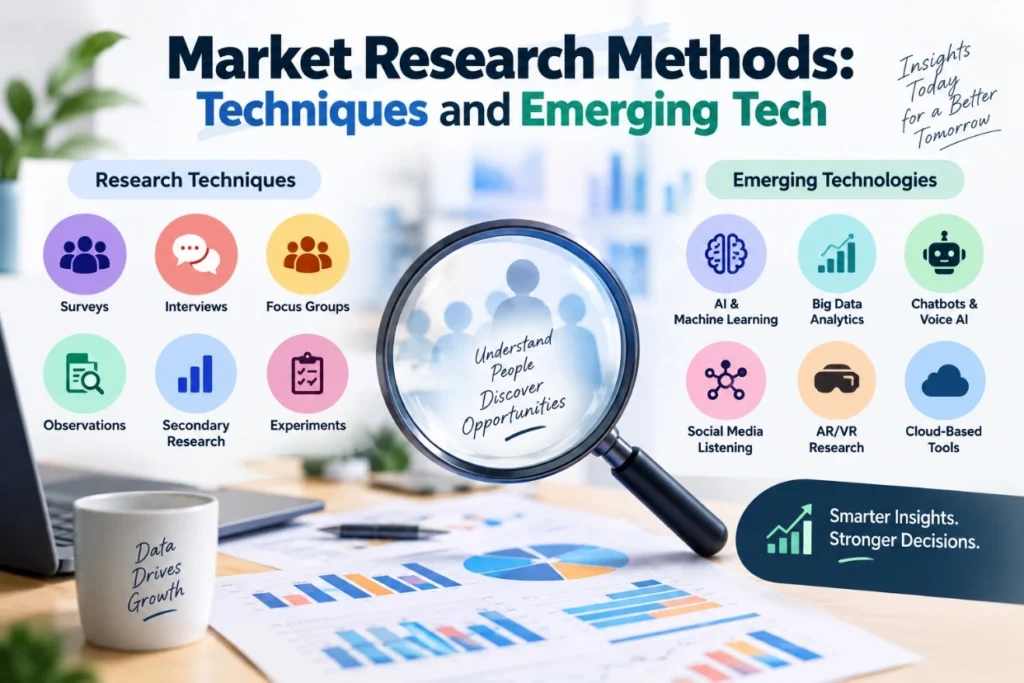
Technology is making market research faster and more scalable. Digital survey platforms can automate data collection, while analytics tools can identify customer behaviour across websites and applications. Artificial intelligence can assist with analysing large volumes of open-ended responses, identifying recurring themes, classifying comments, and performing sentiment analysis. For example, a company receiving thousands of customer reviews can use AI-assisted analysis to identify common complaints about delivery, pricing, product quality, or customer support.
Social listening tools can also help businesses monitor public conversations around brands, products, and competitors. This can provide an early indication of changing customer expectations. However, technology should support research rather than replace research judgement. Poorly designed questions, biased samples, incomplete data, or incorrect interpretation can still produce misleading conclusions even when sophisticated technology is used.
Turn Research Findings into Business Action
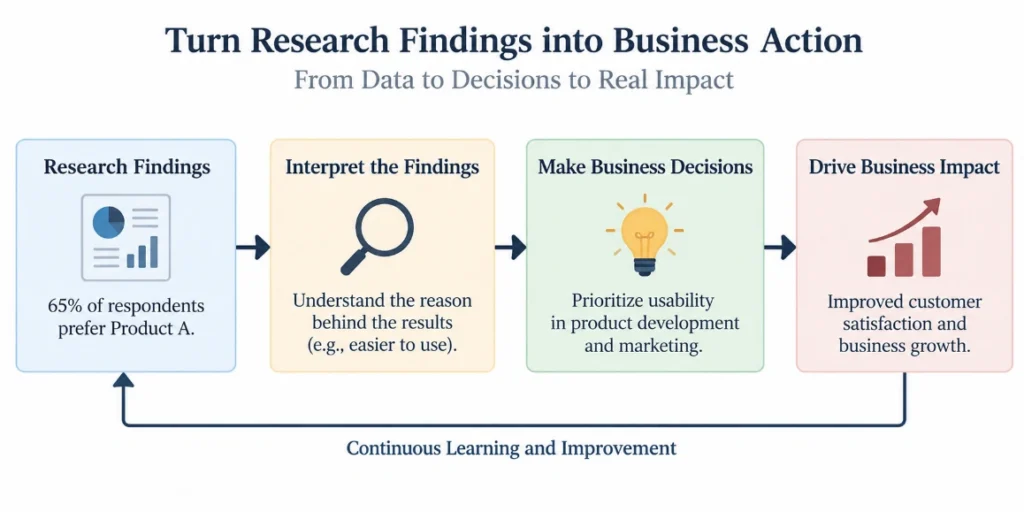
The final stage of market research is often the most important: converting findings into decisions. A research report should not simply state that “65% of respondents prefer Product A.” It should explain what that result means for the business. If Product A is preferred because customers consider it easier to use, the company may need to prioritize usability in product development and marketing. Similarly, research showing that customers consider a product too expensive does not automatically mean the price should be reduced. The business should investigate whether customers perceive sufficient value at the current price.Good market research therefore connects evidence with action.
Build a Practical Market Research Strategy
There is no universal market research method that works for every business. The appropriate approach depends on the decision, target audience, available resources, research timeline, and level of uncertainty.A practical strategy starts with a specific business question, uses secondary research to understand the existing market, selects primary research where additional evidence is required, and applies quantitative or qualitative techniques according to the information needed.
Emerging technologies can make this process faster, but strong research still depends on sound methodology and human interpretation. Businesses that combine reliable data with customer understanding are better positioned to reduce risk, identify opportunities, improve products, and make confident decisions. The goal of market research is ultimately simple: replace assumptions with evidence and turn that evidence into better business decisions.
Book a free consultation for appointment
Email us at : grow@simbi.in
Frequently Asked Questions
1. What are the main market research methods?
The main market research methods include surveys, interviews, focus groups, observation, experiments, A/B testing, competitive analysis, and secondary research. The appropriate method depends on the business question and the type of information required.
2. What is the difference between qualitative and quantitative market research?
Qualitative research focuses on understanding motivations, experiences, perceptions, and opinions, usually through interviews or focus groups. Quantitative research collects measurable data, commonly through structured surveys and statistical analysis.
3. Which market research technique is best for a new product?
A combination of techniques is often more useful than one method. Interviews or focus groups can identify customer needs, surveys can measure preferences across a larger audience, and product testing or A/B testing can help validate the final concept.
4. How is AI used in market research?
AI can help analyse large volumes of customer feedback, identify recurring themes, classify responses, detect sentiment, and identify patterns. It can improve research efficiency, but researchers still need to validate results and interpret them within the correct business context.
5. How can market research help businesses make better decisions?
Market research provides evidence about customer needs, market conditions, competitors, pricing, and behaviour. Businesses can use these insights to reduce uncertainty, improve products, refine marketing strategies, identify market opportunities, and make decisions based on evidence rather than assumptions.