
When Just In Time Manufacturing Fails: Risks, Lessons, and Smarter Strategies
What is Just In Time Manufacturing?
Just-In-Time (JIT) manufacturing is widely praised for making production lean and cost-efficient, but it also highlights the risks seen in many JIT Manufacturing Failures when supply chains are disrupted. By keeping minimal inventory and sourcing materials exactly when they are needed, companies can save storage costs, free up space, and improve cash flow; however, this heavy reliance on timely deliveries can lead to production delays, increased vulnerability to supplier issues, and operational breakdowns during unexpected events like transportation disruptions or global crises.
When the supply chain runs smoothly, JIT works beautifully. But in real-world manufacturing, disruptions happen — and without backup stock, these disruptions can stop production in its tracks.
Read Also : Inventory Shortages in Manufacturing: Causes, Challenges, and Smart Solutions
What are the Risks of JIT?
1. Overdependence on Perfect Timing
The Just-in-Time (JIT) system works only when everything runs exactly as planned. It depends on suppliers delivering materials at the right moment, smooth transportation, and stable demand. Even a small delay or mismatch in timing can disrupt the entire production line.
2. No Safety Net for Errors
Unlike traditional systems that keep extra inventory as a buffer, JIT eliminates safety stock. This means there is no backup if shipments arrive late or items are missing. As a result, even minor errors can bring production to a complete halt.
3. Supplier Vulnerabilities
JIT increases the risk of overreliance on key suppliers. If a manufacturer depends too heavily on a single vendor for critical materials, any issue faced by that supplier—such as strikes, quality problems, or shortages—directly affects the manufacturer’s operations.
What are the Common Situations Where JIT Backfires ?
1. Supplier Delays
In a JIT system, production depends directly on timely supplier deliveries. If suppliers face machinery breakdowns, labour strikes, or raw material shortages, manufacturers feel the impact immediately. Even a short delay can bring the entire production line to a stop.
2. Transportation Disruptions
JIT is highly sensitive to transportation issues. Road closures, port congestion, adverse weather, or customs delays can hold up shipments. With no backup stock, these disruptions quickly leave production lines idle.
3. Demand Surges
Sudden increases in customer demand often expose the weakness of JIT. During festival seasons or unexpected market spikes, suppliers may struggle to keep up. Without surplus stock, manufacturers cannot meet the demand on time.
4. Quality Failures
Quality control problems also create setbacks in JIT operations. If incoming parts fail inspection, there are no reserves available to continue production. Work must pause until replacement supplies arrive, leading to costly downtime.
What are the Real-World Examples ?
1. Seasonal Rush in the Toy Industry
A toy factory using JIT planned steady monthly orders. A pre-festival sales surge left them chasing suppliers for components, leading to missed deadlines.
2. Monsoon Impact on Garment Manufacturing
A clothing plant sourcing zippers from another state faced a week-long halt when monsoon flooding closed main transport routes.
3. Automotive Component Shortage
An Indian car manufacturer using JIT for wiring harnesses had to shut down assembly for four days when a shipment was delayed due to port congestion.
What are the Global Events That Exposed JIT Weaknesses ?
1. COVID-19 Pandemic
Lockdowns, labour shortages, and closed borders disrupted global supply chains. JIT-based factories with minimal stock could not meet orders for weeks.
2. 2021 Suez Canal Blockage
A single ship blocking the canal held up thousands of containers, immediately affecting JIT-dependent production lines worldwide.
3. Geopolitical Tensions
Trade restrictions, tariffs, and political instability in supplier countries have caused sudden shortages of critical parts.
How to Reducing JIT Risks Without Losing Efficiency?
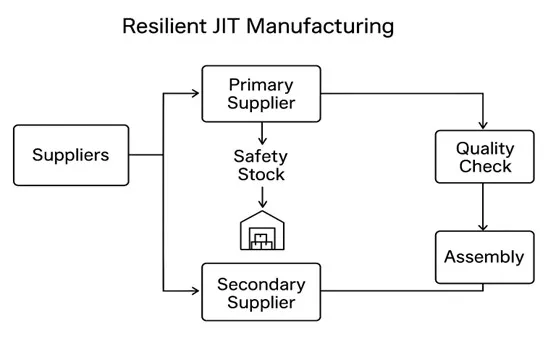
1. Maintain Micro Safety Stocks
Keep a small reserve of the most critical components to prevent complete stoppages.
2. Use Dual Sourcing
Have more than one supplier for essential materials to avoid total dependency.
3. Improve Forecasting Tools
Incorporate supplier performance data, transport timelines, and market trends into demand planning.
4. Build Strong Logistics Partnerships
Work with reliable logistics providers and establish rapid-response agreements for emergencies.
5. Conduct Risk Simulations
Test “what-if” scenarios to prepare for supplier or transport failures.
Balanced Approach to JIT
Pure JIT works best when every part of the supply chain is stable. In today’s unpredictable environment, blending JIT with selective safety measures is more sustainable. A hybrid model can deliver cost savings without leaving production vulnerable to every disruption.
Read Also : Implementing Kanban for Inventory Control in Textile Manufacturing
What are the Industry-Specific Examples ?
1. Automobile Sector
A major Indian auto manufacturer faced delays when imported chips were stuck at customs for 5 days, halting production of its flagship model.
2. Textile Sector
A garment factory missed a big export deadline when imported fabric was delayed due to port congestion during monsoon season.
3. Electronics Sector
A smartphone assembly unit ran out of printed circuit boards (PCBs) after its supplier in another country faced an unexpected lockdown.
What is the Role of Mathematical and Statistical Techniques in Managing JIT Risks ?
| Technique | Purpose in JIT | Formula / Method | How It Helps |
| Time Series Analysis / Moving Average | Forecast future demand | Forecast = (Sum of Demand in Past Periods) / (Number of Periods) | Predicts upcoming orders to avoid shortages during demand spikes |
| Safety Stock Calculation | Maintain minimal backup stock | Safety Stock = Z × σLT | Ensures critical items are available during delays |
| Reorder Point (ROP) | Trigger orders before stockouts | ROP = (Daily Demand × Lead Time) + Safety Stock | Prevents production stoppages by timely ordering |
| Supplier Reliability Analysis | Measure delivery consistency | Statistical variation in lead times | Identifies risky suppliers for JIT operations |
| Statistical Process Control (SPC) | Maintain quality | Control charts such as X-bar chart, R-chart | Detects defects early to avoid production halts |
| Monte Carlo Simulation | Model disruptions | Randomized “what-if” scenarios | Prepares contingency plans for supply delays or demand surges |
| Economic Order Quantity (EOQ) | Find cost-efficient order size | EOQ = √(2 × D × S / H) | Balances cost savings with supply stability |
How to Implement ?
Example: Automotive Wiring Harness Shortage
An automotive plant uses Just-In-Time to source wiring harnesses from a single overseas supplier. A shipment delay of 3 days recently forced production to halt.
Step 1 – Forecasting Demand
Past data shows an average usage of 500 harnesses/day.
Moving Average Formula:
Forecast = (Demand in Last 5 Days) ÷ 5 = 500 harnesses/day.
Step 2 – Calculating Safety Stock
Lead time: 5 days, σLT = 40 harnesses/day, service level factor (Z) = 1.65.
Safety Stock = Z × σLT = 1.65 × 40 = 66 harnesses.
Step 3 – Setting Reorder Point
ROP = (Daily Demand × Lead Time) + Safety Stock
ROP = (500 × 5) + 66 = 2,566 harnesses.
Step 4 – Supplier Reliability Tracking
Analysis of the past 12 months shows 3 delays beyond lead time.
Decision: Add a secondary local supplier to cover urgent needs.
Step 5 – Contingency Plan
Maintain 2 days’ worth of safety stock for wiring harnesses.
Secure express shipping arrangements for emergencies.
Outcome:
The plant can now absorb short delays without stopping production, reducing the risk of JIT backfiring.
Read Also : Reducing Textile Waste with Lean Manufacturing Principles
What are the Human Factors in JIT Success ?
1. Leadership: Quick decision-making during disruptions.
2. Supplier Relationships: Strong ties help secure urgent deliveries.
3. Employee Training: Staff can adapt schedules or switch tasks during delays.
Conclusion
Just-In-Time manufacturing delivers efficiency and cost savings when every part of the supply chain works perfectly. However, real-world uncertainties — from supplier delays to sudden demand spikes — can quickly turn those strengths into weaknesses. Manufacturers that add small safety buffers, maintain strong supplier networks, and plan for emergencies can reduce these risks without losing JIT’s benefits. The smartest approach blends lean operations with resilience, ensuring production keeps moving even when the unexpected happens.
For an in-depth understanding, please refer to our book, “Academic Research Fundamentals: Research Writing and Data Analysis”. It is available as an eBook here, or you may purchase the hardcopy here .