
How to Reduce Food Waste in Food Processing with Lean Six Sigma
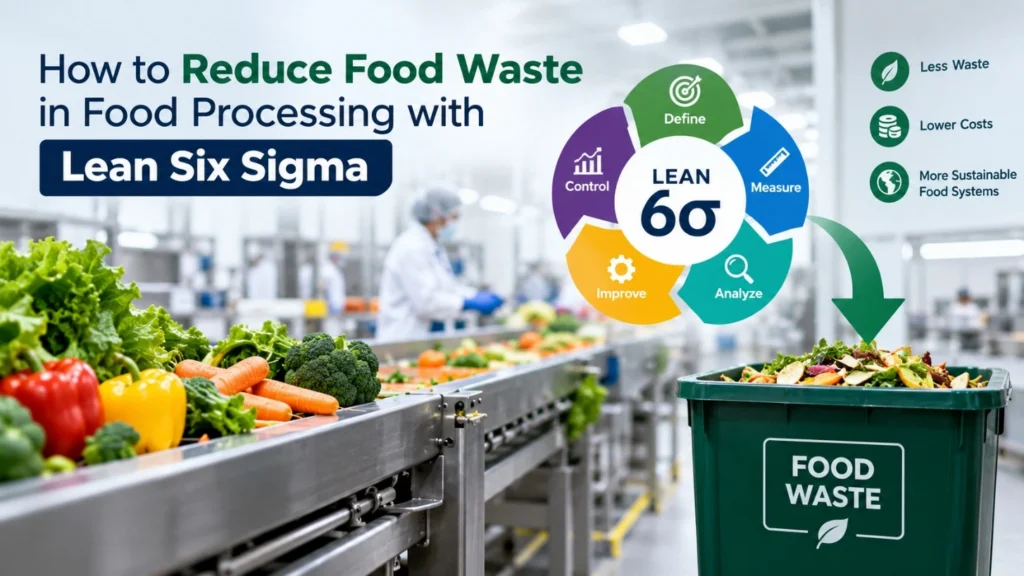
For food manufacturers, food waste directly affects production yield, raw-material costs, and profitability. Waste can occur through excessive trimming, defects, overproduction, spoilage, rework, inaccurate filling, equipment downtime, and inefficient inventory management.
Lean Six Sigma provides a structured approach to reduce these losses. By identifying waste, measuring its impact, analysing root causes, and improving process performance, food manufacturers can reduce avoidable waste while improving efficiency, consistency, and production yield.
READ THIS ALSO: Lean Audits for Food Quality and Traceability
Understanding Food Waste in Food Processing
Food waste can occur throughout the production process, from raw-material handling to processing, packaging, storage, and distribution. Excessive trimming, spills, incorrect ingredient quantities, machine settings, defects, rework, overproduction, and expired inventory are common sources of loss.
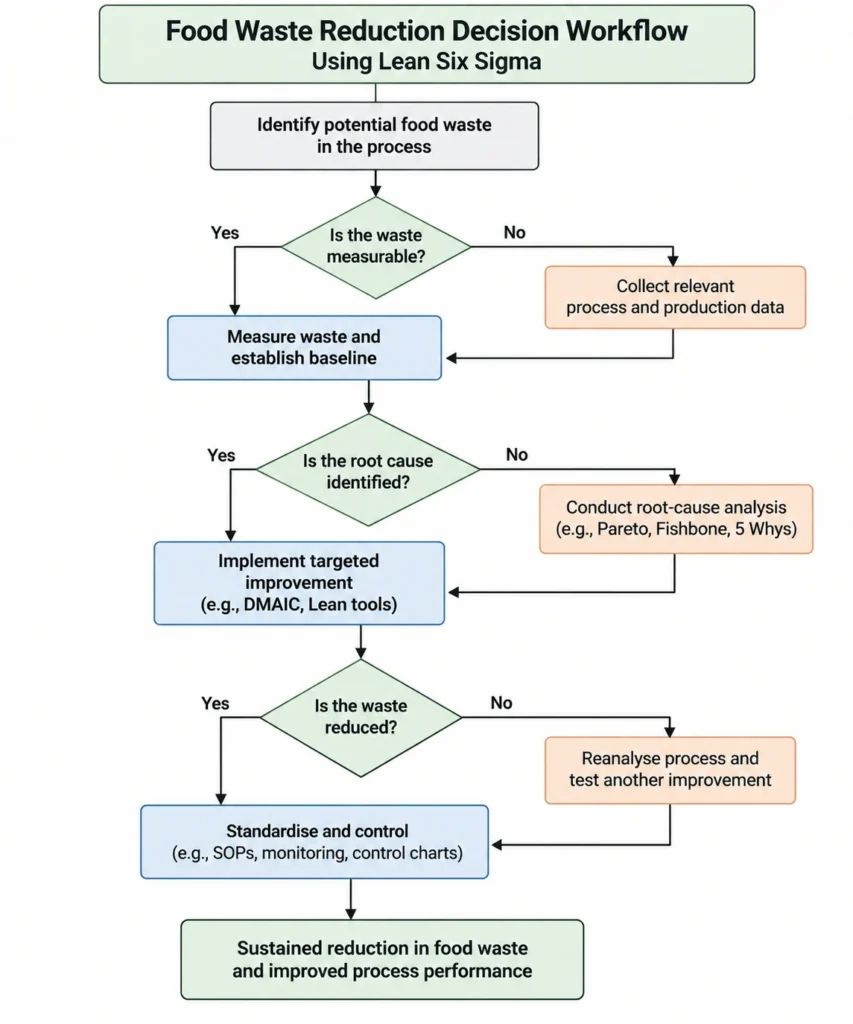
Therefore, food waste reduction in food manufacturing is closely linked to improving process efficiency, yield, and production planning.
Instead of asking only how much food is being discarded, manufacturers should examine three fundamental aspects:
1. Location: Where in the process does the greatest material loss occur?
2. Cause: Which process condition, activity, or variation is responsible?
3. Impact: What is the financial and operational cost of the loss?
Lean Six Sigma for Food Waste Reduction
Lean Six Sigma combines two complementary approaches.
Lean manufacturing focuses on identifying and eliminating activities that consume resources without creating customer value. In the food industry, this can include excess inventory, unnecessary movement, waiting, overproduction, defects, unnecessary processing, and inefficient material flow.
Six Sigma focuses on reducing variation and defects by using data to understand process performance and identify root causes.
Together, these approaches can help manufacturers move beyond treating visible waste and instead address the process conditions creating it.
READ ALSO : Lean Audits for Food Quality and Traceability
The DMAIC Framework for Food Waste Reduction
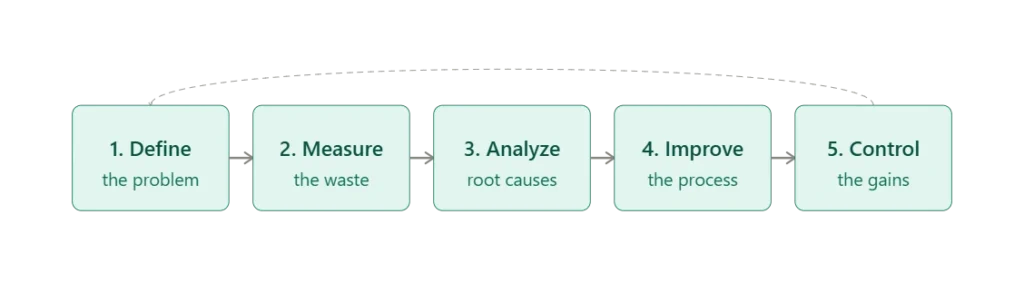
DMAIC — Define, Measure, Analyze, Improve, Control — gives food manufacturers a structured, repeatable way to work through a waste problem instead of relying on one-off fixes that don’t hold.
1.Define
Clearly identify the waste problem, where it occurs, and its business impact.
2.Measure
Establish a baseline using production data such as material yield, waste rate, rework, or downtime.
3.Analyze
Use tools such as 5 Whys, Fishbone, and Pareto Analysis to identify the true root cause rather than treating symptoms.
4.Improve
Test changes that address the root cause, such as adjusting machine settings, updating work standards, or retraining employees. Verify results with data.
5.Control
Standardize successful improvements through updated procedures, training, and ongoing performance monitoring.
The DMAIC cycle for reducing food waste
Major Sources of Food Processing Waste
Effective waste reduction begins with understanding the different forms of loss within the production system.
Raw-Material and Processing Losses: Raw materials can be lost through excessive trimming, inaccurate cutting, spills, incorrect weighing, inefficient equipment settings, or unsuitable processing conditions.
For example, if a cutting operation consistently produces more trim waste than expected, measuring yield across batches can help determine whether the issue is related to machine settings, raw-material variation, operator practices, or equipment condition.
Defects and Rework: A product that fails to meet specifications may need to be reprocessed, downgraded, or discarded. Variation in temperature, cooking time, ingredient ratios, filling quantities, packaging conditions, or equipment performance can contribute to these defects.
Reducing the variation responsible for defects can therefore reduce both food waste and production costs.
Overproduction and Expired Inventory: Producing more food than required can create significant losses, particularly for products with short shelf lives.
Better demand forecasting, production scheduling, batch-size decisions, and inventory control can help manufacturers align production more closely with actual requirements.
Equipment Downtime: Unexpected equipment failures can interrupt production and leave partially processed or temperature-sensitive materials exposed to deterioration.
Equipment reliability therefore forms an important part of food waste management in the food industry. Preventive maintenance, calibration, inspection, and condition monitoring can reduce the risk of waste associated with unstable equipment performance.
Lean Strategies for Food Waste Reduction
| Lean Six Sigma Strategy | Key Approach | How It Helps Reduce Food Waste |
| 1.Standardize Critical Processes | Use Standard Work for weighing, mixing, cooking, cutting, filling, cooling, and packaging. | Reduces process variation, makes deviations easier to detect, and improves consistency. |
| 2. Map Material and Process Flow | Use Value Stream Mapping to identify waiting, excess movement, accumulation, repeated processing, and bottlenecks. | Improves material flow and helps identify process imbalances that contribute to waste. |
| 3. Identify Root Causes | Apply 5 Whys, Fishbone Analysis, Pareto Analysis, and process data to investigate recurring losses. | Addresses the underlying causes of defects, spills, filling losses, and other recurring waste instead of treating symptoms. |
| 4.Improve Workplace Organization | Apply 5S to organize tools, ingredients, equipment, and materials. | Reduces unnecessary movement and handling while supporting consistent and efficient work practices. |
| 5.Improve Equipment Reliability | Use Total Productive Maintenance (TPM) and preventive maintenance to maintain equipment performance. | Reduces failures and process variation that can cause incorrect cuts, filling errors, temperature problems, and packaging defects. |
Measuring Food Waste and Production Yield
A food waste reduction program needs measurable performance indicators. Without baseline data, it is difficult to determine whether an improvement has actually reduced losses.
Important measures can include material yield, waste rate, first-pass yield, rework rate, downtime, and inventory spoilage or expiry.
| KPI | What It Measures |
| Material Yield | Usable finished product obtained from raw-material input |
| Waste Rate | Material lost during production |
| First-Pass Yield | Products meeting specifications without rework |
| Rework Rate | Products requiring additional processing |
| Downtime | Production time lost due to equipment or process issues |
| Inventory Spoilage | Material or products lost due to expiry or deterioration |
Example: Material Yield and Trend Analysis
Material yield is particularly useful because it connects raw-material input with usable finished output. If a process receives 1,000 kg of raw material but produces only 760 kg of acceptable finished product, the manufacturer can investigate where the remaining material is being lost and whether that loss is necessary or avoidable.
Trend analysis can then show whether process improvements are producing sustained gains rather than temporary reductions.
Creating a Sustainable Food Waste Reduction System
Reducing food waste is most effective when improvement becomes part of routine production management rather than a one-time project.
Employees who work directly with equipment and materials can provide valuable insight into recurring losses, process difficulties, and practical improvement opportunities. Continuous-improvement practices such as Kaizen can help organizations capture this knowledge and convert it into measurable changes.
Successful improvements should also be documented through updated procedures, training, process controls, and performance monitoring. This helps prevent the organization from returning to previous operating practices.
Frequently Asked Questions
1. How can Lean Six Sigma reduce food waste?
Lean Six Sigma reduces food waste by identifying process losses, measuring waste, analyzing root causes, reducing variation, and controlling improved processes.
2. What are the main causes of food waste in food processing?
Common causes include excessive trimming, defects, rework, overproduction, spoilage, inaccurate filling, equipment downtime, and inventory expiry.
3. How does DMAIC help reduce food waste?
DMAIC helps manufacturers define the waste problem, measure losses, analyze root causes, implement improvements, and control the improved process.
4. How can food manufacturers measure waste reduction?
Manufacturers can monitor material yield, waste rate, first-pass yield, rework rate, defect rate, equipment downtime, and inventory spoilage or expiry.
5. Can technology help reduce food waste in food manufacturing?
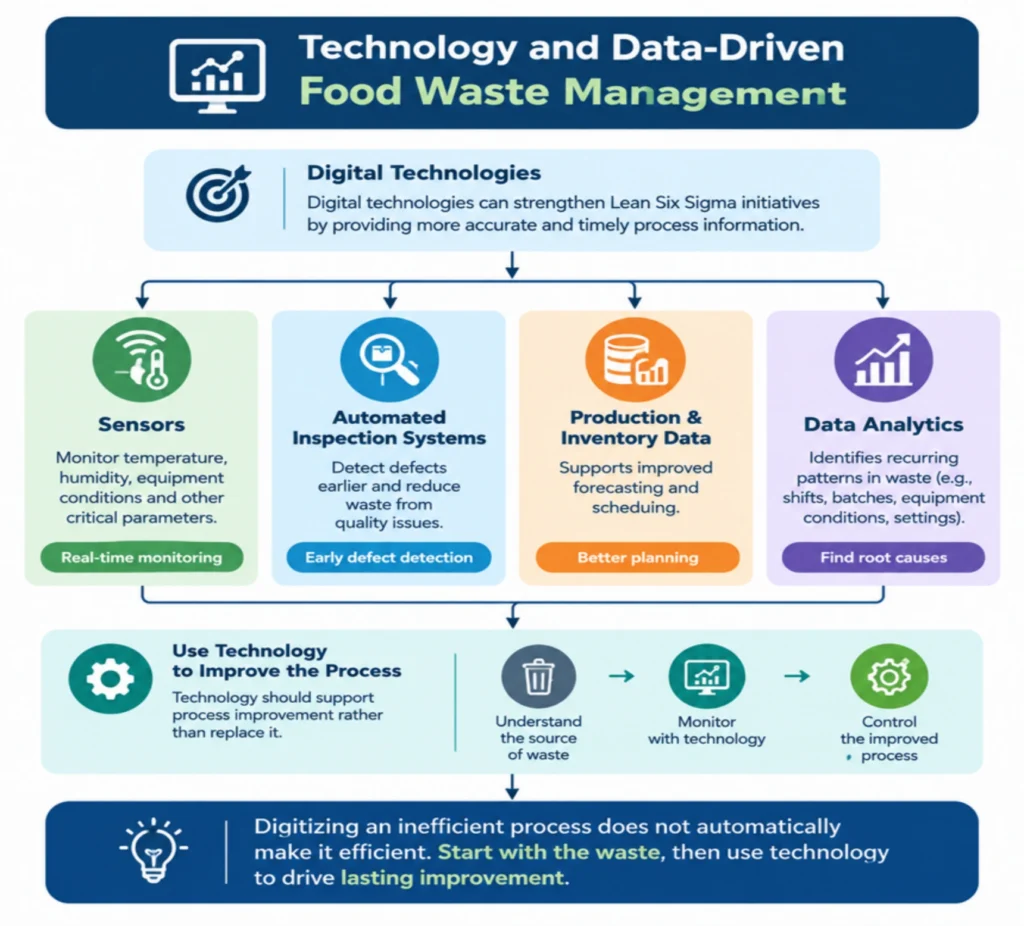
Yes. Sensors, automated inspection systems, production data, inventory systems, and data analytics can help manufacturers detect problems earlier and monitor process performance.
Reduce Food Waste with Lean Six Sigma
Ready to reduce food waste and improve production yield?
Help your food-processing team apply Lean Six Sigma to reduce waste, solve process problems, and improve manufacturing efficiency.
Explore Lean Six Sigma training with Simbi Labs.
Book a free consultation for appointment
Call Now : +91 99505 66669
Email : grow@simbi.in