AI vs Academic Integrity: What Students Must Know in 2026 for Ethical and High-Quality Research
Introduction
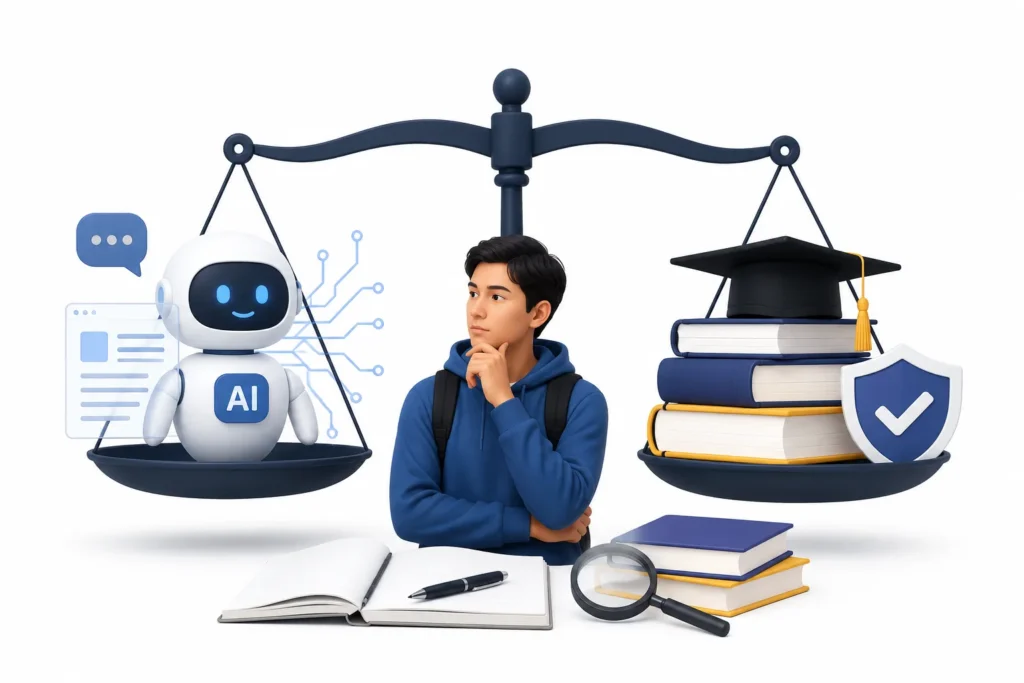
AI’s impact on the education landscape has revolutionized student research, writing, and submission processes. But with this move have come serious issues of ethics and originality. In 2026, understanding AI vs Academic Integrity is crucial for students to ensure they maintain the authenticity of their academic work and uphold university credibility. AI tools can be useful and convenient, but their improper use may result in academic policy violations. This guide will explore the fine balance between using artificial intelligence responsibly and maintaining academic honesty.
The Changing Landscape of Academic Writing in the AI Era
Students are no longer limited to creating research summaries, full-length research papers, or even entire essays in a matter of minutes with the help of AI tools. This has been a great convenience, both for productivity and the risk associated with originality and authenticity.
In response to this change, academic institutions are tightening up security and employing more sophisticated monitoring systems.To meet this change, academic institutions are reinforcing the security measures and deploying more sophisticated detection systems. Consequently, students need to be aware of the responsible use of AI while maintaining the academic integrity.
Understanding AI vs Academic Integrity in 2026
AI in education is defined as the use of tools that help to create, modify, and evaluate educational material. Academic integrity, however, is characterized by honesty, originality and proper citation.
| Aspect | AI Usage in Academics | Academic Integrity Requirements |
| Content Creation | Generates drafts quickly | Requires original thinking |
| Efficiency | Saves time and effort | Emphasizes quality over speed |
| Knowledge Representation | Summarizes information | Demands critical analysis |
| Ethical Use | Depends on user behavior | Strictly regulated by institutions |
| Evaluation Criteria | May lack depth | Focuses on authenticity |
This comparison highlights the need to balance AI usage with ethical academic practices.
Why Academic Integrity Matters More Than Ever
Academic integrity is a process that guarantees that research is an expression of understanding and contribution. Originality has become a significant focus in Indian universities to ensure high standard of education and research.
Infringement of integrity guidelines may lead to penalty, rejection of work or long-term academic repercussions. As such, there is a need for students to prioritize ethical use, even with the use of AI tools.
How AI Tools Are Commonly Used by Students
Students leverage AI across a range of educational tasks, such as idea generation, research summary, and enhancing text quality. These are beneficial uses, but can also cause an originality problem if too much is used.
- Drafting essays and assignments
- Summarizing research papers
- Improving grammar and readability
- Generating references and outlines
- Editing and restructuring content
Responsible usage is key to avoiding academic risks.
Risks of Misusing AI in Academic Work
However, there are significant risks to using AI tools, particularly when content isn’t appropriately adjusted or understood. Detection systems are evolving to become more sophisticated, simplifying institutions’ ability to recognize AI-generated patterns.
| Risk Area | Description | Impact on Students |
| Lack of Originality | Submitting AI-generated content without changes | High similarity scores |
| Ethical Violations | Using AI without acknowledgment | Academic penalties |
| Reduced Learning | Over-reliance on automation | Weak subject understanding |
| Detection by Tools | AI patterns identified by systems | Rejection or revision |
| Poor Content Quality | Lack of depth and critical thinking | Lower grades |
These risks emphasize the importance of balancing AI usage with academic integrity.
Best Practices for Maintaining Academic Integrity with AI
Using AI, while maintaining integrity, requires a disciplined and informed approach. Pupils should use AI not as a replacement for their own thinking but as a tool to help them.
- Use AI for guidance, not final content
- Rewrite and refine content in your own words
- Add personal analysis and critical insights
- Cite all sources appropriately
- Review and validate content before submission
Following these practices ensures ethical and effective use of AI.
Role of Professional Academic Support Services
The use of AI tools is driving the importance of professional services to help students remain original. They integrate AI functionalities and skilled editing to deliver top-tier, plagiarism-free content.
They help to edit and polish drafts, enhance readability, and adhere to academic standards. This is especially helpful for the complex area of investigation.
How Institutions in India Are Responding to AI Usage
Schools and universities in India are catching up with AI and changing their policies and assessment systems to align with the new era. There are some high tech tools now available to detect plagiarism and AI content in many universities.
Additionally, ethical use of AI in education is becoming increasingly emphasized, with a focus on ensuring that technology does not supplant, but enhances learning.
Future Outlook of AI and Academic Integrity
As AI technology progresses and academic rules get even tougher, the landscape of AI vs Academic Integrity will continue to evolve in 2026, influencing what students can expect to see in the year ahead. Ethical practices will be reshaped with the advent of real-time detection systems, enhanced AI tools, and deeper awareness of ethical practices.
Those who learn to leverage these advancements and apply AI responsibly will gain a great advantage in ensuring efficiency and credibility.
Conclusion
As AI continues to play a more prominent role in education, it is essential that students understand the difference between AI vs Academic Integrity to avoid plagiarism and cheating. AI is a tool that can be incredibly useful when creating content and learning, but it is important to maintain originality and ethical practices. In the end, with AI’s responsible use and a commitment to understanding, students can excel both academically and in terms of maintaining a reputable online presence.
Looking for support to maintain academic integrity in your academic writing? Collaborate with a professional AI team that provides AI services, plagiarism checking, data analysis, and research assistance in India. Academic writing that is of high quality, ethical and original—reach out to us today.
Book a free consultation for appointment
Email us at : grow@simbi.in