
Production Bottleneck Management: Causes and Solutions
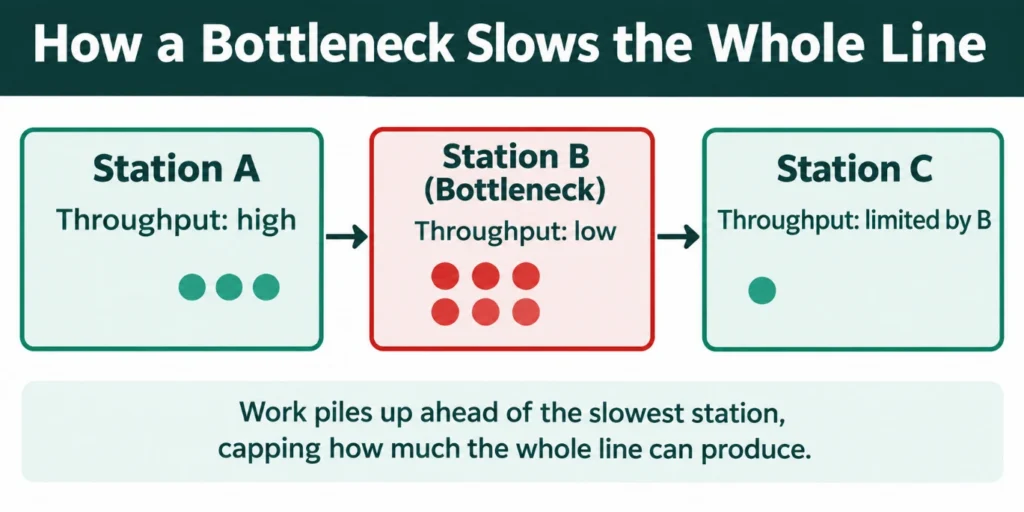
A production line moves only as fast as its slowest step. When one machine, one operator or one process stage cannot keep pace with everything around it, work piles up in front of it, output falls behind schedule, and costs quietly climb even though every other station is running at full capacity. This single constraint, wherever it sits on the line, is what production teams call a bottleneck.
Production bottleneck management is the ongoing discipline of finding that constraint, measuring how much capacity it is actually costing, and applying a fix that holds up under real production volumes, rather than one that looks good for a week and then quietly reappears. It is not a single project with an end date; it is a recurring cycle, because as one constraint is resolved, the next slowest step in the line becomes the new limit.
READ THIS ALSO: How to Reduce Downtime in Manufacturing: 7 Proven Ways
Causes of Manufacturing Bottlenecks
Manufacturing bottlenecks rarely have one single cause. They usually build up from a mix of the following, and identifying which one applies to a given line is the first real diagnostic step.
1. Machine Capacity Limitations
When one machine runs slower than the stations feeding it and the stations receiving from it, work-in-progress (WIP) collects in front of it. This is common with older equipment nearing the end of its rated life, or with machines that require long changeovers between product variants.
2. Workforce Shortages or Skill Gaps
A process step that depends on a small number of specially trained operators becomes fragile. If those operators are absent, reassigned, or simply too few for the shift’s volume, that step becomes the bottleneck regardless of how well the equipment itself is performing.
3. Inefficient Workflow Design
A poor floor layout forces unnecessary movement between stations, and the absence of standard operating procedures leads to inconsistent cycle times from one operator or shift to the next. Both effects compound the moment volume increases.
4. Equipment Downtime
Frequent breakdowns, a slow maintenance response, or the absence of a preventive maintenance schedule turn what should be planned capacity into unplanned stoppages, and those stoppages are rarely spread evenly across the line.
5. Quality Control Rework
A stage with a high defect rate consumes capacity twice: once to produce the defective unit, and again to rework or scrap it. That second pass ties up the same equipment and operators that should be processing new work.
6. Material Shortages
Interruptions in raw material supply, whether from poor planning, supplier delays or inventory mismanagement, stall a station regardless of how efficient its own process is. A well-run station starved of input is still a bottleneck.
Identifying a Bottleneck in Production
A bottleneck in production is easiest to fix once it has been confirmed with data rather than assumed from experience, since the station operators complain about most is not always the one actually limiting output. The techniques below, used together, give a reliable picture of where a line’s real constraint sits.
| Technique | Purpose | How It Helps | Example |
| Cycle Time Analysis | Measures time per process step | Flags the stage with the longest cycle time | Timing each workstation to find the slowest |
| Throughput Analysis | Calculates units produced per period | Shows where output trails expectation | Comparing units per hour across stations |
| WIP Analysis | Tracks inventory waiting at each stage | Reveals buildup ahead of a constraint | A large queue before painting signals a bottleneck |
| Queuing Theory | Models how items wait before processing | Predicts delays and ideal capacity levels | Estimating machines needed to avoid queue buildup |
| Capacity Utilization | Compares actual to maximum output | Highlights under- or over-used resources | A CNC machine at 95% utilisation is likely the constraint |
| Value Stream Mapping | Visualises flow with time and value data | Separates value-added from waiting time | Mapping a line to expose transport and wait delays |
| Statistical Process Control | Monitors process stability with control charts | Detects variation that causes slowdowns | Tracking cycle-time trends for out-of-control points |
| Pareto Analysis (80/20) | Ranks causes of delay by impact | Focuses effort on the highest-impact issue | Roughly 80% of delays traced to 20% of machines |
READ MORE: Troubleshooting Production Line Failures Lean Six Sigma
Reducing Production Bottleneck Delays: Practical Solutions and Improvements
Once the constraint is confirmed, the fix has to match its actual root cause rather than a generic efficiency drive. The six approaches below cover most of what resolves a bottleneck in production on the shop floor.
A Practical Bottleneck in Operations Management Example
A furniture factory traced its output shortfall to the sanding station, which ran noticeably slower than every process feeding into it and every process downstream. Investigation found two compounding causes: the sanding equipment itself was several years older than the rest of the line, and the operators had not been trained on the newer sanding technique the factory had adopted elsewhere.
The fix combined three of the approaches above rather than relying on one: the company upgraded its sanding machines, trained every operator assigned to that station, and added a second sanding line to balance the workload during peak runs. Production time per batch fell by roughly 25%, and on-time deliveries improved noticeably within the following quarter. This kind of bottleneck in operations management example is common precisely because a single constraint rarely has a single cause, and the fix that works is usually the one that addresses more than one factor at once.
Step-by-Step Implementation for Production Bottleneck Management
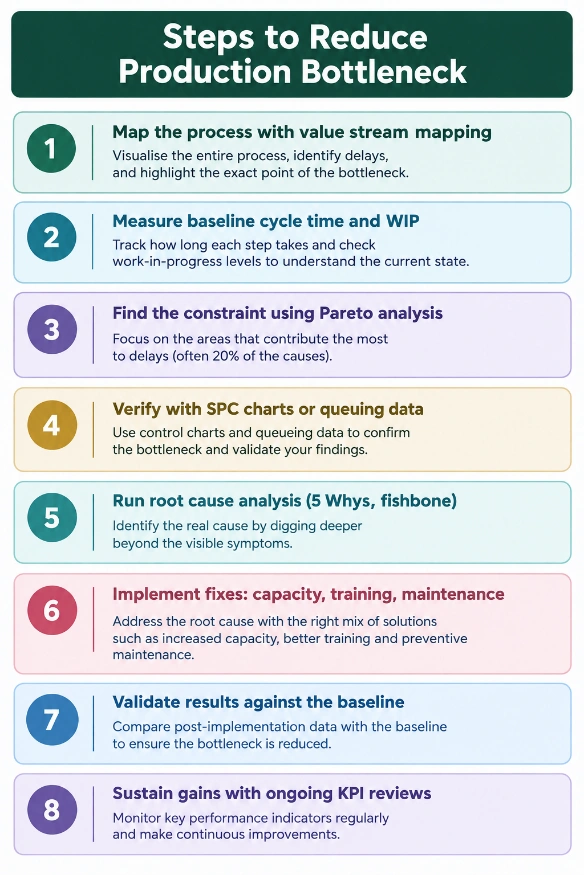
- Map the process using value stream mapping to see every step, its cycle time and its WIP.
- Measure a baseline: record cycle time, throughput and queue length at each stage before changing anything.
- Find the constraint with Pareto charts and capacity utilisation figures rather than by instinct.
- Verify the finding with SPC charts or queuing calculations to rule out a false positive.
- Run a root cause analysis using 5 Whys or a fishbone diagram to identify the underlying issues.
- Implement the fix: upgrade capacity, rebalance workload, cross-train staff, or improve maintenance, as the root cause requires.
- Validate the result against the baseline for throughput, queue size and cycle time.
- Sustain the gain with ongoing SPC monitoring, preventive maintenance and regular KPI reviews.
Turning Bottleneck Production Into Continuous Flow
Every fix applied to one constraint shifts the limit to whatever station is next slowest in line, which is why production bottleneck management works best as a standing practice rather than a one-off project. A line that is measured, reviewed and adjusted on a regular cycle keeps shifting its constraint upward instead of letting the same station reassert itself once conditions change.
Building a Bottleneck Management System That Holds
Diagnosing a constraint with cycle-time data is one thing; building the monitoring, maintenance and training systems that keep it from reappearing is another. Simbi Labs works with manufacturers to apply Lean Six Sigma methods, capacity analysis and statistical process control to identify manufacturing bottlenecks, implement lasting fixes, and set up the KPI reviews that sustain the improvement.
Need Help Eliminating Production Bottlenecks?
Production bottlenecks can increase downtime, reduce efficiency, and affect overall productivity. Simbi Labs helps businesses identify production constraints, analyse root causes, and implement data-driven strategies to improve workflow, resource utilisation, and operational performance.
Ready to improve your production efficiency? Contact Simbi Labs today for expert analysis and practical solutions.
Book a free consultation for appointment
Call Now : +91 99505 66669
Email : grow@simbi.in
FAQs
1. What is production bottleneck management?
It is the ongoing process of identifying the constraint limiting a production line’s output, measuring its impact with data, and applying and sustaining a fix, rather than treating it as a one-time repair.
2. What are the most common causes of manufacturing bottlenecks?
Machine capacity limits, workforce shortages or skill gaps, inefficient workflow design, equipment downtime, quality control rework, and material shortages are the most frequent causes.
3. How do you identify a bottleneck in production?
By combining cycle time analysis, throughput analysis, WIP tracking and capacity utilisation data, then confirming the finding with value stream mapping or statistical process control, rather than relying on which station operators complain about most.
4. What steps help reduce production bottleneck delays?
Capacity balancing, cross-training employees, process redesign, preventive maintenance, quality improvement and reliable material management address most of the root causes behind a bottleneck.
5. Can you give a bottleneck in operations management example?
A furniture factory found its sanding station was the constraint due to outdated equipment and untrained operators; upgrading the machines, training staff and adding a second sanding line cut batch time by about 25%.