
The Complete Guide to Patient Recruitment Support Services for Clinical Trials
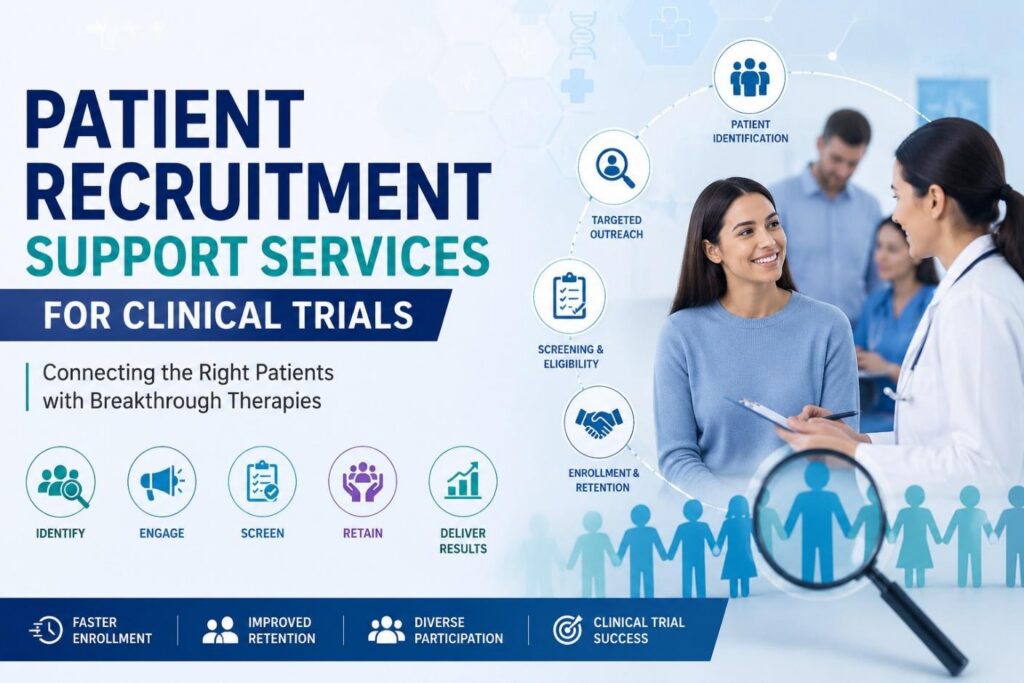
The Growing Need for Patient Recruitment Support Services
Patient recruitment is one of the most time consuming phases in a clinical trial and demands a judicious approach in planning, coordinating and engaging patients. The recruitment process can impact the quality, timeliness and success of clinical research, from identifying potential participants to keeping them engaged throughout the study.
These complexities are being handled by sponsors who are increasingly relying on the expertise of Clinical Research Organizations (CROs) for Patient Recruitment Support Services. These services combine CRO Support, Clinical Operations, Clinical Trial Support and Clinical Monitoring to streamline recruitment, boost patient retention and guarantee studies are carried out in compliance with regulatory and ethical guidelines.
This Guide examines patient recruitment support services in clinical trials, effective patient recruitment strategies, patient recruitment challenges, new technologies, and best practices for successful study recruitment results.
READ THIS ALSO: Clinical Research Support
A Closer Look at Patient Recruitment Support Services
Patient Recruitment Support Services are dedicated to the process of finding, screening, enrolling, and retaining eligible patients in a clinical trial throughout the study.
These services are offered primarily by Clinical Research Organizations (CROs) to boost recruitment efficiency, speed up participant enrollement, improve retention, minimize timelines, and support compliance with regulatory requirements – as part of comprehensive Clinical Trial Support and Clinical Operations.
The Need for Efficient Patient Recruitment in Clinical Trials
Every clinical trial depends on having the right participants,if recruitment is slow or ineffective, sponsors may face:
- Extended study timelines
- Increased operational costs
- Budget overruns
- Delayed regulatory approvals
- Reduced statistical power
- Loss of competitive advantage
Common Challenges in Patient Recruitment
While it is true that recruitment of patients can be a more complicated process than just recruiting volunteers, some of the challenges include: Strict in and out criteria
1.Strict Eligibility Criteria: Many studies have very specific inclusion and exclusion criteria which make it challenging to identify appropriate participants.
2. Limited Patient Awareness:Many patients who are eligible for clinical trials are not aware of the availability of clinical trials or do not understand the benefits of the trial.
3. Geographic Limitations: Patients may live far from research sites making participation difficult.
4. Competition Among Clinical Trials: Many clinical trials can enroll the same patients at the same time.
5. Patient Hesitation: Side effects, doubts about the clinical research, and mistrust are common reasons for discouraging participation
6. High Dropout Rates:Participant engagement in long-term studies is a great challenge due to high drop out rates.
The Impact of CRO Support on Clinical Trial Recruitment Outcomes
Clinical Research Organizations provide specialized expertise that allows sponsors to recruit participants more efficiently, CRO support includes:
- Recruitment planning
- Site feasibility assessment
- Recruitment campaign management
- Participant database management
- Digital patient outreach
- Community engagement
- Screening coordination
- Clinical monitoring support
- Retention management
- Performance analytics
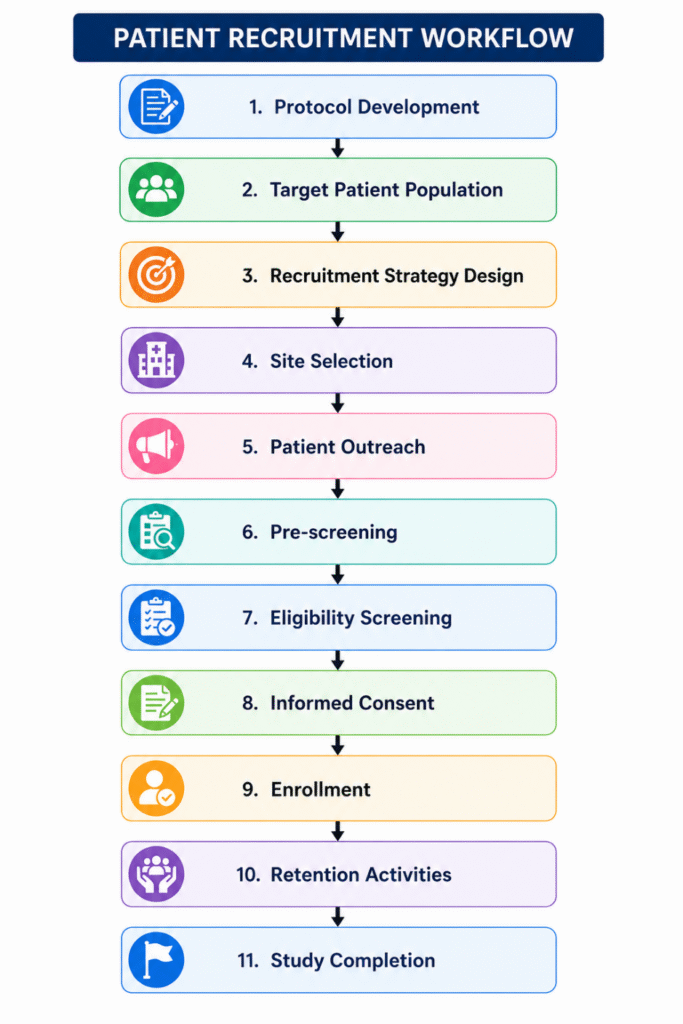
Key Patient Recruitment Support Services
| Service | Purpose | Key Activities / Focus Areas |
| Recruitment Planning | Develops a customized recruitment strategy based on study requirements. | Disease prevalence, patient demographics, geographic distribution, investigator capabilities, enrollment targets, and timeline requirements. |
| Site Selection and Feasibility | Identifies clinical sites with the highest potential for successful recruitment. | Previous recruitment performance, available patient population, investigator experience, staffing capacity, infrastructure, and regulatory readiness. |
| Patient Database Identification | Finds eligible participants using trusted healthcare data sources while maintaining privacy and ethics. | Hospital records, disease registries, Electronic Health Records (EHRs), physician networks, and patient advocacy organizations. |
| Digital Patient Recruitment | Expands patient reach through online and digital platforms. | Social media campaigns, search engine advertising, clinical trial websites, patient communities, mobile applications, email campaigns, and healthcare portals. |
| Community Outreach | Builds awareness and trust within local communities to encourage participation. | Health awareness programs, educational seminars, physician referrals, local healthcare partnerships, and patient advocacy collaborations. |
| Patient Pre-Screening | Evaluates potential participants before formal screening to improve recruitment efficiency. | Reduces screening failures, saves investigator time, lowers study costs, and improves enrollment efficiency. |
| Informed Consent Support | Ensures participants fully understand the clinical trial before enrollment. | Explains study objectives, procedures, potential risks and benefits, confidentiality, and voluntary participation. |
| Participant Retention Programs | Keeps enrolled participants engaged throughout the study to minimize dropouts. | Appointment reminders, travel assistance, patient education, regular follow-up communication, flexible scheduling, and patient support coordinators. |
Clinical Monitoring During Recruitment
Clinical Monitoring ensures recruitment activities comply with:
- Good Clinical Practice (GCP)
- Study protocol
- Ethical guidelines
- Regulatory requirements
Clinical monitors verify:
- Informed consent documentation
- Eligibility verification
- Source documentation
- Enrollment records
- Protocol compliance
- Data accuracy
Technologies Transforming Patient Recruitment
Technology has significantly improved recruitment efficiency.
Emerging innovations include:
| Technology | Application |
| Artificial Intelligence | Identifying eligible participants |
| Machine Learning | Predicting recruitment success |
| Electronic Health Records | Patient identification |
| Clinical Trial Management Systems | Recruitment tracking |
| Telemedicine | Remote participant screening |
| Wearable Devices | Continuous patient monitoring |
| Mobile Apps | Participant engagement |
| Electronic Consent (eConsent) | Digital informed consent |
Benefits of Professional Patient Recruitment Support
There are numerous benefits that organizations can obtain from specialized recruitment services.
- Enhanced Enrollment: Standardized recruitment approaches minimise recruitment times.
- Targeted Outreach: Greater age, ethnic and geographic diversity among participants.
- Reduced Recruitment Costs: Effective planning reduces advertising and screening costs.
- Improved Data Quality: Appropriate Participants increase the reliability of the study.
- Improved Participant Retention: Ongoing involvement decreases drop-outs.
- Regulatory Compliance: Seasoned CROs make sure that recruitment complies with international regulations.
Metrics Used to Measure Recruitment Performance
There are a number of measures that are considered key performance indicators (KPIs) for successful patient recruitment programs, such as:
- The Enrollment Rate is the percentage of all the people within a given time frame who are enrolled.
- Recruitment Timeline: Information regarding the time it will take to reach the target population.
- Screen Failure Rate: Percentage of candidates screened who are ineligible.
- Participant Retention Rate: Measures the percentage of patients that enter a clinical trial who remain in the study.
- Cost per Enrolled Participant: Determines the cost to recruit each person who was successfully enrolled.
- Recruitment Source Effectiveness: evaluates which recruitment sources yield the greatest number of qualified participants.
- Site Enrollment Performance: This measures the effectiveness of clinical trial sites to enroll patients.
- Time to First Patient Enrolled (FPI): Time elapsed between initiation of the study and enrollment of the first patient.
- Time to Full Enrollment: Measures the amount of time it takes to enroll all of the necessary people in the study.
Best Practices for Successful Patient Recruitment
The first step in effective recruitment is to understand the target patient population and what challenges they may be likely to encounter. Study designs are patient-centred, communications are simple, and culturally responsive approaches to outreach increase participation.
Digital advertising, physician referrals, and patient advocacy group partnerships can help increase reach, and consistent performance monitoring can allow teams to make rapid adjustments to their recruitment strategies. Reminders, educating and providing support through continuous engagement is also crucial to enhancing participant retention.
Example
A pharmaceutical company is running a Phase III clinical trial for diabetes in a number of cities that needs 600 patients. Enrollment is slow to start as many eligible patients are not aware of the study and there are challenges identifying patients at several sites.
The sponsor works through a CRO to implement a robust recruitment program that includes physician referrals, social media marketing, eHR screening and patient education webinars. The recruitment coordinator also arranges travel and sends reminders about the appointments to participants.
This means that enrollment moves at a much faster pace, participation rates increase, and the study is able to meet enrollment milestones on time, without sacrificing quality or regulatory standards.
Future Trends in Patient Recruitment
Patient recruitment is becoming increasingly data-driven and patient-focused. AI-driven eligibility matching, decentralized clinical trials, wearable healthcare technologies, multilingual digital recruitment initiatives, enrollment prediction tools, remote eConsent, and individualized patient engagement platforms are anticipated to be further features. The new innovations will expedite the recruitment process, include more individuals and make the recruitment process more efficient, while enhancing the experience of the participants.
Why Choose Professional Clinical Trial Support?
Professional Clinical Trial Support integrates the knowledge of CRO Support, Clinical Operations and Clinical Monitoring to provide effective recruitment strategies for each study.
Through sophisticated technology, regulatory expertise and patient-centric methods, experienced teams can optimize the process of enrolling patients for clinical trials, maintain high quality enrollments and ensure successful clinical trial results for sponsors.
Frequently Asked Questions (FAQs)
1. What are Patient Recruitment Support Services?
2. Why is patient recruitment important in clinical trials?
3. What role does a CRO play in patient recruitment?
4. How does digital recruitment improve enrollment?
5. What is patient retention in clinical research?
Final Thoughts
The key to any clinical trial is successful patient recruitment. Enrollment delays can have a profound effect on study timelines, budgets, regulatory milestones, and can enhance the quality of clinical evidence through efficient recruitment. The strategic approach of CRO Support, alongside robust Clinical Operations, Clinical Trial Support, and Clinical Monitoring, empowers organizations to surmount recruitment hurdles, boost participant satisfaction, and execute clinical trials more swiftly, accurately, and assuredly. With advancements in technology and patient-centred ways of doing clinical research, professional recruitment support will continue to be crucial for future success.
Book a free consultation for appointment
Email us at : grow@simbi.in