
Influence of Education and Occupation on Attitudes Toward Predators and Threat Perception

Introduction
Human-wildlife conflict is shaped not just by ecological realities but also by how people perceive wildlife, and these perceptions are strongly influenced by socio-economic factors like education and occupation. Individuals with higher education levels often demonstrate greater awareness of conservation benefits and are more likely to support coexistence strategies, whereas those with limited education may view wildlife, especially predators, as direct threats to safety and livelihood. Similarly, occupation plays a critical role-farmers, livestock owners, and forest-dependent communities tend to have more negative attitudes due to frequent encounters and economic losses. This dynamic highlights the importance of the keyword Education Occupation Attitudes Predators, as it captures how knowledge and livelihood experiences together shape tolerance levels, risk perception, and ultimately the success of conservation initiatives.
1. Attitudes toward predators
2. Perceived threats to livestock and ecology
3. Reasoning behind predator attacks
Using cross-tabulated SPSS outputs from a hypothetical dataset of 50 individuals in high-altitude pastoral communities, we examine these associations and their conservation implications.
Education levels often determine access to conservation information, while occupational roles shape firsthand experiences with predators—together forming Education Occupation Attitudes Predators in real-world contexts. Herders often understand behavioural patterns through direct interaction, whereas more formally educated individuals may rely on conceptual knowledge. This blend of practical and theoretical perspectives influences how communities assess risks and respond to predator encounters. By uncovering these nuances, this blog by Simbi Labs aims to support more inclusive, community-centered conservation strategies.
1. Education and Attitudes Toward Predators Association Between Education Level and Attitudes Toward Predators
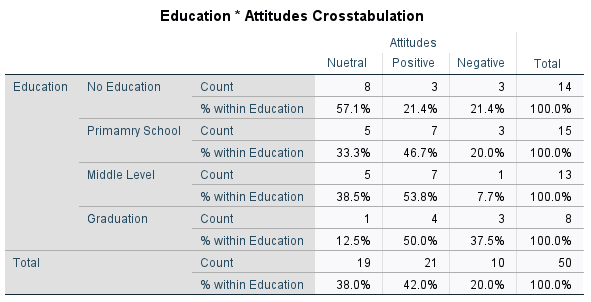
To explore how educational attainment affects community attitudes toward predators, a cross-tabulation was conducted between education level and attitudes (neutral, positive, and negative) using SPSS.
We categorized education into three levels:
0: No education
1: Primary level
2: Middle Level
3: Graduation
Interpretation:
The Chi-square test shows (χ² = 7.074, p = 0.314) which gives conclusion as no any statistically significant association between education level and attitudes toward predators. However, perceptible trends suggest educational background plays a role in shaping awareness and emotional responses.
Observed Trends:
i. No Education: Over half (57.1%) having neutral attitudes, possibly due to limited access to conservation narratives or awareness about predator roles in ecosystems.
ii. Primary and Middle-Level Education: These groups showed the highest proportion of positive attitudes (46.7% and 53.8%, respectively), suggesting that even basic education fosters ecological understanding.
iii. Graduates: While 50% expressed positive attitudes, and this group also had the highest negative sentiment (37.5%), possibly reflecting awareness of economic or livestock losses due to predator presence.
Interpretive Insights:-
i. The neutral stance among the uneducated may reflect passive acceptance or lack of informed opinion rather than indifference.
ii. Positivity in the primary and middle education groups indicates that basic ecological education may encourage coexistence mindsets.
iii. Graduates likely weigh both conservation values and livelihood risks, leading to divided sentiments—appreciating ecological roles but reacting to losses more critically.
Policy Implications:-
i. Conservation education must not stop at formal schooling; instead, it should use local dialects, community workshops, and participatory tools to engage all literacy levels.
ii. Graduates and semi-literate groups can serve as peer educators or awareness facilitators due to their balanced perspectives.
iii. Neutral respondents—especially those with no education—can be gradually engaged using storytelling, visual aids, and success stories that bridge emotional connection with ecological science.
iv. Occupation and Attitudes Toward Predators
2. Occupation and Attitudes Toward Predators Association Between Occupation Level and Attitudes Toward Predators
To explore how Occupational attainment affects community attitudes toward predators, a cross-tabulation was conducted between education level and attitudes (neutral, positive, and negative) using SPSS.
We categorized occupation into three levels:
1: Livestock herders
2: Agriculture
3: Daily wage/other labor
4: Government/service-related
Interpretation:-
The Chi-square test output (χ² = 5.493, p = 0.482) shows here no any statistically significant association among the source of occupation and attitudes toward predators. However, attitudinal patterns vary across occupational groups, reflecting differing exposure to wildlife, economic stakes, and ecological understanding.
Observed Trends:
i. Livestock Herders:-
60.0% expressed positive attitudes, the highest among the all groups, with only of 13.3% showing negativity. Their direct dependence on livestock may promote a balanced outlook between protecting assets and coexisting with predators.
ii. Agriculture Workers:
60.0% reported neutral attitudes, with fewer expressing strong opinions. This group may have less direct confrontation with predators, hence limited emotional or practical investment in the issue.
iii. Daily Wage / Other Labor:
Showed a mixed response – 41.7% neutral, 33.3% positive, and 25% negative. Likely due to indirect exposure to conflict and limited influence over livestock decisions.
iv. Government/Service Sectors:-
This group had the highest share of negative attitudes (30.8%), possibly due to analytical detachment or a focus on economic costs and safety, rather than traditional coexistence norms.
Interpretive Insights:
i. Livestock herders likely understand predator patterns more intimately and may have adopted non-lethal protective strategies, leading to tolerance-based attitudes.
ii. Farmers, who are less exposed to direct attacks, might view predators as a remote issue, resulting in passivity rather than fear or acceptance.
iii. Government workers and daily laborers might form opinions based on media, policy narratives, or second-hand stories, leading to polarized views not rooted in experience.
Policy Implications:
i. Livestock communities can be empowered as grassroots champions in predator coexistence campaigns.
ii. For agricultural and labor groups, awareness initiatives must clarify how ecological imbalances (e.g., declining prey or habitat loss) can impact wider communities.
iii. Service sector professionals, often involved in policymaking or administration, need evidence-based sensitization to ensure their influence supports informed wildlife management, rather than fear-driven responses.
iv. Programs should tailor outreach materials to align with daily realities and concerns of each occupational group—for instance, using financial risk narratives for service workers and practical herding demonstrations for livestock owners.
3. Education and Threat Perception Association Between Education Level and Threat Perception Toward Predators
To explore how Occupational attainment affects community attitudes toward predators, a cross-tabulation was conducted between education level and attitudes (neutral, positive, and negative) using SPSS.
We categorized education into four levels:
1: No education
2: Primary School
3: Middle School
4: Graduation
Interpretation:
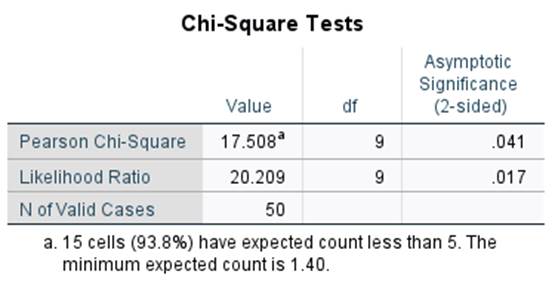
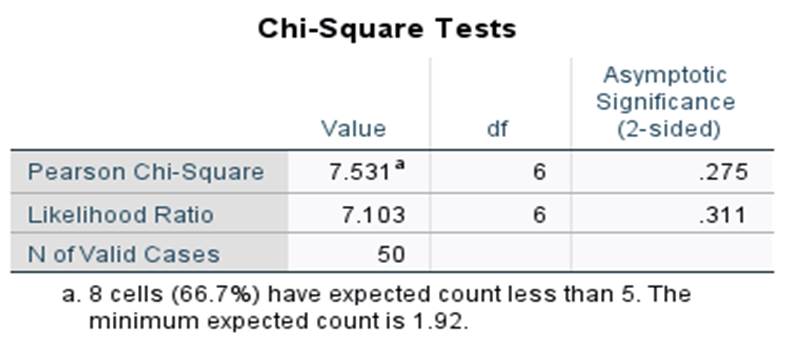
Chi-Square value of 7.531 with 6 degrees of freedom and a p-value of 0.275, which is greater than 0.05. This means there is no statistically significant relationship between the variables studied.
Observed Trends:
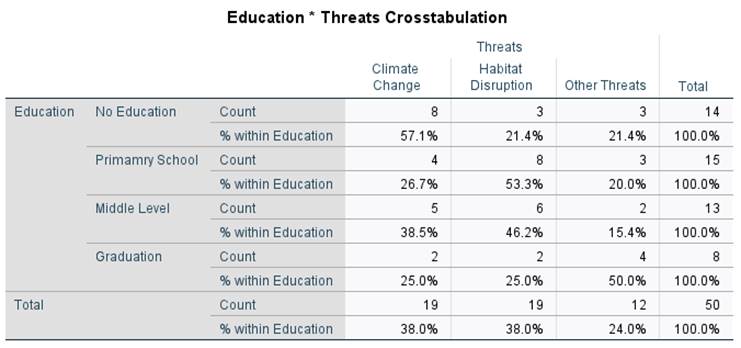
The cross-tabulated data shows how individuals with different levels of education perceive threats to livestock and ecology. Although no Chi-square output is given, we observe clear patterns in threat prioritization across education levels. These insights can help tailor awareness efforts to the specific understandings and knowledge gaps of each educational group.
i. No Education:
57.1% of individuals in this group identified Climate Change as the main threat, suggesting their perception may be shaped by observed weather patterns, such as reduced snowfall or drought, even if they lack formal knowledge. Only 21.4% recognized Habitat Disruption, showing possible underestimation of landscape-level changes.
ii. Primary School Educated:
This group had the highest focus on Habitat Disruption (53.3%), indicating that basic education may enhance awareness of physical environmental changes, such as deforestation or pasture encroachment.
iii. Middle-Level Education:
Responses were more balanced: 38.5% cited Climate Change and 46.2% Habitat Disruption. This reflects a developing ability to recognize both global and local environmental drivers of wildlife conflict.
iv. Graduates:
The majority (50.0%) identified Other Threats, suggesting a broader, more nuanced understanding. These could include tourism pressures, feral dog populations, or infrastructural development—concerns typically raised in higher education curricula or media exposure.
Interpretive Insights:
i. Individuals with no formal education often rely on personal experience and traditional knowledge, which may overemphasize visible climate effects while underrepresenting systemic threats like habitat fragmentation.
ii. Primary and middle-level education strengthens ecological literacy, likely through exposure to environmental studies or community programs.
iii. Graduates exhibit diverse perspectives, likely influenced by exposure to complex ecological narratives or interdisciplinary information.
Policy Implications:
i. Awareness campaigns for uneducated groups should use visual storytelling and local analogies to explain abstract issues like habitat disruption.
ii. For those with primary and middle-level education, interactive workshops focusing on ecosystem balance, predator-prey dynamics, and land use change can deepen understanding.
iii. Educated individuals can be mobilized as community ambassadors to bridge gaps between policy and practice—especially in introducing emerging threats like infrastructure development or tourism-driven disturbance.
iv. Education-level segmentation allows precision targeting in conservation outreach, ensuring messages resonate with each group’s existing worldview and informational exposure.
4. Occupation and Reasoning Behind Predator Attacks Association Between Occupation and Reasoning Behind Predator Attacks
To explore how Regional attainment affects community predators attack toward livestock, a cross-tabulation was conducted between education level and attitudes (neutral, positive, and negative) using SPSS.
We categorized reasons into:
i. EP = Exposed Predator
ii. NPD = Natural Prey Decline
iii. FF = Favourite Food
iv. NS = Not Sure
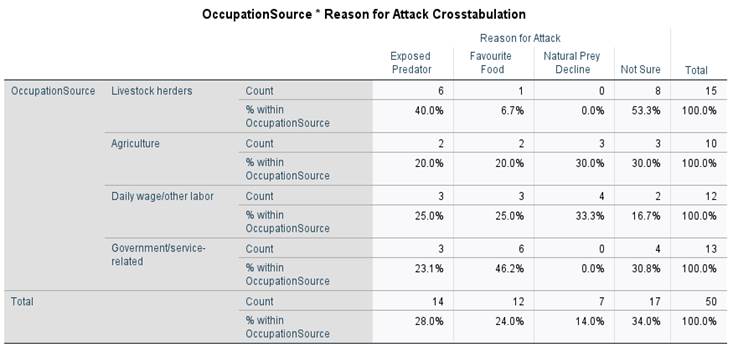
Interpretation:
The Chi-square test result (χ² = 17.51, p = 0.041) indicates a statistically significant association between occupation and perceived reason for predator attacks. This suggests that individuals’ livelihood types influence how they interpret predator behavior, likely due to differences in daily exposure, responsibilities, and informational access.
Observed Trends:
i. Livestock Herders:
A large portion (53.3%) were not sure about the reason behind predator attacks, while 40% attributed it to Exposed Predators. This reflects their practical experience with livestock predation, yet also shows gaps in ecological knowledge, possibly due to lack of formal training or scientific information.
ii. Agricultural Workers:
Responses were fairly evenly distributed: 30% cited Natural Prey Decline, 20% Favourite Food, and 20% Exposed Predators, with another 30% uncertain. This balanced view may stem from indirect involvement in herding, leading to mixed perceptions shaped by both anecdotal knowledge and community narratives.
iii. Daily Wage/Other Laborers:
This group showed the most diverse perception: 33.3% identified Natural Prey Decline, 25% each for Favourite Food and Exposed Predators, and 16.7% were unsure. Their exposure to multiple roles in village life might explain their wider range of understanding.
iv. Government/Service Sector:
This group leaned heavily on the Favourite Food explanation (46.2%), possibly reflecting education-based reasoning or exposure to documentary and media explanations, while 30.8% remained unsure.
Interpretive Insights:
i. Livelihood proximity to predators does not always guarantee ecological awareness. Even though herders face attacks firsthand, their interpretation may be driven more by experience than understanding of ecological dynamics like prey decline.
ii. Those in non-herding occupations are more likely to speculate or combine personal belief with second-hand knowledge, leading to heterogeneous responses.
iii. Government employees may have greater access to information (formal or media-based), influencing their choice of Favourite Food as a rationale—though this may oversimplify predator behavior.
Policy Implications:
i. Tailored educational outreach is necessary:
a. For herders, focus on interactive trainings that connect their real-life experiences to ecological causes like prey loss and habitat shifts.
b. For agriculture and labor sectors, use community storytelling and demonstrations to improve understanding of predator needs and behaviors.
c. For government/service workers, emphasize science-based predator-prey dynamics, and encourage them to serve as information intermediaries within their communities.
ii. Conservation programs must recognize that occupation shapes perception, and designing one-size-fits-all interventions may not be effective.
iii. Bridging the knowledge-experience gap through livelihood-sensitive content can foster better coexistence strategies and informed predator management.
Key Takeaways
i. Education and occupation influence predator perception, even though statistical significance was not established.
ii. Primary education and livestock-based occupations correlate with more positive attitudes and more ecologically-grounded reasoning.
iii. Higher education enhances climate change awareness, but does not always correlate with tolerance toward predators.
iv. There is a knowledge gap among service and wage workers, suggesting a need for inclusive awareness initiatives.
Policy Implications
i. Community-based education programs should be designed to bridge perceptual gaps across education levels.
ii. Livelihood-based conservation models should involve herders actively, recognizing their ecological insight.
iii. Education campaigns should be:
a. Locally contextual
b. Visually engaging
c. Multilingual
d. Delivered via village meetings and local leaders
For an in-depth understanding, please refer to our book, “Academic Research Fundamentals: Research Writing and Data Analysis”. It is available as an eBook here, or you may purchase the hardcopy here .