
Smart Scaling in 2025: How Food Processing Units Can Achieve Growth Without Sacrificing Quality

“In 2025, India’s food processing industry is more than just kitchens and factories. It’s a high-tech battlefield where new ideas decide who wins the market share. The country is leading the charge with its booming agro-tech hubs and data analytics ecosystem.”
It’s not enough to merely increase the size of a food processing plant nowadays. You also need to create smart, flexible systems that can predict demand, achieve high quality requirements, and save costs. Businesses need to use AI-powered analytics, automation, and eco-friendly practices to remain competitive since consumer tastes are changing quickly and the market is expected to develop at an unprecedented rate. This year is a turning moment, and those that combine data-driven decision-making, operational excellence, and eco-friendly procedures will be the ones who dominate both local and global markets. The future of food depends on finding the right balance between size, speed, and responsibility. This will transform forward-thinking plans into long-term market leadership.
Read Also : From Kitchen to Global Plates: Navigating the Journey of Business Expansion in Food Manufacturing
Background
History— Role in India’s food processing growth
Food-processing narrative started as an offshoot of its rich dairy and agro-trading hinterland. In the past twenty years, the city has grown from small businesses like dairies, spice shops, and traditional snack shops to a larger group of businesses that support value-added manufacturing, such as bakeries and candy stores, frozen food companies, juice concentrates, and ingredient companies. Local chambers and industry groups have worked hard to connect farmers, processors, and markets. This helped turn seasonal crops into items that can be stored for a long time and helped local businesses grow.
Government initiatives & FDI inflow — policy fueling scale
The Ministry of Food Processing Industries (MoFPI) has started several programs at the national level to build common facilities, cold chains, and formalise small businesses. These programs include Agro Processing Clusters, Mega Food Parks, PMFME (PM Formalisation of Micro Food Processing Enterprises), and a Production Linked Incentive scheme. These programs make it easier for scaling units to get started and build common infrastructure that smaller processors in and surrounding can utilise. The central and state cluster-development funding have also helped micro and small businesses in the area.
India’s open FDI policy for food processing and related retailing has brought in a lot of money. In recent years, total FDI in the food processing sector has reached multi-billion-dollar levels, showing that investors trust the country and allowing technology transfer, cold-chain investments, and brand-led scale-ups that help manufacturers. Official investment and FDI trackers keep track of these movements and show that the industry is a good place to invest.
Key industries in using food-processing innovations
This cluster supports several subsectors where innovation and scale are visible:
1. Dairy & Frozen Dairy — organized milk collection, cold-chains and automated processing for value-added products (paneer, ice-cream mixes, UHT milk).
2. Packaged snacks & bakery — local bakeries and snack manufacturers adopt automation, packaging innovations and shelf-life engineering to reach retail and e-commerce channels.
3. Frozen & ready-to-eat (RTE) foods — processors use blast-freezing, MAP (modified atmosphere packaging) and cold storage to serve distant markets.
4. Juices & concentrates, spices and ingredients — small processors leverage dehydration, aseptic processing and standardized formulation to enter institutional and export markets.
These businesses are relying more and more on shared infrastructure (such cold warehouses, testing laboratories, and APCs) and data-enabled quality controls to fulfil export and regulatory requirements. Because it is close to the agricultural belt and has industrial parks and testing and technology schools, it is a good site for these subsectors to try out new ideas and grow their businesses.
Top Strategies for Scaling Without Sacrificing Quality
Food Processing Units Growth in 2025: Key Trends to Watch
To grow a food processing unit in 2025, you need a balance of technology, efficiency, and sustainability.
1. Adopt advanced automation and IoT-driven monitoring : Using AI, IoT, and predictive analytics to regulate processes in real time helps spot problems early and keep quality high.
2. Invest in robust traceability systems (blockchain, data transparency): Blockchain and other technologies make guarantee that everything is visible from farm to fork and can’t be tampered with. This builds confidence and accountability.
3. Leverage innovative processing technologies : Aseptic processing, for example, keeps nutrients better than older procedures and makes it possible to produce vast amounts of food.
3. Implement smart quality control (optical sorting, biosensors) : Using optical sorting and biosensors to automate processes leads to more accuracy, less waste, and faster work.
4. Focus on training, automation, and workforce planning : To help with labour shortages, you may upskill current employees, work with schools, and establish career paths.
5. Incorporate sustainability into process innovation: By using eco-friendly packaging, lean manufacturing, energy-efficient tools, and ways to cut down on waste.
6. Adopt centralized production (e.g., production kitchens): These types of kitchens allow for more capacity, predictable operations, and lower costs.
7. Balance cost control with rigorous safety systems: Use lean systems, energy-efficient machines, and cost-aware automation to keep safety and quality high while staying inside your budget.
Present Scenario — Where We Stand in 2025
Market Size & Growth Rate (2025)
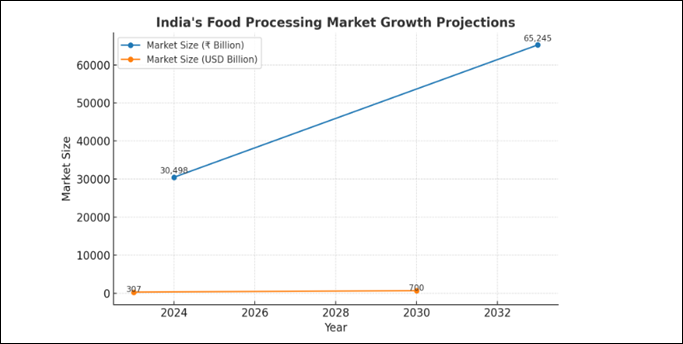
India’s food processing industry was worth ₹30,498 billion in 2024. Projections show that it would grow at a strong CAGR of 8.38% between 2025 and 2033, reaching over ₹65,245 billion by 2033 (IMARC Group). In addition, industry forecasts say that the sector would grow from USD 307 billion in 2023 to USD 700 billion by 2030, more than double (Business Standard, The Economic Times). These development trends clearly show that this is a high-momentum business with big chances to expand operations all across the country.
Future Trends & Opportunities
1. AI-Based Quality Control – Enables real-time defect detection, ensuring consistent results and reducing waste.
2. Eco-Friendly Packaging & Green Production – Attracts environmentally conscious customers and meets global sustainability standards.
3. Smart Warehousing & Blockchain – Creates transparent supply chains, building greater customer trust.
4. Data-Driven Demand Forecasting – Aligns production with market demand, reducing losses and improving efficiency.
5. Growth Opportunities – These innovations open profitable avenues in both domestic and export markets, positioning India as a competitive hub in the global food industry.
Common Bottlenecks in Scaling – Food Processing Units
1. High Infrastructure Cost: Setting up processing plants, cold storage facilities, and effective distribution networks costs a lot of money, which makes it hard for small and medium businesses (SMEs) to do so.
2. Regulatory Complexity—Following FSSAI rules, getting licenses like the FPO mark, and satisfying strict food safety compliance requirements all take time, money, and knowledge.
3. Shortages of skilled workers— The industry can’t adapt and keep up with new technology since there aren’t enough educated machine operators, food technologists, and data analysts.
4. Operational Inefficiencies: Poor production planning, equipment downtime, and poor coordination of the supply chain may all slow down attempts to scale up.
5. Limited Access to Finance: Many small and medium-sized businesses have trouble getting loans or investments that are reasonable, which slows down efforts to modernise and expand their capacity.
Key Challenges Smart Scaling in Food Processing :-
1. Disruptions in the supply chain and rising costs
Geopolitical concerns, bad weather, a lack of workers, and changing tariffs are making it hard to get raw materials and raising prices. Prices keep going up quicker than they used to.
2. Lack of workers and skills
An ageing workforce, fewer new hires for agricultural and processing jobs, and a lack of qualified personnel all make it harder to run a business and grow.
3. Keeping nutritional integrity on a large scale
Using more severe processing methods, including longer heat treatments and higher pressure, to speed up production will lower the nutritional content.
4. Pressure from the environment and the law
As rules become stricter and more people want eco-friendly operations and packaging, it becomes harder to scale up.
5. Finding a balance between safety and cost management
Controlling costs is now just as important as food safety, which is a big change in the objectives of the sector.
6. Problems in integrating technology
It may be hard to use AI, IoT, traceability, and automation because of problems with data protection, complicated implementation, and keeping the system accurate.
Read Also : Lean and Sustainable Textile Production: Reducing Environmental Impact
How Simbi Labs Helps Scale Food Processing Units in
At Simbi Labs know that in 2025, growing a food processing unit isn’t just about adding more space; it’s also about making better, data-driven choices that keep you ahead of the competition. This is how we help:
1. Demand Forecasting: Simbi Labs uses powerful statistical models to estimate seasonal and regional demand trends so that firms may plan their production and inventories. For instance, snack makers may avoid making too much during months when demand is low and increase production before the holidays.
2. Production Optimisation: The team looks at machine performance, cycle durations, and defect rates to find process gaps that slow down production. This helps cut down on downtime and boost yield.
3. Quality Control Analytics: Real-time monitoring and statistical process control find quality problems early, which cuts down on waste and customer complaints.
4. Market Feasibility Studies: Simbi Labs looks at possible product launches by looking at what customers want, how much they are willing to pay, and how the competition works in both local and foreign markets.
5. Competitor Benchmarking: Businesses may strategically position themselves by carefully looking at their competitors’ pricing, distribution, and marketing techniques.
6. SPSS and Stata Knowledge: We use advanced statistical tools for in-depth trend analysis, operational efficiency studies, and risk modelling.
7. AI-Powered Analytics: Machine learning algorithms find patterns in production and market data that aren’t obvious, which makes it possible to anticipate when maintenance will be needed, estimate demand, and learn about consumer behaviour.
8. Lower Costs : Streamlined processes and better use of resources reduce down on energy usage, waste, and inefficient labour.
9. Better ROI: Strategies based on data make sure that investments pay off quicker.
10. Better sell Positioning: Using insights to differentiate products and sell them better makes brands more competitive in a developing food industry.
Conclusion
Smart scaling in food processing requires a careful balance between expansion and quality. To get around problems like supply chain problems, a lack of workers, and regulatory pressure, companies need to use new technologies like automation, the Internet of Things (IoT), and blockchain for traceability. Long-term success depends on putting sustainability and worker development first. Innovative processing processes help maintain nutritional integrity at scale. Food processing plants may grow quickly without lowering quality by combining cost management with strict safety requirements and using environmentally friendly methods. In the end, the only way to do well in this changing, competitive environment is to be strategic and always adapt.
For an in-depth understanding, please refer to our book, “Academic Research Fundamentals: Research Writing and Data Analysis”. It is available as an eBook here, or you may purchase the hardcopy here .
For an in-depth understanding, please refer to our book, “Academic Research Fundamentals: Research Writing and Data Analysis”. It is available as an eBook here, or you may purchase the hardcopy here .
For an in-depth understanding, please refer to our book, “Academic Research Fundamentals: Research Writing and Data Analysis”. It is available as an eBook here, or you may purchase the hardcopy here .