
How to Reduce Downtime in Manufacturing: Causes, Impact, and Practical Solutions
Downtime is one of the most significant operational challenges in manufacturing because every interruption can affect production output, labour utilisation, delivery schedules, and operating costs. The most effective approach to how to reduce downtime in manufacturing is not simply to prevent every failure. It is to systematically identify why production stops, detect problems earlier, reduce recovery time, and prevent recurring causes.
Read More : Transform Your Workplace with 5S: The Lean Secret to Efficiency and Growth
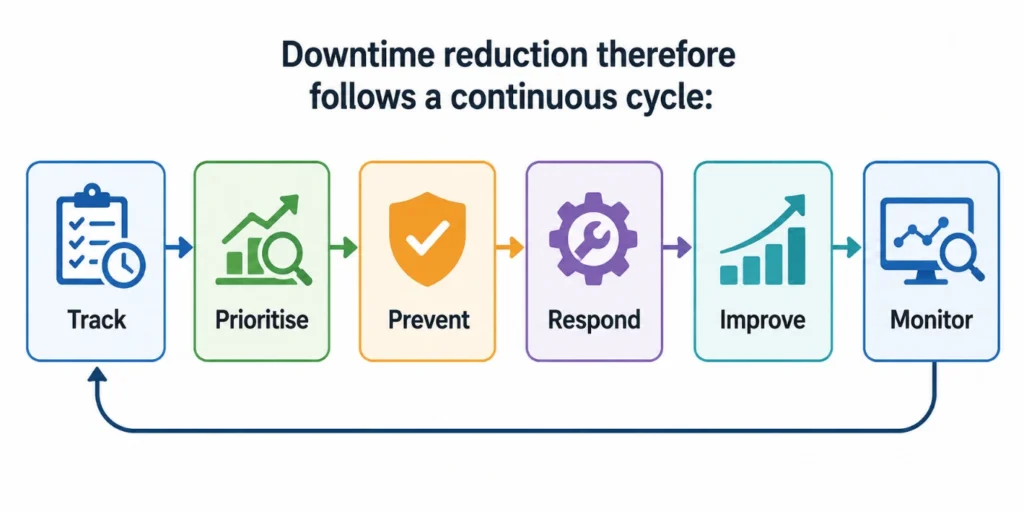
Understanding Planned and Unplanned Downtime
Downtime is not always negative. The first step is to distinguish between interruptions that are necessary and those that require improvement.
Planned Downtime
Planned downtime is a scheduled interruption for activities such as maintenance, equipment inspection, cleaning, changeovers, upgrades, or training. Although production temporarily stops, planned downtime can prevent more disruptive failures and allows resources, personnel, and spare parts to be prepared in advance.
Unplanned Downtime
Unplanned downtime occurs unexpectedly because of equipment failure, material shortages, utility interruptions, quality problems, or operational errors. These events require immediate attention and are generally the primary focus when organisations want to reduce downtime manufacturing.

Common Sources of Manufacturing Downtime
Downtime can originate from several parts of the production system:
Equipment: Mechanical wear, lubrication failures, electrical faults, and inadequate maintenance.
People: Incorrect settings, operating errors, insufficient training, or delayed problem escalation.
Materials: Shortages, late deliveries, and poor-quality inputs that interrupt production.
Utilities: Power, compressed air, water, or other essential service interruptions.
Quality: Process deviations, defective batches, rework, and stoppages required to investigate non-conforming products.
Start with Downtime Measurement
A manufacturer cannot reliably improve downtime that is not consistently measured. Every significant event should provide enough information to answer:
What stopped?
When did it stop?
How long did it last?
Why did it stop?
What was being produced?
What action restored production?
A practical downtime record may therefore include:
| Information | Why It Matters |
| Machine or process | Identifies where the event occurred |
| Start and end time | Measures duration accurately |
| Downtime cause | Supports root-cause analysis |
| Product or process condition | Identifies operating patterns |
| Shift or crew | Helps identify recurring conditions |
| Error code or observation | Provides technical evidence |
| Recovery action | Shows how the problem was resolved |
Consistent tracking converts individual stoppages into data that can be analysed for patterns. Automated systems can help where available, but the important requirement is that the information is accurate and consistently recorded.
Prioritise Frequency and Impact
A common mistake is to focus only on the event with the longest downtime duration.
Consider two problems:
- Failure A: Occurs once and stops production for 10 hours.
- Failure B: Occurs 20 times, each causing a 40-minute interruption.
Failure A requires investigation because of its severity. However, Failure B creates more than 13 hours of cumulative downtime and may represent a recurring weakness in the production process.
Downtime should therefore be evaluated using a combination of:
Frequency × Duration × Production Impact
Additional factors such as safety risk, material waste, quality losses, and customer impact may also influence priorities.
Pareto analysis can help identify the causes contributing most to total downtime, but decision-makers should also consider whether a problem is recurring, preventable, and economically significant.
Reduce the Time Between Failure and Detection
One practical way to reduce machine downtime is to identify abnormal conditions before they develop into complete failure.
The process can be understood as:
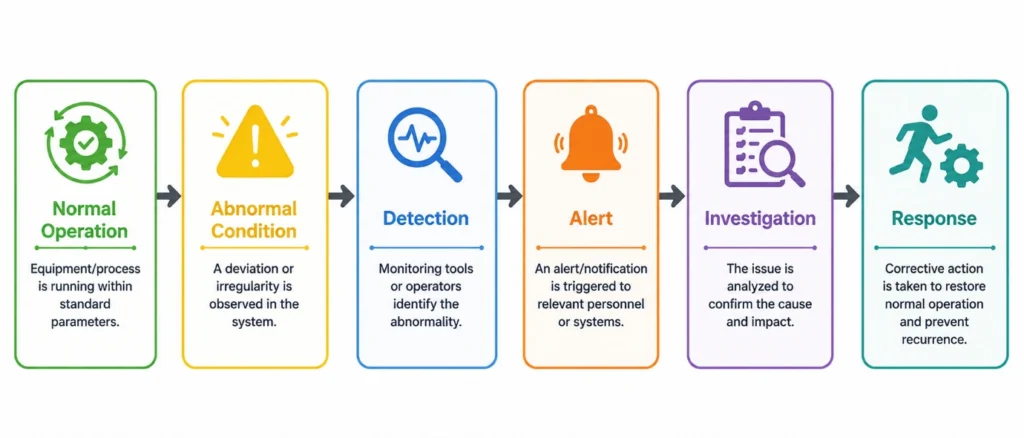
Temperature increases, unusual vibration, pressure changes, declining process performance, or repeated alarms may indicate developing problems. Real-time monitoring can make these conditions visible earlier and allow teams to intervene before production stops.
This does not require every facility to adopt advanced technology immediately. Even standard operating limits, inspection routines, and operator observations can improve early fault detection.
Strengthen Preventive and Predictive Maintenance
Preventive and predictive maintenance should serve different but complementary purposes.
Preventive Maintenance
Preventive maintenance uses scheduled activities such as:
- inspections;
- lubrication;
- cleaning;
- adjustments;
- component replacement.
The objective is to reduce the likelihood of predictable failures by acting before equipment reaches a critical condition.
Predictive Maintenance
Predictive maintenance uses equipment-condition information to estimate when maintenance may be required. Depending on the production environment, this can involve vibration, temperature, pressure, oil, or other performance data.
The key difference is simple:
Preventive maintenance = service according to a planned schedule
Predictive maintenance = intervene according to equipment condition
A strong maintenance strategy may use both approaches, depending on equipment criticality and available data.
Reduce Recovery Time When Downtime Occurs
Preventing failures is important, but some unplanned downtime will still occur. Therefore, manufacturers must also improve how quickly production can recover.
A practical recovery system includes:
Clear fault identification → Standard troubleshooting → Available technician → Correct spare part → Safe restart
This is particularly relevant when focusing on how to reduce machine downtime.
First-level troubleshooting guides can help operators identify basic problems and follow approved response procedures. Clear escalation criteria ensure that complex failures reach maintenance personnel without unnecessary delay.
Manufacturers should also examine whether frequently required spare parts are available when needed. A technically simple repair can become a long downtime event if the necessary component, specialist, or technical information is unavailable.
Eliminate Recurring Causes Through Root-Cause Analysis
Repairing a machine restores production, but it does not necessarily eliminate the cause of the failure.
When downtime repeatedly occurs, organisations need to move from:
“How do we restart the machine?”
to:
“Why does this problem keep returning?”
Several analytical methods can support this process:
- 5 Whys: Useful for progressively examining the underlying reason for a problem.
- Fishbone Diagram: Helps organise potential causes across categories such as people, equipment, methods, materials, and environment.
- FMEA: Helps prioritise potential failures according to their potential risk and consequences.
The appropriate method depends on the problem. A simple recurring fault may require a 5 Whys analysis, while a complex production risk may require a more structured FMEA.
Improve Operator Response Capability
Operators are often the first people to observe an abnormal machine condition. Their ability to respond appropriately can therefore influence both the frequency and duration of downtime.
Training should focus on practical capabilities, including:
- recognising abnormal operating conditions;
- following standard operating procedures;
- performing approved first-level checks;
- reporting faults accurately;
- knowing when to escalate a problem.
Reduce Material- and Utility-Related Interruptions
Not all production downtime originates from equipment failure. Material shortages can stop an otherwise healthy production line. Manufacturers should therefore identify critical materials, review supplier reliability, establish appropriate inventory policies, and assess whether alternative sources are necessary for high-risk components.
Similarly, operations dependent on electricity, compressed air, water, or other utilities should understand which interruptions can stop production and how recovery will be managed.
Backup systems may be appropriate for critical operations, but the right solution depends on operational risk and the importance of the process.
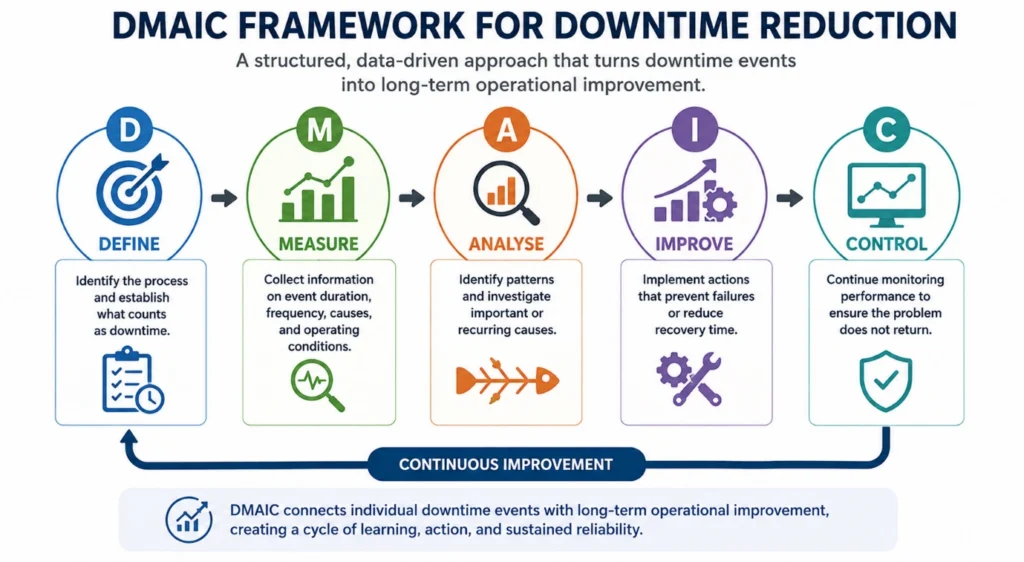
Use Continuous Improvement to Control Downtime
Downtime reduction should be treated as an ongoing improvement process rather than a one-time maintenance activity.
The DMAIC framework provides a structured approach:
Statistical and Analytical Techniques for Downtime Reduction
Different tools answer different questions.
| Technique | Best Used For |
| Pareto Analysis | Identifying major contributors to downtime |
| Time-Series Analysis | Detecting recurring patterns over time |
| Control Charts | Identifying unusual changes in process performance |
| Regression Analysis | Examining relationships between downtime and other variables |
| MTBF and MTTR | Evaluating reliability and recovery performance |
| FMEA | Prioritising potential failure risks |
| Hypothesis Testing | Assessing whether an improvement produced a meaningful change |
These methods should be selected according to the available data and the question being investigated. Advanced analysis is most useful when it supports a specific operational decision rather than being applied simply because the technique is available.
Monitor the Right Downtime Metrics
Improvement should be measured after changes are introduced.
| Metric | Practical Question |
| Downtime duration | How much production time was lost? |
| Downtime frequency | How often are interruptions occurring? |
| MTBF | How reliably is equipment operating between failures? |
| MTTR | How quickly are failures being resolved? |
| OEE | How effectively is planned production time being used? |
No single metric provides a complete picture. For example, a lower number of failures may still result in high production losses if recovery time is excessive.
A Practical Downtime Reduction Scenario
Consider a packaging line experiencing repeated short stoppages.
Instead of immediately replacing equipment, the manufacturing team first records every event for several weeks. The data shows that most interruptions are associated with the same machine condition. The team then:
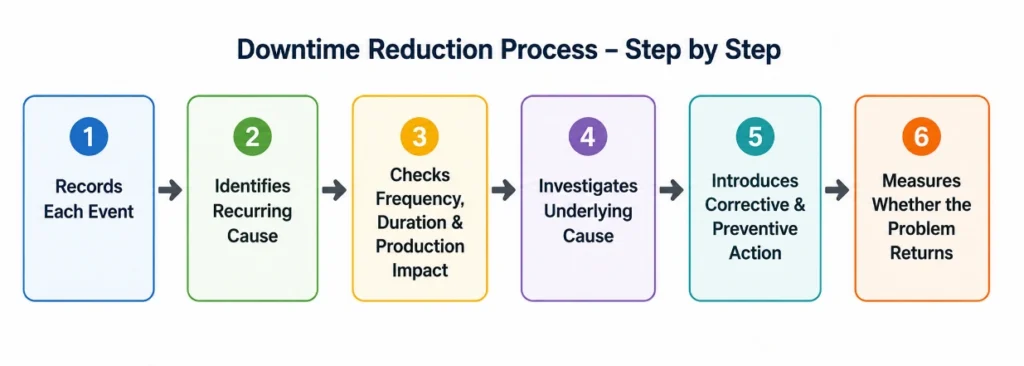
If the frequency of the stoppage decreases, the team can continue monitoring the improvement. If it returns, the analysis can be reviewed and a different corrective action considered.
This illustrates a practical approach to how to reduce downtime in production: decisions are based on recurring operational evidence rather than assumptions.
Advanced Technologies That Can Support Downtime Reduction
Advanced technologies can strengthen existing downtime-management practices.
IoT sensors can provide continuous information on equipment condition.
AI and machine learning may support pattern recognition and predictive models when sufficient quality data is available.
Digital twins can support modelling and analysis of equipment or process behaviour.
Frequently Asked Questions
What is the most effective way to reduce downtime in manufacturing?
There is no single solution. Effective downtime reduction begins with accurate measurement and cause identification, followed by preventive or predictive maintenance, faster recovery procedures, root-cause analysis, and continuous monitoring. The best strategy depends on the type and frequency of the production interruptions.
How can manufacturers reduce machine downtime?
Manufacturers can reduce machine downtime by improving maintenance practices, monitoring equipment condition, detecting abnormalities earlier, maintaining critical spare parts, and standardising troubleshooting and recovery procedures. MTBF and MTTR can also help assess equipment reliability and repair efficiency.
How can production downtime be reduced?
Production downtime can be reduced by analysing equipment failures as well as material shortages, utility interruptions, quality problems, and operational issues. A production-wide approach is important because not every stoppage is caused by a machine.
Why should downtime be categorised?
Categories make it easier to identify patterns. For example, separating planned maintenance from unplanned equipment failures, material shortages, and quality stoppages allows manufacturers to focus improvement efforts on the appropriate causes.
What data should be recorded for a downtime event?
Useful information includes the machine or process affected, start and end time, duration, cause, product being produced, shift, operating condition, error information, and the action taken to restore production.
Is planned downtime always undesirable?
No. Planned downtime is often necessary for maintenance, inspections, cleaning, upgrades, and other activities that support reliable operations. The objective is not to eliminate all planned downtime but to manage it efficiently and reduce unnecessary interruptions.
For an in-depth understanding, please refer to our book, “Academic Research Fundamentals: Research Writing and Data Analysis”. It is available as an eBook here, or you may purchase the hardcopy here .