
Cutting Downtime with SMED in Food Production
Introduction: The Clock Is Ticking in Food Manufacturing
Imagine this your manufacturing line stops for a “quick” changeover, but it takes hours instead of minutes. Orders are piling up, raw supplies are waiting, personnel are standing about, and customers are becoming antsy. It seems like money is sliding through your fingertips every minute. In the fast-paced food business, where freshness doesn’t last long and demand never stops, downtime is more than just a pain—it’s a killer of profits.
That’s where SMED, or Single-Minute Exchange of Die, comes in. SMED started as a lean manufacturing idea in the auto industry, but it has already spread to bakeries, dairy plants, beverage factories, and snack production lines, where it has cut changeover times from hours to just a few minutes. Those extra minutes might mean fresher food, happier consumers, and a healthier bottom line for food manufacturers.
SMED, or Single-Minute Exchange of Dies, is a lean manufacturing method that tries to cut down on the time it takes to swap out equipment to less than 10 minutes. Separating internal (when the machine is stopped) and external (while the machine is operating) activities, changing internal chores to external, standardising processes, and educating personnel are some of its most important aspects. SMED cuts down on idle time by reducing procedures and getting materials ready ahead of time. This makes it easier to switch between production runs more quickly. This cuts down on downtime, enhances production, and makes things more flexible, which is great for sectors like food processing, automotive, and packaging.
SMED, or Single-Minute Exchange of Dies, is a lean manufacturing method that tries to cut down on the time it takes to swap out equipment to less than 10 minutes. Separating internal (when the machine is stopped) and external (while the machine is operating) activities, changing internal chores to external, standardising processes, and educating personnel are some of its most important aspects. SMED cuts down on idle time by reducing procedures and getting materials ready ahead of time. This makes it easier to switch between production runs more quickly. This cuts down on downtime, enhances production, and makes things more flexible, which is great for sectors like food processing, automotive, and packaging.
Read More : Lean Audits: Improving Food Quality & Traceability
Background: SMED’s Journey from Metal to Meals
Shigeo Shingo came up with SMED in the 1950s to help Toyota’s assembly lines replace dies in stamping machines more quickly. The objective is to make changeovers happen in less than 10 minutes.
In food production, the basic idea is still the same, but there’s a twist: changeovers aren’t only about setting up machines. Cleaning to meet sanitary standards, swapping out ingredients, changing packaging, and checking quality are all things that happen a lot. SMED procedures assist you figure out which chores may be done while the machine is operating (external setup) and which tasks must be done while the machine is not running (internal setup). The result: speedier restarts, less waste, and quality that stays the same.
What is SMED?
SMED, or Single-Minute Exchange of Dies, is a lean manufacturing method that tries to cut down on the time it takes to swap out equipment to less than 10 minutes. Separating internal (when the machine is stopped) and external (while the machine is operating) activities, changing internal chores to external, standardising processes, and educating personnel are some of its most important aspects. SMED cuts down on idle time by reducing procedures and getting materials ready ahead of time. This makes it easier to switch between production runs more quickly. This cuts down on downtime, enhances production, and makes things more flexible, which is great for sectors like food processing, automotive, and packaging.
Why SMED Works for Food Manufacturing
SMED cuts down on downtime in food processing by separating operations that may be done while the machine is operating (external) from those that must be done when it is stopped (internal). This division makes changeovers easier, thanks to standardised procedures and well-trained workers. Cross-training personnel helps them work together and be flexible, which lets them move quickly and in a coordinated way that keeps production going smoothly without lowering hygiene or quality requirements.
Key Reasons SMED Works:
1. Clearly separates internal and external tasks to minimize idle time.
2. Standardizes procedures for repeatable, efficient changeovers.
3. Empowers employees through cross-training to handle diverse tasks.
3. Improves communication and coordination during changeovers.
4. Enhances flexibility to switch between multiple product SKUs quickly.
Present Scenario: The Business & Customer Perspective
From the Business Side:
When food production stops, it may cost thousands of dollars an hour. Faster changeovers let you make more batches in a shift, which cuts down on idle time, makes better use of equipment, and greatly increases the return on investment.
From the Customer Side:
Less downtime means quicker, fresher delivery of goods. Customers don’t have to deal with as many stockouts and delays, and the quality is always good. In competitive marketplaces, this dependability develops trust, increases satisfaction, and creates long-term commitment to the brand.
Objectives of SMED in Food Manufacturing
1. Reduce Changeover Time: From hours to minutes without compromising food safety.
2. Increase Productivity: More batches per day = higher output and profitability.
3. Improve Flexibility: Switch between SKUs to meet changing market demands.
4. Maintain Quality & Compliance: Ensure hygiene, allergen control, and consistency.
5. Minimize Waste: Reduce product loss during transition phases.
Causes of Downtime in Food Manufacturing
1. To achieve food safety regulations, long cleaning and sanitation procedures are needed, but they make changeovers take much longer.
2. Adjusting complicated machines for various goods needs exact calibration, which makes the line stay idle longer.
3. Poorly organised equipment and supplies slow things down since workers have to look for or get ready for changeovers, which wastes time.
4. Untrained or inexperienced employees have a hard time performing changeover activities, which causes mistakes and longer downtime.
5. Changes to the size and shape of packaging require resetting and retooling of equipment, which slows down output even further.
6. Poor communication and a lack of established processes cause workers to have to wait and coordinate shifts longer than required.
Implementation Roadmap for SMED in Food Production
The goal of using SMED (Single-Minute Exchange of Dies) in food manufacturing is to cut down on changeover downtime by a lot, which will increase efficiency and output.
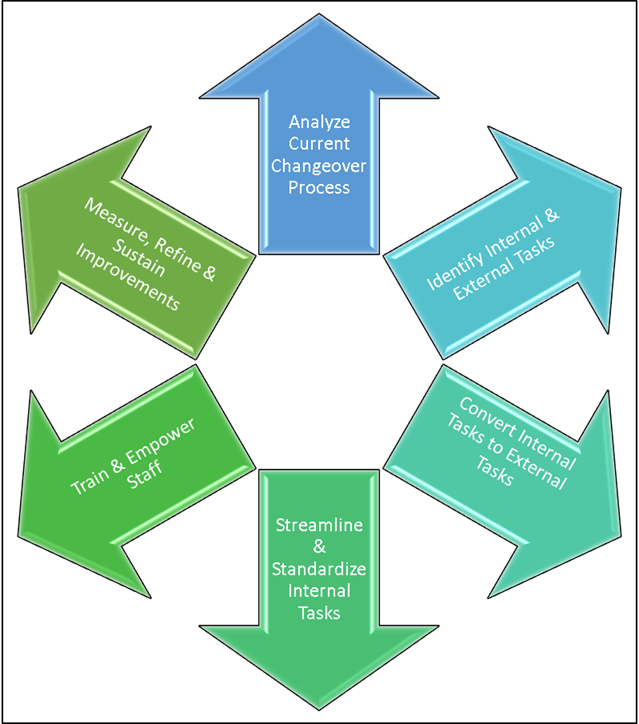
1. The first step is to look at the existing changeover stages and find any places where things get stuck.
2. Next, tasks are divided into internal (done when the equipment is stopped) and external (done while the equipment is operating). The goal is to turn as many internal jobs into external ones as feasible.
3. Clear methods, quick-release mechanisms, and the best positioning of tools make internal chores easier and more consistent.
4. Staff are taught and given the tools they need to make quick and accurate changeovers.
5. Finally, performance is checked on a regular basis, and changes are made to keep improvements going and make sure that changeovers happen quicker and more consistently without sacrificing food safety or quality.
Impact of Downtime – The Business & Customer Perspective
Business Side:
Long periods of downtime during changeovers cost a lot of money and make everyone less productive. Without SMED, food makers have to deal with inefficient line stoppages and lengthier cleaning cycles, which leads to poor equipment use and worse ROI.
Customer Side:
Longer downtime means later delivery and less stock, which makes customers unhappy. When product quality isn’t consistent throughout fast changeovers, it hurts the brand’s reputation, which makes customers less likely to trust and stay loyal over time. SMED helps lessen these effects by making changeovers happen quicker and more reliably.
Future Outlook: SMED in the Next Decade
By 2035, SMED in food processing will be a completely automated system that runs on data. Machines will automatically adjust to changing product standards, which will cut down on the need for people to do it. Autonomous cleaning robots will do a good job of controlling allergens, which will mean fewer long breaks. SMED will work with real-time supply chain and demand forecasting systems to allow for dynamic scheduling of changeovers. This will make sure that food manufacturing firms have the most uptime, the least waste, and the fastest reaction to changes in the market. This will turn downtime reduction into a strategic advantage for these enterprises.
A Real Life Application SMED Implementation in a Biscuit Manufacturing Plant
A major Indian biscuit maker was wasting more than four hours a day because it took too long to switch between various types of biscuits. Because of this downtime, supplies were late, manufacturing capacity went down, and labour prices went up. During the transition, the mixers had to be cleaned, the baking temperature profiles had to be changed, and the moulds had to be changed. Most of this work was done while the production line was halted.
Solution Steps:
1. Current Process Analysis: The team documented each changeover step using video analysis to identify inefficiencies.
2. Task Separation: All activities were classified into internal (requiring stoppage) and external (possible during operation).
3. Conversion of Internal to External Tasks: Pre-heating ovens, preparing molds, and staging raw materials were shifted to be done while production was still running.
4. Streamlining Internal Tasks: Quick-lock mold systems and color-coded cleaning kits were introduced to speed up in-line changes.
5. Standardization: Clear SOPs and visual work instructions were implemented to ensure every team followed the same sequence.
6. Training & Empowerment: Operators were trained on SMED techniques and encouraged to suggest further improvements.
7. Continuous Measurement: A digital dashboard tracked changeover times in real-time to maintain progress.
Result
The installation of SMED cut down on changeover times by a lot, which made operations run more smoothly and increased production capacity. Standardising procedures and streamlining processes made things run more smoothly, and better organising tasks cut down on delays. By making better use of labour and cutting down on downtime, the company was able to save money. The changes also made customers happier by making sure deliveries were on schedule. This method showed that using organised changeover reduction approaches in food production may lead to long-term operational advantages, higher productivity, and better connections with clients by consistently and reliably performing.
Read More : Fresh to Fork: How Lean JIT Slashes Food Waste and Boosts Kitchen Efficiency
How Simbi Labs Delivers Efficient Solutions as a Six Sigma Consultant Using SMED
As Six Sigma consultants, we analyze changeover processes, eliminate non-value-added activities, and apply tailored SMED techniques to shorten setup times, optimize workflow, ensure compliance with food safety regulations, and sustain productivity, quality, and cost savings through continuous training, standardization, and performance monitoring.
1. Process Mapping & Time Study – Analyze the existing changeover workflow using Six Sigma tools to identify bottlenecks and waste.
2. SMED Implementation – Apply Single-Minute Exchange of Die principles to separate internal and external tasks and streamline setup activities.
3. Standardization & SOPs – Develop clear, visual Standard Operating Procedures to ensure consistent, fast, and error-free changeovers.
4. Skill Development & Training – Conduct targeted operator training to improve efficiency, teamwork, and changeover speed.
5. Continuous Monitoring & Control – Use control charts and KPIs to track performance, sustain improvements, and ensure downtime remains minimized.
Conclusion
Every minute of downtime in the food business means less work and less money. SMED is an organised, useful way to get this time back by making changeover procedures easier and better. It lets you move quicker without losing quality by carefully analysing, separating tasks, and standardising them. The end result is more production, less waste, and a better ability to meet client needs. Food manufacturers may improve their efficiency, stay competitive, and keep providing value in a fast-paced, demanding market by using SMED.
Interesting Fact:
Did you know? Nestlé reduced changeover times in one of its chocolate production lines by over 80% using SMED principles—saving millions annually while meeting festive season demand peaks.
If your factory could gain an extra hour of production every day, what would you do with it—launch a new product, serve more customers, or simply outpace the competition?
Contact Simbi Labs today and take the first step toward your goals with confidence.
Schedule your free consultation now.
Book a free consultation for appointment
Email us at : grow@simbi.in