How We Work: Reliable Methods for Smarter Market Insights

Our research philosophy at Simbi Labs of India grounded in rigor, transparency, and actionable insights. We don’t just run surveys; we design studies that stand up to scrutiny and deliver clarity for decision-making. Below is our structured approach to provide reliable methods that drive smarter market insights.
1. Mixed-Methods Research
Qualitative Methods
i. In-Depth Interviews (IDIs): One-on-one conversations that uncover motivations, barriers, and hidden drivers of choice.
ii. Focus Group Discussions (FGDs): Group dynamics that bring out shared perceptions and contrasting opinions.
iii. Ethnography & Observations: Immersive techniques to study customers in their natural environments—homes, shops, or workplaces.
Example: For a consumer goods brand, Simbi Labs of India conducted in-home ethnography to observe how families store and consume packaged foods, revealing storage challenges that shaped packaging innovation.
Quantitative Methods
i. Structured Surveys: Large-scale questionnaires for measurement and benchmarking.
ii. Controlled Experiments: A/B testing and randomized trials to identify causal impacts.
Example: A fintech app tested different onboarding journeys, with experiments showing a 23% uplift in KYC completion rates.
2. Right-Sized Sampling
Power-Based Design
We calculate required sample sizes based on statistical power rather than guesswork. This ensures results are reliable and cost-efficient.
India-Wide Coverage
We maintain national panels that cut across metros, Tier-2/3 towns, and rural regions, with language localization for inclusivity.
City-Level Deep Dives
When needed, we zoom into specific urban markets for city diagnostics—ideal for retail audits or regional ad effectiveness checks.
Example: For a quick-commerce player, Simbi Labs of India compared Mumbai vs. Bengaluru shopper habits, finding different peak-hour purchase patterns.
3. Bias Control in Research
Randomization
Survey orders, concept rotations, and test/control assignments are randomized to avoid leading patterns.
Attention & Consistency Checks
Trap questions and response-time flags help identify inattentive participants.
Fraud Prevention
i. Deduplication: Digital fingerprinting ensures no duplicate respondents.
ii. Supervision & Back-Checks: On-ground validation for field interviews.
iii. Geo-Verification: Location pings confirm survey authenticity in the intended region.
Example: In a national FMCG tracker, fraud prevention tools filtered out 7% of low-quality responses, improving overall data reliability.
4. Data Governance & Ethics
Informed Consent
All participants are briefed on purpose, usage, and their right to withdraw.
Anonymization
Personally identifiable information is stripped at source, and all reports are shared in aggregated form only.
ISO-Style SOPs
Our processes mirror international best practices, covering:
i. Secure data transfer and storage (encrypted formats).
ii. Version control and audit logs.
iii. Controlled team access to sensitive datasets.
Compliance & Transparency
We adhere to GDPR-like norms, ensuring client confidence in both methodology and outcomes.
Example: In a healthcare study, anonymization protocols allowed doctors to share candid insights without risking privacy breaches.
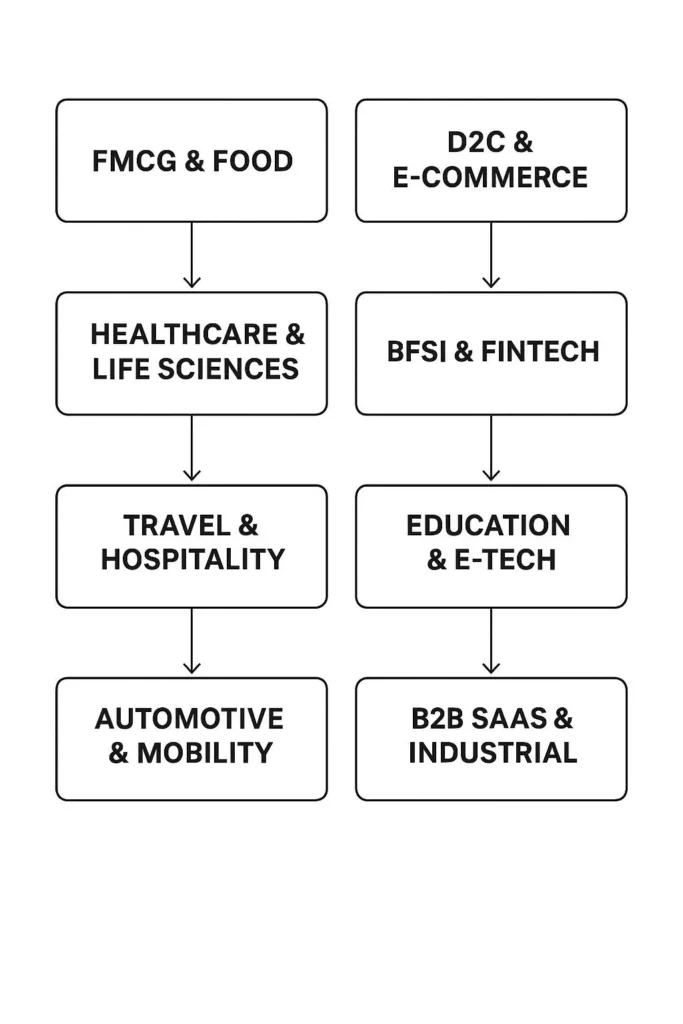
Industries We Serve
Our expertise spans a wide range of industries. We bring domain knowledge, customized research designs, and contextual insights that translate into clear business actions.
1. FMCG & Food
We work with packaged food and personal care brands on:
Market Sizing & Share: Identifying growth potential in urban and rural channels.
Product & Concept Testing: Testing new flavors, formats, and pack sizes before launch.
Brand Tracking: Monitoring awareness, trial, repeat, and loyalty over time.
Example: A snack brand used conjoint analysis with us to select the right pack-size and price-point, projecting an 11% revenue increase.
2. D2C & E-Commerce
For digital-first and omni-channel players, we provide:
Customer Segmentation: Understanding online buying triggers and pain points.
UX/CX Research: Improving website/app journeys with usability tests and funnel analytics.
Competitive Benchmarking: Analyzing share of search, reviews, and pricing strategies.
Example: A D2C beauty brand optimized its checkout process after our UX tests revealed cart drop-offs due to unclear shipping policies.
3. Healthcare & Life Sciences
We support pharma, health-tech, and wellness players through:
Patient & Doctor Research: Capturing treatment journeys and adoption drivers.
Market Access & Policy Scans: Mapping regulatory landscapes for new therapies.
Digital Health Studies: Evaluating telemedicine and health app user experiences.
Example: A healthcare app validated teleconsultation adoption in Tier-2 towns through mixed-method studies.
4. BFSI & Fintech
For banks, insurers, and fintech disruptors, we deliver:
Customer Needs Mapping: Identifying drivers of trust, safety, and convenience.
Product & Pricing Research: Testing digital loan products, insurance plans, and payments.
Brand Lift Studies: Measuring ad effectiveness in crowded digital spaces.
Example: A fintech wallet saw a 23% uplift in KYC completion after we ran UX tests on its onboarding flow.
5. Travel & Hospitality
We help airlines, hotels, and OTAs stay customer-centric by:
Experience Tracking: Measuring satisfaction at every touchpoint—booking, check-in, stay.
Concept Testing: Evaluating new loyalty programs or service packages.
Trend Analysis: Spotting shifts in domestic vs. international travel behavior.
Example: A leading OTA restructured its loyalty tiers after conjoint research revealed what customers valued most.
6. Education & EdTech
We partner with schools, universities, and edtech platforms on:
Student Journey Mapping: From discovery to enrollment and retention.
Course & Content Testing: Identifying most valued features in online programs.
Market Sizing: Estimating demand for skill-based or vocational learning.
Example: An edtech platform optimized pricing for short-term coding courses using Van Westendorp analysis.
7. Automotive & Mobility
We work with OEMs, EV players, and mobility services to:
Purchase Journey Studies: Understanding dealer visits, test drives, and decision factors.
Feature Prioritization: Identifying which car or EV features customers will pay for.
Future Mobility Research: Tracking adoption of ride-hailing, EV charging, and shared mobility.
Example: A two-wheeler company used our conjoint analysis to test willingness-to-pay for battery swap stations in Tier-1 cities.
8. B2B SaaS & Industrial
We specialize in reaching niche decision-makers, including:
- Expert Interviews: Procurement managers, IT leads, and regulators.
- Win/Loss Analysis: Learning why deals are won or lost in complex sales cycles.
- Stakeholder Mapping: Understanding multi-buyer committees in enterprise sales.
Example: A SaaS firm repositioned its product for operations heads after buyer committee mapping revealed they were key influencers.
Conclusion
Market research is most valuable when it balances strong methodology with industry context. By combining qualitative depth and quantitative rigor, right-sized sampling, bias control, and strict data governance, we ensure every project delivers reliable insights. Simbi Labs of India uses reliable methods across sectors to provide smarter market insights from FMCG and e-commerce to healthcare, fintech, and B2B—shows that each industry requires a tailored approach. The common thread is turning complex data into clear, actionable guidance. With this framework, businesses can make confident decisions, reduce risks, and uncover new opportunities for growth in competitive markets.
For an in-depth understanding, please refer to our book, “Academic Research Fundamentals: Research Writing and Data Analysis”. It is available as an eBook here, or you may purchase the hardcopy here .