
Agricultural Insights in India: How Modern Data Collection Is Transforming Farming Decisions
The Growing Need for Smarter Agricultural Data
In India, agriculture plays a vital role and has significant importance in the economy of the country and there are millions of lives on the agriculture related livelihoods. Today’s agriculture requires more than just the wisdom and knowledge of the ages, however. In today’s era of agriculture, even the farmers, agribusiness, policymakers and researchers are increasingly utilizing agricultural information to enhance their productivity, reduce risk and make informed decisions based on true agriculture conditions in the field.
With the changing climate, market dynamics, and resource constraints, well-designed data gathering and AI-driven analysis are increasingly vital for sustainable development in the agricultural sector. Organizations can benefit from accurate agricultural insights to better gauge market needs, soil conditions, farmer actions, and crop trends.
Understanding Agricultural Insights and Their Role
Agricultural insights are valuable pieces of information that are gathered and analyzed in agriculture. This encompasses the information about the cultivation, weather, soil status, farmers’ choices, water usage, and market dynamics.
These are developed based on the quantitative data (crop yield and rainfall statistics) as well as the qualitative data obtained from farmer experiences and field observations. When analyzed together, these various data sources can help enhance planning, forecasting and agricultural decision making actions for India.
Why Agricultural Insights Matter in India
India’s agricultural landscape is highly diverse, with differences in climate, soil quality, crop patterns, and farming practices across regions. Because of this complexity, accurate agricultural insights are critical for improving efficiency and reducing uncertainty.
Key reasons driving the demand for agricultural insights include:
· Better policy development for rural and agricultural programs
· Improved crop productivity and yield forecasting
· Efficient allocation of water, fertilisers, and labor
· Early detection of risks such as droughts and pests
· Stronger market intelligence for agribusiness companies
As digital agriculture expands, organisations increasingly depend on agricultural insights to support long-term sustainability and profitability.
How Agricultural Insights Are Generated
Survey Planning and Design
Targets are set and questionnaires are designed for questioning on various aspects of crop production, farmers income, market situation, or a supply chain analysis.
Sampling and Field Selection
Structured sampling methods assure consistency of representation of different regions of agriculture and population.
Data Collection Methods
Agricultural insights are gathered using several approaches, including:
· Field surveys and interviews
· Mobile-based data collection systems
· Remote sensing technologies
· Telephonic and digital surveys
Validation and Cleaning
Data gathered is checked for inconsistencies and data quality.
Data Analysis
The raw data from the field is used to deliver meaningful insights in agriculture using advanced analytics and AI driven systems.
It assures correctness, scalability and relevance of the data output and facilitates decision-making.
Technologies Improving Agricultural Insights
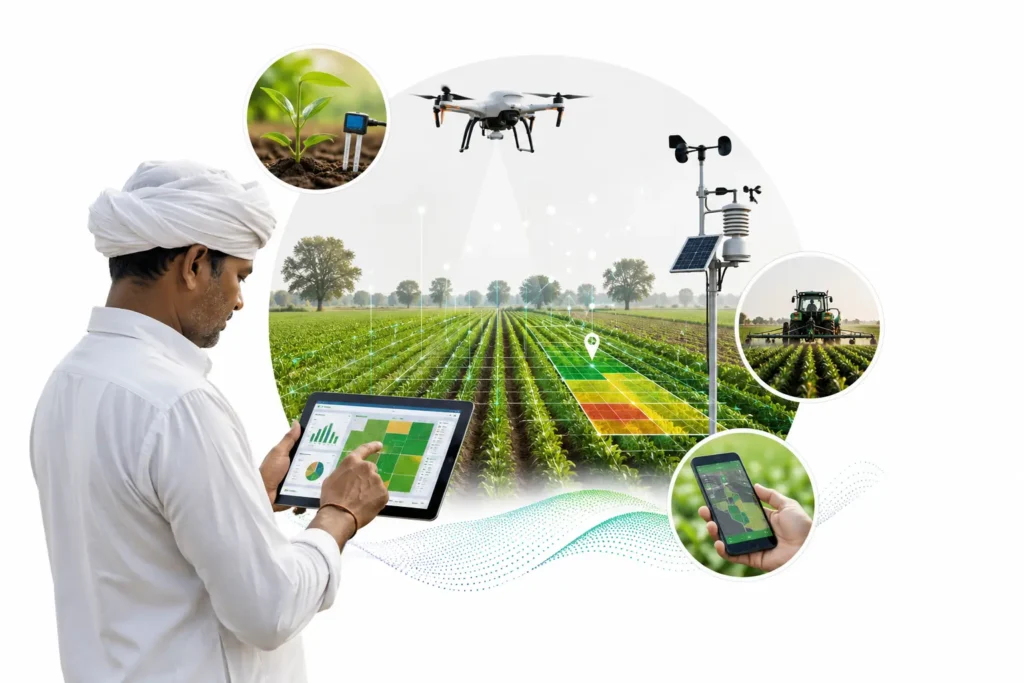
Digital solutions and automation are increasingly in use to accelerate and enhance agricultural research.
Mobile Data Collection Tools
Data collection is made efficient with the use of Applications like Open Data Kit and KoboToolbox even in rural remote areas.
AI and Predictive Analytics
The use of machine learning models for prediction of crop yield, risk assessment and precision farming.
Remote Sensing and GIS
Satellite imagery and GIS mapping systems aid in the monitoring of the land and crop assessment.
Cloud-Based Platforms
Cloud systems enable the real-time and scalable storage, monitoring and analysis of data.
The technologies not only add quality and value to the agricultural knowledge gained in India but also give a strong impetus to the overall capacity of farmers.
Features of Professional Agricultural Data Services
Organizations increasingly work with professional service providers to improve research quality and operational efficiency.
· End-to-end survey management
· Customized questionnaire design
· Multi-language survey support
· Real-time reporting dashboards
· High validation and quality standards
· AI-integrated analytics systems
These features help generate more reliable agricultural insights across diverse rural environments.
Benefits of Strong Agricultural Insights
Better Farming Decisions
Crop decision making, pricing, and resource management by farmers and agribusinesses can be informed.
Improved Productivity
Data-driven farming practices increase efficiency and crop performance.
Cost Reduction
Optimized planning helps reduce unnecessary use of water, fertilizers, and labor.
Market Intelligence
Businesses gain better visibility into demand trends and supply chain gaps.
Risk Management
Early detection of climate or pest-related issues improves preparedness.
These advantages demonstrate how agricultural insights contribute to both profitability and sustainability.
Industry Applications of Agricultural Insights in India
Agribusiness Companies
Supporting market expansion, customer segmentation, and product development.
Government and Policy Planning
Designing agricultural subsidies, insurance programs, and rural development strategies.
Research Institutions
Conducting studies on climate change, soil health, and agricultural innovation.
NGOs and Rural Development Programs
Monitoring field activities and evaluating community-based initiatives.
Across sectors, agricultural insights support more effective planning and execution.
Common Challenges in Agricultural Data Collection
Even large-scale agricultural studies can face operational and methodological issues.
· Poorly structured questionnaires
· Non-representative or biased sampling
· Weak data validation systems
· Ignoring regional languages and local context
· Excessive dependence on manual collection methods
Avoiding these mistakes improves the reliability of agricultural insights and strengthens research outcomes.
Choosing the Right Agricultural Research Partner
Selecting the right data collection provider is essential for achieving accurate and scalable results. Organizations should evaluate:
· Experience within Indian agriculture and rural markets
· Use of AI, mobile tools, and cloud-based systems
· Strong validation and quality assurance processes
· Ability to manage large-scale multi-state surveys
· End-to-end support from collection to reporting
An experienced provider helps organisations generate actionable agricultural insights that support long-term growth.
Future Trends Shaping Agricultural Insights
The future of agricultural insights is increasingly connected to intelligent and automated technologies.
· AI-powered predictive farming systems
· IoT-enabled smart agriculture devices
· Drone-based field monitoring
· Blockchain-enabled supply chain transparency
· Real-time dashboards for farmers and agribusinesses
These innovations are expected to make agriculture more efficient, sustainable, and data-driven across India.
Final Thoughts
In India, agricultural intelligence is becoming the pillars of today’s agribusiness approach and modern agriculture. With a mix of structured data collection, cutting-edge analytics and digital technologies, organisations can boost productivity, minimise risk and make better decisions throughout the agricultural value chain.
In the fast-paced world of agriculture, where data is becoming more and more critical, investing in reliable agricultural information is key for businesses, scientists and decision makers to remain competitive.
Looking for Professional Agricultural Research Solutions?
We offer Agricultural Insights in India through end-to-end agricultural data collection, AI-based analysis, market research, and reporting solutions for agribusinesses, research institutes, NGOs, and Government projects in India. Our expertise in Agricultural Insights in India helps organizations gain accurate, real-time understanding of farming conditions, market trends, and rural agricultural patterns. By delivering reliable Agricultural Insights in India, we enable smarter decision-making, improved productivity, and more efficient agricultural planning across diverse sectors.
Connect with us to transform agricultural insights into impactful and measurable outcomes.
Connect with us transform Agricultural Insights in India into actionable, data-driven strategies that improve productivity, reduce risk, and deliver measurable farming outcomes.
Book a free consultation for appointment
Email us at : grow@simbi.in