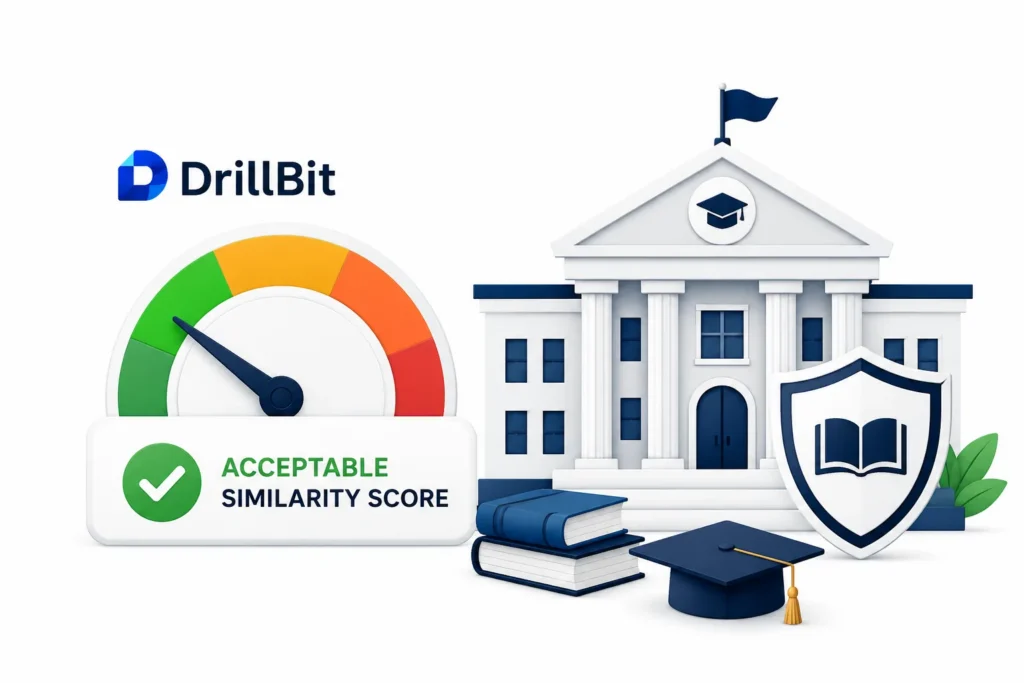
DrillBit Acceptable Similarity Score for Colleges and Universities
What Does a “Safe” DrillBit Score Really Mean?
One of the first questions students ask after checking their plagiarism report is simple:
What is an acceptable DrillBit similarity score?
It is a valid concern. A similarity percentage often feels like a direct judgment of your academic honesty, especially when submission deadlines are close.
But here is what many students misunderstand:
A DrillBit similarity score does not automatically decide whether your work is plagiarized.
The percentage only measures how much text overlaps with existing indexed content. It does not explain why the overlap exists.
Some matches are completely acceptable, while others may need correction. The real key is understanding what colleges and universities usually consider safe and how to respond when your score looks too high.
There Is No Universal Similarity Rule
Many students expect a fixed number that applies everywhere.
That is not how universities work.
Each institution sets its own acceptable similarity score for colleges based on:
- Academic policies
- Submission type
- Departmental standards
- Research level
- Citation expectations
A dissertation often receives different evaluation criteria than a short classroom assignment.
This means the “right” DrillBit similarity score depends on your academic context.
Typical DrillBit Similarity Score Ranges
Although standards vary, most institutions interpret similarity reports within general ranges.
0%–10% → Excellent Originality
This range usually indicates highly original writing.
Minor overlap often comes from:
- Standard academic wording
- Reference formatting
- Common technical terminology
For most submissions, this is considered a very safe DrillBit acceptable similarity score.
10%–20% → Normally Acceptable
This is common for research-based academic work.
Similarity often appears due to:
- Properly cited references
- Discipline-specific language
- Methodology descriptions
Most universities accept this range if citations are accurate.
This is often viewed as a practical safe plagiarism percentage.
20%–30% → Review Carefully
At this level, institutions usually expect closer review.
Common reasons include:
- Weak paraphrasing
- Heavy source summarization
- Citation inconsistencies
- Excessive direct quotations
This score is not automatically problematic, but it often requires revision.
Above 30% → Usually Needs Correction
A high DrillBit similarity score often indicates excessive overlap.
Possible causes include:
- Structural copying
- Poor paraphrasing
- Missing attribution
- Large quoted blocks
Most colleges will require correction before approval.
Read Also : How DrillBit Detects AI Content and Paraphrasing Tricks
Why Some Academic Papers Naturally Score Higher
Not all academic writing behaves the same way.
Certain submission types naturally produce more overlap.
Literature Reviews
These summarize existing research and often contain repeated terminology.
Technical Research Papers
Scientific definitions and methodological language may trigger matches.
Institutional Templates
Standard formatting language often appears across submissions.
This is why acceptable similarity score for colleges depends on document type.
Context matters more than raw numbers.
What Universities Actually Review
A strong DrillBit similarity score review looks beyond percentages.
Most institutions focus on:
- Source attribution quality
- Citation accuracy
- Original analysis presence
- Nature of overlap
- Intentional vs unavoidable similarity
A paper with 22% similarity and perfect citations may be safer than one with 8% containing uncited copied passages.
This is why percentages alone never tell the full story.
How to Lower a High DrillBit Similarity Score
If your score is above your institution’s threshold, focus on meaningful improvement.
Effective methods include:
Improve Paraphrasing
Rewrite ideas from understanding rather than changing isolated words.
Reduce Direct Quotations
Summarize source ideas in your own academic voice.
Correct Citations
Ensure every borrowed idea is properly referenced.
Add Independent Analysis
Original interpretation strengthens authenticity.
These methods support stronger original academic writing.
Avoid Quick-Fix Rewriting Tools
Many students try instant plagiarism removers.
These often create:
- Broken sentence flow
- Distorted meaning
- Awkward phrasing
- New detectable patterns
Real DrillBit similarity correction requires thoughtful human revision.
Quality matters more than shortcuts.
When to Ask for Professional Help
For final dissertations or major university projects, expert editing can save time.
Professional review helps:
- Identify risky overlap
- Strengthen originality
- Preserve academic precision
- Improve report confidence
This often produces safer DrillBit acceptable similarity score outcomes.
Final Thoughts
There is no single perfect DrillBit similarity score that guarantees approval.
What matters most is why similarity appears and whether your work demonstrates real academic ownership.
Instead of chasing the lowest number, focus on proper citation, strong paraphrasing, and meaningful analysis.
That is what colleges and universities truly value—and what defines genuine originality.
Book a free consultation for appointment
Email us at : grow@simbi.in