
High DrillBit Similarity Score: 10 Common Causes & Fixes
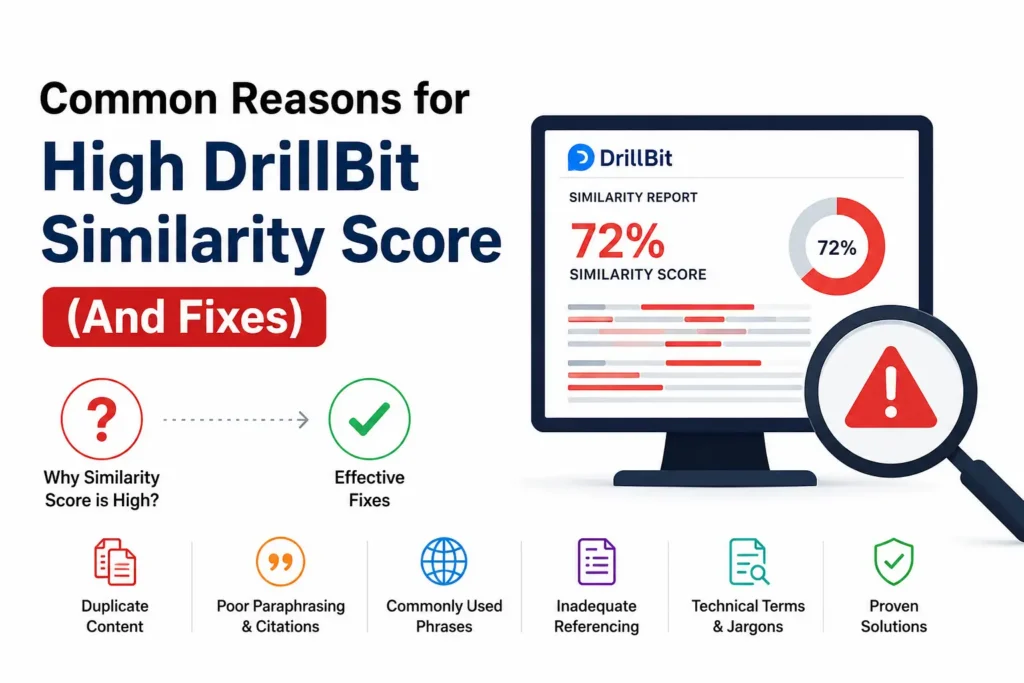
Why Does DrillBit Show High Similarity?
Getting a high DrillBit similarity score can feel frustrating, especially when you have spent hours writing your assignment, thesis, or research paper.
Many students immediately assume they have done something seriously wrong.
In reality, a high similarity percentage often happens because of small academic writing mistakes, citation problems, or formatting habits—not intentional plagiarism.
The good news is that most of these issues are fixable.
Understanding the most common reasons behind high DrillBit similarity score reports helps you correct the right sections quickly and improve originality before final submission.
Let’s look at the biggest causes and the smartest ways to fix them.
Read Also : How DrillBit Detects AI Content and Paraphrasing Tricks
1. Weak Paraphrasing
One of the most frequent causes of high DrillBit similarity score is weak paraphrasing.
This usually happens when students:
- Replace only a few words
- Keep the original sentence structure
- Rearrange phrases slightly
- Depend too heavily on source wording
DrillBit can often detect structural similarity even when exact wording changes.
How to Fix It
Instead of editing individual words:
- Read and understand the source fully
- Close the source material
- Rewrite from understanding
- Use your own structure and flow
This improves DrillBit similarity reduction naturally.
2. Too Many Direct Quotations
Quotes are useful when exact wording matters.
However, overusing them increases your DrillBit similarity score, even when correctly cited.
Large quoted blocks often contribute heavily to overlap percentages.
How to Fix It
Use quotations only when essential.
For most academic writing:
- Summarize source ideas
- Explain them in your own words
- Add analysis or interpretation
This strengthens original academic writing.
3. Citation Errors
Proper attribution matters—but incorrect formatting can still trigger DrillBit plagiarism report matches.
Common citation mistakes include:
- Missing quotation marks
- Incomplete in-text references
- Incorrect referencing style
- Missing bibliography entries
How to Fix It
Double-check every source reference.
Ensure your citation style is consistent throughout the paper.
Correcting references is often one of the fastest ways to lower high DrillBit similarity score results.
4. Overdependence on Source Material
A paper built mostly from external summaries naturally produces higher overlap.
This often happens in:
- Literature reviews
- Background research sections
- Source-heavy dissertations
When your voice is missing, similarity rises.
How to Fix It
Add more:
- Personal analysis
- Critical discussion
- Comparative evaluation
- Independent interpretation
This supports stronger plagiarism-free university submissions.
5. Submitting Multiple Draft Versions
Many universities store uploaded assignments in institutional databases.
Your final draft may then match your earlier submission.
This creates self-overlap and can increase DrillBit similarity score unexpectedly.
How to Fix It
Check with your institution about:
- Repository settings
- Draft exclusions
- Resubmission policies
Understanding this avoids unnecessary rewriting.
6. Repeated Academic Phrases
Certain academic expressions appear in thousands of submissions.
Examples include:
- “The findings suggest that”
- “This study demonstrates”
- “Based on the results obtained”
While individually harmless, repeated use can increase overlap.
How to Fix It
Vary your academic language naturally.
Develop your own analytical voice instead of repeating standard templates.
7. Copying Technical Definitions Exactly
Some subjects require exact wording for definitions or legal statements.
These often trigger high DrillBit similarity score reports.
How to Fix It
If exact wording is necessary:
- Cite properly
- Use quotation marks where required
- Confirm institutional guidelines
Do not force unnecessary rewrites that weaken accuracy.
8. Using Automatic Paraphrasing Tools
Many students rely on instant rewriting software.
These tools usually:
- Replace words awkwardly
- Distort meaning
- Create unnatural flow
- Leave structural similarity intact
This often makes DrillBit similarity reduction harder.
How to Fix It
Use manual editing instead.
Human revision preserves meaning and improves originality far better.
9. Poor Report Analysis
Some students only look at the percentage and ignore source details.
This leads to random editing rather than strategic correction.
How to Fix It
Perform detailed DrillBit report analysis.
Focus on:
- Large match blocks
- Repeated source overlaps
- Citation-related flags
This creates efficient revision.
10. Lack of Final Review
Even strong papers can contain unnoticed overlap if submitted without checking.
Small errors often remain hidden until final upload.
How to Fix It
Before submission:
- Review citations
- Recheck paraphrasing
- Analyze highlighted matches
- Confirm originality improvements
Final proofreading prevents avoidable similarity issues.
The Smartest Approach to DrillBit Correction
The best way to lower a high DrillBit similarity score is not aggressive rewriting.
It is thoughtful academic improvement.
Strong originality comes from:
- Better understanding
- Clearer explanation
- Personal analysis
- Accurate citation
- Natural structure
This protects both quality and academic integrity.
Final Thoughts
A high DrillBit similarity score usually reflects correctable writing habits—not failure.
Weak paraphrasing, citation errors, over-quoting, and source-heavy structure are common reasons reports rise.
Once you identify these patterns, fixing them becomes straightforward.
The goal is not just lowering a percentage.
It is producing work that clearly reflects your own thinking, understanding, and academic contribution.
Book a free consultation for appointment
Email us at : grow@simbi.in