
Data Analytics in Finance: Benefits, Uses & Trends in 2026
Financial institutions generate enormous volumes of data through transactions, payments, investments, lending, customer interactions, market movements and regulatory reporting. The challenge is no longer simply collecting this information but converting it into reliable insights that can support faster and more informed financial decisions.
Data analytics in finance brings together statistical analysis, data engineering, machine learning and visualisation to examine financial information and identify patterns, risks and opportunities. In 2026, the field is increasingly moving towards real-time analytics, AI-supported decision-making, automated risk monitoring and stronger data governance.
How Data Analytics Is Changing Financial Decision-Making
Traditional financial analysis often relies on historical reports and periodic reviews. Modern analytics allows institutions to examine continuously updated data and identify changes much earlier.
A typical analytical workflow may involve:

Financial datasets may include transaction records, customer profiles, credit histories, market prices, payment behaviour, operational data and external economic indicators. These datasets can be combined to develop a more complete view of financial performance and risk.
This is where a finance data analyst plays an important role by preparing datasets, developing analytical reports, identifying trends and communicating findings to finance, risk and management teams.
Major Uses of Data Analytics in Finance
The applications of analytics extend across banking, insurance, investment management, payments and corporate finance.
| Application | How Analytics Is Used | Typical Outcome |
| Fraud detection | Analyse transaction patterns and anomalies | Identify suspicious activity |
| Credit risk | Evaluate borrower characteristics and repayment behaviour | Improve risk assessment |
| Investment analysis | Examine market, portfolio and economic data | Support portfolio decisions |
| Customer analytics | Analyse customer behaviour and product usage | Improve segmentation and retention |
| Financial forecasting | Model revenue, expenses and cash flows | Improve financial planning |
| Risk management | Monitor exposure and changing risk indicators | Enable earlier intervention |
| Regulatory analytics | Analyse financial and transaction records | Support reporting and compliance |
| Insurance analytics | Analyse claims, customer and risk data | Improve pricing and claims assessment |
These applications show that analytics is not restricted to investment decisions. Data Analytics for Financial Services also supports operational efficiency, compliance, customer management and financial risk control.
Predictive Analytics for Financial Risk and Forecasting
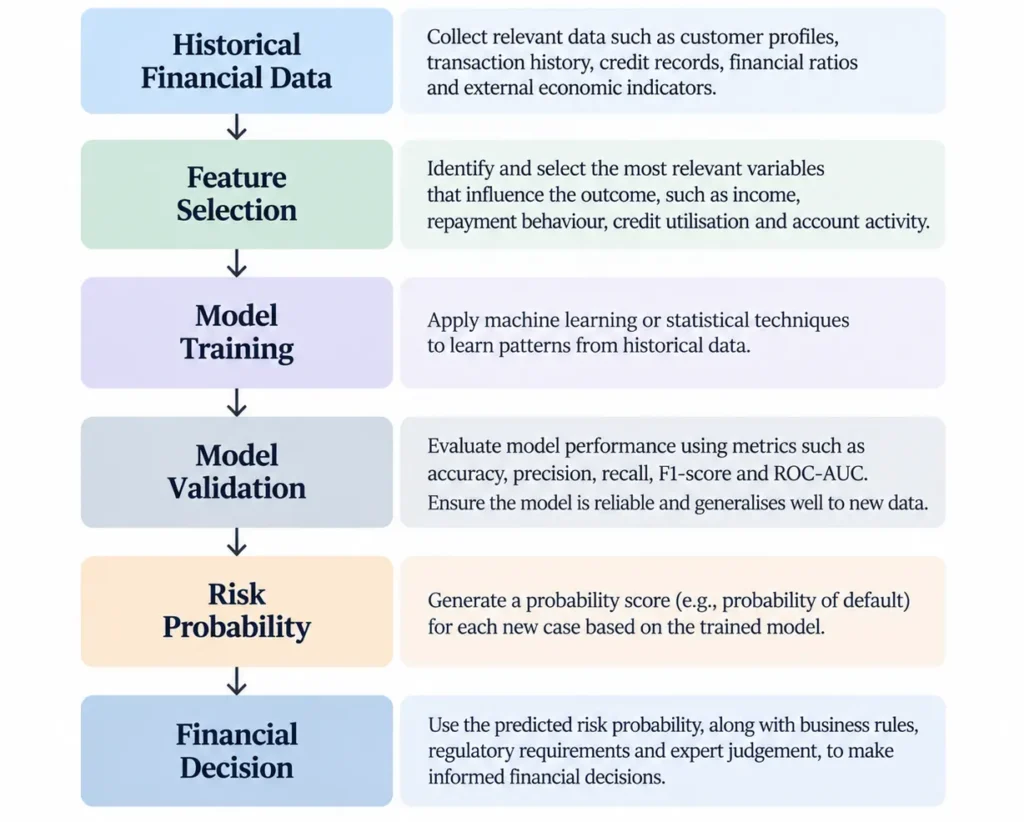
One of the most important developments in finance is the use of predictive analytics in finance. Instead of describing what has already happened, predictive models estimate the probability of future events.
Predictive models can estimate:
- Probability of loan default
- Customer churn
- Fraud risk
- Cash-flow requirements
- Claims frequency
- Payment delays
- Market or portfolio risk
- Demand for financial products
Consider a lending institution that has historical information on 50,000 borrowers. The institution could use repayment history, income characteristics, outstanding balances, credit utilisation and transaction behaviour to develop a default-risk model.
The dataset could be divided into training and testing subsets. After model development, performance could be evaluated using measures such as ROC-AUC, precision, recall, F1-score, calibration and confusion matrices rather than relying only on overall accuracy.
READ ALSO : Inferential Statistics vs Predictive Analytics: Key Differences
Fraud Detection Through Real-Time Financial Data
Fraud detection is another area where analytics has become increasingly sophisticated. Traditional rule-based systems may flag transactions based on predefined conditions, such as unusually large payments or transactions from unexpected locations.
For instance, a payment may appear normal when considered individually but become suspicious when analysed alongside unusual login activity, device changes, transaction velocity and previous customer behaviour.
This makes anomaly detection, machine learning and network analysis increasingly relevant to financial fraud monitoring. Recent IMF research also highlights the growing importance of analytics and AI in addressing digital fraud and cyber-related risks across financial services.
Customer and Portfolio Analytics
Financial analytics helps institutions understand customer behaviour and portfolio performance. Transaction data can support customer segmentation, product analysis and retention strategies, while portfolio data can be used to assess asset correlations, volatility, drawdowns and exposure.
By combining historical and scenario-based data, analysts can evaluate potential financial outcomes and support evidence-based financial decisions rather than relying only on periodic reports.
Data Infrastructure Matters as Much as the Analytical Model
Advanced modelling cannot compensate for poor-quality financial data. Duplicate records, missing values, inconsistent definitions, outdated information and disconnected databases can significantly affect analytical results.
Financial organisations therefore need strong data pipelines and governance frameworks covering:
- Data quality and validation
- Metadata and data lineage
- Access controls
- Privacy and security
- Standardised definitions
- Model-data compatibility
- Auditability and traceability
Skills and Tools for a Finance Data Analyst
The role of a finance data analyst combines financial knowledge with technical, statistical and communication skills. The key capabilities can be grouped as follows:
| Skill Area | Core Skills | Application in Finance |
| Technical Skills | SQL, Python, R, Excel, statistical modelling, data visualisation | Data preparation, analysis, automation and reporting |
| Financial Knowledge | Financial statements, credit risk, portfolio analysis, financial ratios, regulatory concepts | Interpreting financial performance and risk |
| Analytical Skills | Regression, forecasting, hypothesis testing, segmentation, anomaly detection, model evaluation | Identifying trends, estimating risks and supporting financial decisions |
| Communication Skills | Data interpretation, reporting, visualisation and business communication | Converting analytical findings into actionable recommendations |
Tools such as Power BI, Tableau, Python, R, SQL-based platforms and cloud analytics environments may be used depending on the organisation’s technology architecture.
Key Trends Shaping Data Analytics in Finance in 2026
1. AI-Assisted Financial Analytics
AI and machine learning are increasingly used for fraud detection, credit assessment, compliance, customer service and financial analysis. Strong governance remains essential for responsible AI adoption.
2. Real-Time Analytics
Real-time transaction monitoring enables faster fraud detection, payment-risk assessment and operational responses.
3. Generative and Agentic AI
Generative AI supports financial document analysis, reporting and information retrieval, while agentic AI can assist with selected workflows. Strong controls are needed to manage inaccurate outputs and model risks.
4. Stronger Data Governance
Privacy, data quality, cybersecurity, model transparency and accountability are becoming central to managing financial data and AI systems.
5. Predictive Risk Monitoring
Financial organisations are moving from periodic risk reporting towards continuous monitoring, using historical and current data to identify emerging risks earlier.
Conclusion
Data analytics in finance is evolving from descriptive reporting towards predictive, real-time and AI-supported financial decision-making. Its applications now extend across fraud detection, credit risk, investment analysis, customer analytics, forecasting, compliance and operational management.
For organisations working with Data Analytics for Financial Services, the greatest value comes from connecting reliable data with appropriate analytical methods and sound financial judgement. Predictive analytics in finance can help identify potential risks and opportunities earlier, while skilled finance professionals ensure that analytical results are interpreted within the appropriate business and regulatory context.
In 2026, the competitive advantage is therefore not simply having more financial data. It is the ability to turn high-quality data into timely, explainable and actionable financial intelligence while maintaining strong governance, security and human oversight.
Book a free consultation for appointment
Email us at : grow@simbi.in