
Inferential Statistics vs Predictive Analytics: Key Differences
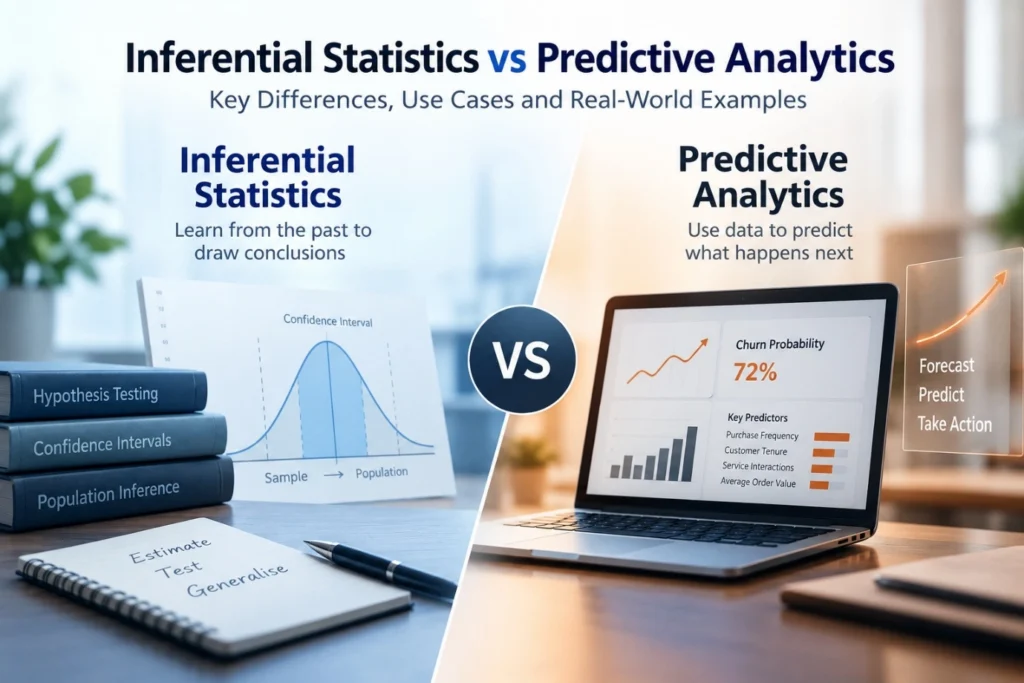
Modern data analysis involves more than calculating averages or identifying patterns. Researchers and organisations often need to determine whether findings from a sample can be generalised to a wider population, while also estimating what may happen for future or previously unseen observations. This makes understanding inferential statistics vs predictive analytics important when selecting analytical methods and interpreting results.
Although both approaches use statistics, probability and mathematical modelling, their objectives are different. Inferential statistics focuses on drawing conclusions about a population from sample data, whereas predictive analytics focuses on generating useful estimates for future or new cases.
Inferential Statistics and Predictive Analytics: Core Difference
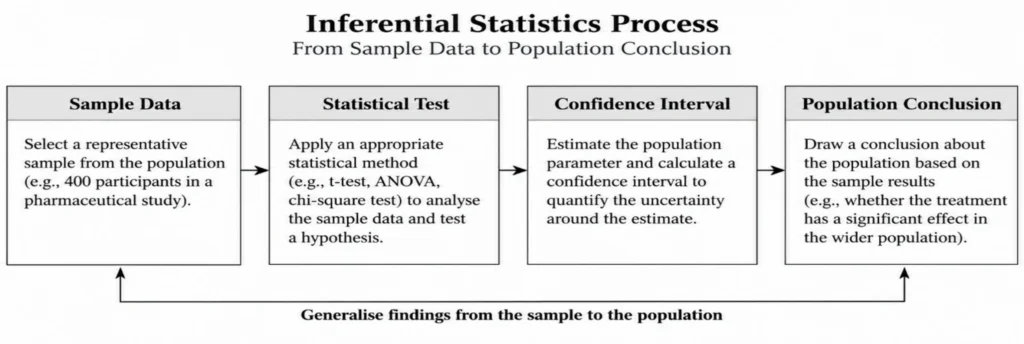
Inferential statistics uses sample data to make conclusions about a broader population. It is commonly used to estimate population parameters, test hypotheses and quantify uncertainty around sample-based findings. Confidence intervals and hypothesis tests are therefore important components of inferential analysis.
Predictive analytics has a different emphasis. It uses historical and current data to estimate an outcome for a future or previously unseen observation. Predictive models may include regression, decision trees, random forests, neural networks and other statistical or machine-learning techniques.
| Aspect | Inferential Statistics | Predictive Analytics |
| Primary purpose | Draw conclusions about a population | Predict outcomes for new or future observations |
| Typical question | What can the sample tell us about the population? | What is likely to happen for a new case? |
| Main target | Population parameter or hypothesis | Individual outcome, class or future value |
| Typical output | Estimate, confidence interval, p-value or test result | Prediction, probability, risk score or forecast |
| Uncertainty focus | Sampling uncertainty and parameter estimation | Prediction uncertainty and model error |
| Common methods | t-tests, ANOVA, chi-square tests, confidence intervals and regression | Regression, classification, decision trees, random forests and time-series models |
| Evaluation focus | Statistical significance, confidence intervals and model assumptions | Cross-validation, holdout testing and predictive performance metrics |
The distinction is therefore based primarily on what the analysis is intended to accomplish, rather than on whether a particular method is statistical. Many techniques, including regression, can be used for either inferential or predictive purposes depending on the research objective.
READ MORE: Inferential Statistics vs Predictive Analytics: Expert Tip
Inferential Statistics: Estimating Beyond the Sample
Inferential statistics addresses a fundamental research problem: it is usually impractical to collect information from every member of a population. Instead, researchers select a sample and use probability-based methods to determine what that sample can reveal about the wider population.
Two major components of inferential statistics are:
- Estimation: Uses sample data to estimate population parameters and quantify uncertainty, often through confidence intervals.
- Hypothesis testing: Evaluates whether the observed evidence provides sufficient statistical support for or against a specified hypothesis.
For example, a pharmaceutical study may compare the mean outcome between two treatment groups. A statistical test can assess whether the observed difference provides evidence against the null hypothesis, while a confidence interval can indicate the estimated magnitude and uncertainty surrounding that difference.
Predictive Analytics: Estimating What Comes Next
Predictive analytics shifts attention from population inference to estimating outcomes for future or previously unseen observations. A predictive model learns relationships between input variables and an outcome using historical data and then applies those relationships to new cases.
For example, a customer-retention model may use purchase frequency, customer tenure, service interactions and previous engagement to estimate the probability that a customer will leave within the next 30 days. The objective is to produce useful predictions rather than simply determine whether individual predictors are statistically significant.
This difference also affects model development and evaluation. Predictive analytics generally requires training and testing datasets, cross-validation and out-of-sample evaluation because a model that performs well on existing observations may not necessarily predict unseen cases accurately.
READ MORE: Predictive Analytics for Businesses
Inferential vs Predictive Statistics: Statistical Significance and Predictive Accuracy
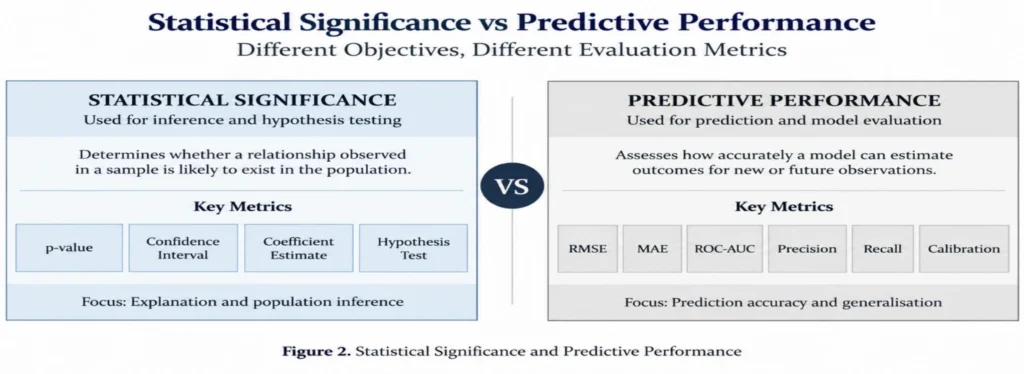
A common source of confusion in Inferential vs Predictive Statistics is treating statistical significance and predictive performance as equivalent. They measure different aspects of an analytical model and should therefore be interpreted separately.
A variable can have a statistically significant coefficient but contribute relatively little to the model’s ability to predict new observations. Conversely, a predictive model may achieve useful out-of-sample performance even when individual predictors are not statistically significant under traditional inferential testing.
Consider the regression model:

In an inferential analysis, researchers may focus on estimating β₁ and β₂, constructing confidence intervals and testing hypotheses about these population parameters. In predictive modelling, the focus may instead be on how accurately the model estimates Y for observations that were not used during model development.
Predictive performance can therefore be assessed using measures such as RMSE, MAE, R², accuracy, precision, recall or ROC-AUC, depending on whether the outcome is continuous or categorical.
Inferential and Predictive Statistics in a Single Analytical Problem
Inferential statistics and predictive analytics can be applied to the same dataset, but they answer different questions. Inferential analysis examines whether relationships found in a sample can be generalised to a wider population, while predictive analytics estimates outcomes for new or future cases.
Consider an e-commerce company with data from 20,000 customers, including purchase frequency, average order value, service interactions and churn status.
An inferential analysis could use logistic regression to determine whether frequent service interactions are significantly associated with customer churn. The results could include odds ratios, confidence intervals and p-values to assess the relationship and its uncertainty.
A predictive model could use the same variables to estimate each customer’s probability of churning within the next 30 days. The model could be evaluated using measures such as ROC-AUC, precision, recall and calibration to determine how well it predicts new cases.
| Inferential Statistics | Predictive Analytics |
| Is there evidence of a relationship? | What is likely to happen? |
| Focuses on population inference | Focuses on new or future cases |
| Confidence intervals and p-values | Prediction accuracy and error |
Thus, inferential statistics vs predictive analytics is not necessarily a choice between competing methods. The same dataset can support both approaches when the objective is to understand relationships as well as predict future outcomes.
Predictive Analytics Requires More Than a Statistical Model
Predictive analytics is often associated with machine learning, but machine learning is not required for every prediction problem. Traditional statistical techniques such as linear regression, logistic regression and time-series models can also be used to generate predictions.
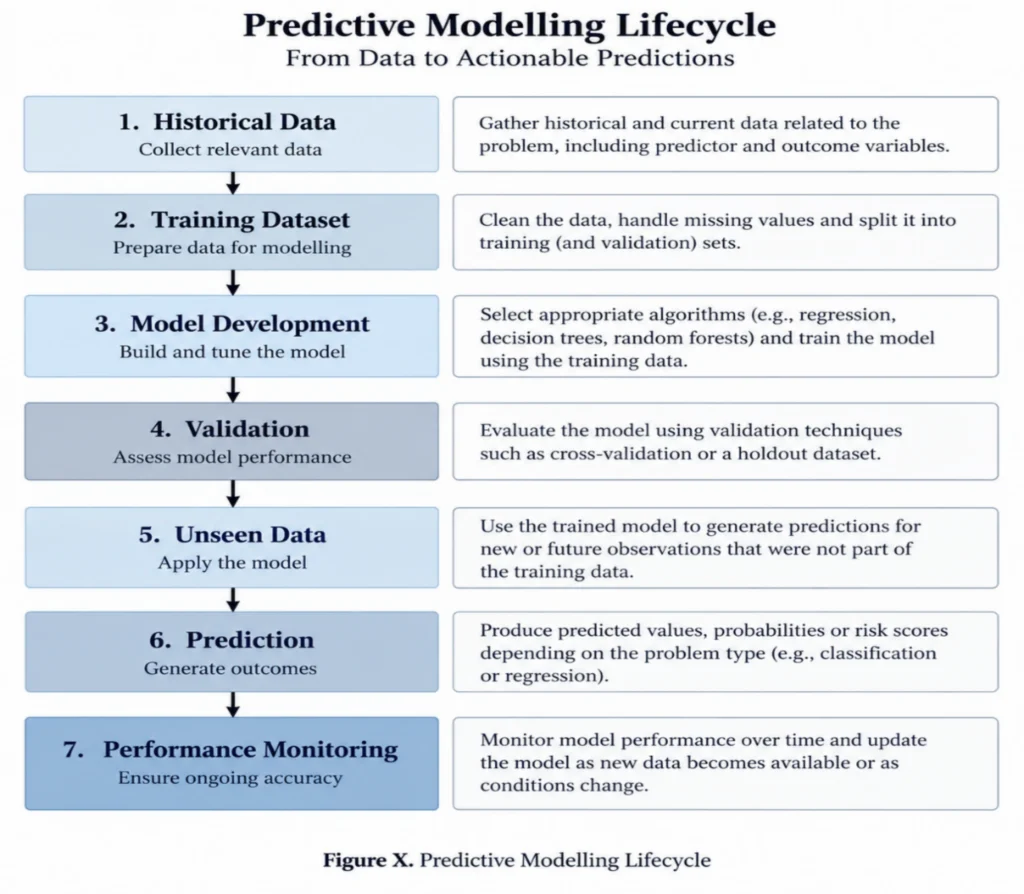
A predictive workflow typically involves several stages:
- Problem definition: Specify the outcome to be predicted and the prediction timeframe.
- Data preparation: Clean, transform and organise the data used for modelling.
- Feature selection: Identify variables that provide useful predictive information.
- Model development: Train an appropriate statistical or machine-learning model.
- Validation: Test whether the model generalises beyond the training data.
- Performance evaluation: Assess predictive accuracy using appropriate metrics.
- Deployment and monitoring: Apply the model to real cases and monitor its performance over time.
Data leakage is particularly important because information that would not be available at the actual prediction point must not inadvertently enter the training data. Model drift is another concern, as relationships between predictors and outcomes can change over time and may require models to be recalibrated or retrained.
Inferential and Predictive Statistics: When Each Approach Fits
| Analytical requirement | Appropriate approach |
| Estimate a population mean or proportion | Inferential statistics |
| Test whether groups differ | Inferential statistics |
| Quantify uncertainty around an estimate | Inferential statistics |
| Examine whether an observed relationship is statistically supported | Inferential statistics |
| Predict customer churn | Predictive analytics |
| Forecast demand | Predictive analytics |
| Classify credit or fraud risk | Predictive analytics |
| Estimate future sales | Predictive analytics |
| Understand relationships and generate future predictions | Both approaches |
The choice should therefore begin with the research or business question, rather than the software or algorithm. The same statistical technique may serve different purposes depending on whether the goal is inference, prediction or a combination of both.
Conclusion
Understanding inferential statistics vs predictive analytics requires distinguishing between two different analytical objectives. Inferential statistics uses sample evidence to estimate population characteristics and evaluate hypotheses, while predictive analytics focuses on generating estimates for future or unseen observations.
Inferential vs Predictive Statistics also differs in how analytical performance is interpreted. Confidence intervals, hypothesis tests and parameter estimates are central to inferential reasoning, whereas predictive analytics places greater emphasis on out-of-sample performance, prediction error, calibration and generalisation.
In practice, the two approaches can complement one another. A well-designed analytical project may use inferential methods to understand relationships within a population and predictive models to estimate what is likely to happen for new observations.
Get Expert Support for Statistical and Predictive Analysis
Need support with inferential statistics, predictive modelling, regression analysis, hypothesis testing, model validation or data analysis? Simbi Labs provides research and analytical support for academic, healthcare and business research projects.
Call Now : +91 99505 66669
Email : grow@simbi.in
FAQs
1. What is the main difference between inferential statistics and predictive analytics?
Inferential statistics focuses on drawing conclusions about a population from sample data, while predictive analytics focuses on estimating outcomes for future or unseen observations.
2. Is predictive analytics part of statistics?
Predictive analytics uses statistical methods but can also incorporate machine learning, data mining and computational techniques. It therefore extends beyond traditional statistical analysis.
3. Can regression be used for both inferential and predictive analysis?
Yes. Regression can be used to estimate and test relationships between variables or to generate predictions for new observations. The analytical objective and evaluation criteria determine how the model is interpreted.
4. Is a statistically significant model automatically a good predictive model?
No. Statistical significance does not guarantee strong predictive performance. Predictive models should be evaluated using appropriate out-of-sample validation and prediction-performance metrics.
5. approach should researchers use?
The choice depends on the research objective. Questions concerning population parameters, relationships and hypotheses generally require inferential methods, whereas questions involving future or individual-level outcomes generally require predictive modelling.