
Healthcare Research in India: Building Reliable Insights Through Better Data Collection
Why Accurate Healthcare Data Matters More Than Ever
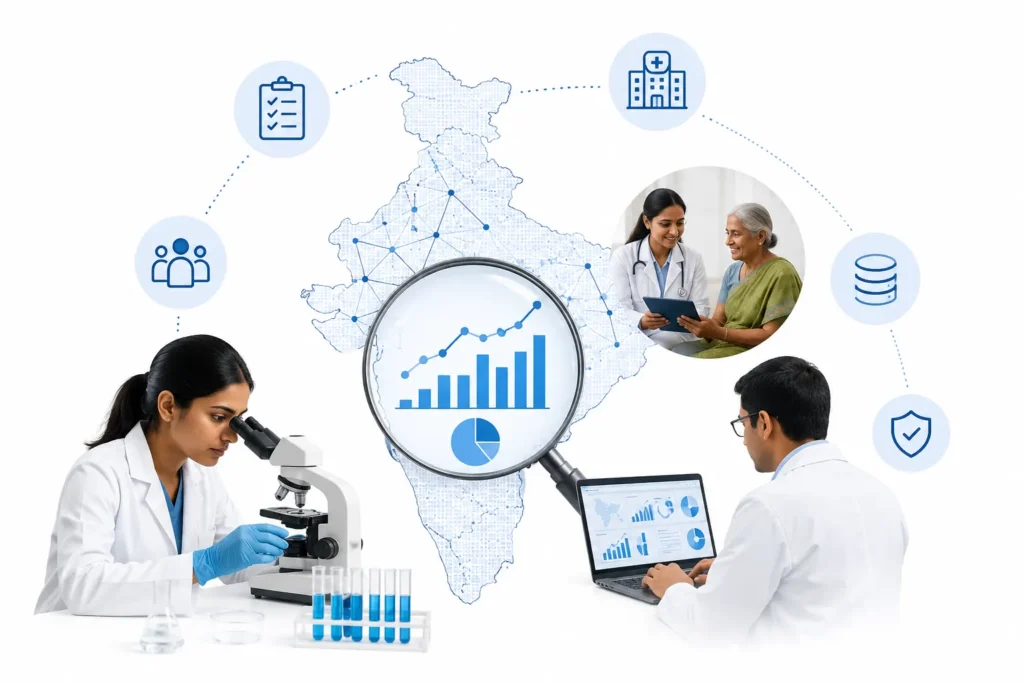
The healthcare industry is undergoing rapid growth in India, with digital transformation, medical advancements, and increased public health initiatives playing a major part in strengthening Healthcare Research in India. In the growing amount of information created by hospitals, pharmaceutical companies, and research institutions, structured healthcare research has never been more important. Healthcare data plays a pivotal role in this process, enabling organizations to gain insights into patient behaviour, enhance treatment results, and make informed decisions.
Healthcare data, whether it’s from clinical studies or nationwide health surveys, plays a crucial role in informing better healthcare planning, robust policy formation, and improved medical services in India.
Understanding the Role of Healthcare Data in Research
Healthcare data encompasses information related to health, medicine, patient data, and Healthcare Research in India gathered from digital health systems, clinical trials, healthcare institutions, and patients. The information can be in the form of numbers, patient data, treatment outcomes, behavioral trends, or a patient’s medical records.
For healthcare data analysis in modern times, both qualitative and quantitative healthcare data play a vital role in discovering trends, healthcare system evaluation, and new medical solution concepts in Healthcare Research in India. Even the most sophisticated research projects can lead to misconclusions if they are not based on accurate data collection.
Major Types of Healthcare Data Used in India
Clinical Trial Data
Information collected during drug testing and treatment evaluation processes.
Electronic Health Records
Digital patient records maintained by hospitals and healthcare providers.
Patient Surveys and Interviews
Direct feedback from patients regarding treatment experiences and healthcare access.
Epidemiological Data
Population-level data used to track diseases and public health patterns.
Diagnostic and Imaging Data
Medical imaging reports and laboratory test results used for analysis and treatment planning.
These different forms of healthcare data help researchers generate accurate and meaningful insights.
Why Healthcare Data Collection Is Expanding in India
Several factors are increasing the demand for professional healthcare data collection services across the country.
- Rapid growth of digital healthcare systems
- Government programs such as Ayushman Bharat
- Expansion of pharmaceutical and biotechnology industries
- Increasing focus on evidence-based healthcare
- Growing use of AI-driven analytics in medical research
As healthcare systems become more data-driven, organizations increasingly rely on structured healthcare data to improve efficiency and patient outcomes.
The Process Behind Healthcare Data Collection
Defining Research Objectives
Every study begins with identifying clear goals and determining what type of healthcare data is required.
Choosing Data Collection Methods
Researchers may use surveys, interviews, observational studies, clinical trials, or digital tracking tools depending on the project.
Data Acquisition
Information is gathered from hospitals, patients, laboratories, and digital systems while following ethical and legal standards.
Data Cleaning and Validation
Collected healthcare data is reviewed to remove inconsistencies, duplicates, and errors.
Analysis and Reporting
Advanced analytical tools and AI systems transform raw information into actionable insights.
This structured process ensures that healthcare data remains accurate, organized, and suitable for research purposes.
Key Features of Professional Healthcare Data Services
Healthcare research is becoming more complex, which is why many organisations are opting for specialist providers.
- Data with high accuracy and validated data sets.
- Following the healthcare rules and regulations as well as moral guidelines.
- Adaptable solutions for both small and large studies
- The use of AI-powered technologies to enhance integration.Use of AI-powered technologies for better integration.
- Multiple data sources that include data collection.
These features provide greater confidence and usability of healthcare data in research projects.
Benefits of Outsourcing Healthcare Data Collection
Improved Efficiency
Research teams can focus on analysis and strategy rather than operational data management.
Access to Expertise
Professional providers use trained personnel and advanced healthcare research tools.
Better Accuracy
Structured workflows reduce errors and maintain consistency across datasets.
Cost Optimization
Organizations avoid heavy investments in infrastructure and staffing.
End-to-End Support
Many providers offer complete services including collection, analysis, reporting, and documentation.
Outsourcing helps organizations manage healthcare data more efficiently while maintaining research quality.
Where Healthcare Data Is Commonly Used
Clinical Trials
Pharmaceutical companies use healthcare data to evaluate drug effectiveness and safety.
Public Health Research
Government agencies analyze population health trends and disease outbreaks.
Hospitala Operations
Hospitals monitor patient care, service quality, and operational efficiency.
Healthcare Market Research
Organizations study treatment preferences, healthcare demand, and patient behavior.
Academic Research
Universities and research institutions depend on healthcare data for studies and publications.
These applications show how healthcare data supports decision-making across multiple sectors.
Technologies Transforming Healthcare Data Collection
Modern healthcare research increasingly depends on digital technologies to improve speed and accuracy.
- AI and machine learning for predictive analytics
- Electronic Data Capture systems for clinical studies
- Mobile data collection applications
- Cloud platforms for secure storage and access
- Natural Language Processing for analyzing patient feedback
These technologies help organizations manage healthcare data more effectively and at larger scales.
Common Mistakes That Affect Healthcare Data Quality
Even experienced teams can face challenges during research projects.
- Poorly defined research objectives
- Sampling bias and incomplete datasets
- Ignoring privacy and compliance requirements
- Inconsistent formatting of healthcare data
- Lack of proper validation systems
Avoiding these issues is essential for maintaining accuracy and research credibility.
Choosing the Right Healthcare Data Partner in India
Selecting the right service provider is critical for long-term research success. Organizations should evaluate:
- Industry experience in healthcare research
- Use of advanced analytics and AI tools
- Strong data security practices
- Ability to manage end-to-end projects
- Expertise in reporting and documentation
An experienced provider not only manages healthcare data collection but also helps convert information into meaningful insights.
Future Trends Shaping Healthcare Data in India
The future of healthcare data collection is becoming increasingly technology-driven.
- AI-powered automation for faster processing
- Wearable devices generating real-time patient data
- Big data analytics supporting personalized medicine
- Blockchain improving data security and sharing
- Telemedicine expanding digital healthcare ecosystems
These innovations are expected to transform healthcare research and patient care across India.
Final Thoughts
The healthcare sector has seen significant transformation as a key driver of medical research, aiding in enhancing patient care practices, driving innovation, and enabling evidence-based decision-making in Healthcare Research in India. With the ever-changing landscape of healthcare, the need for accurate, ethical, and technologically advanced collection of data will only continue to rise.
In the context of healthcare IT, adopting trustworthy data practices in healthcare is crucial for organizations and researchers in India to achieve impactful and meaningful results.
Book a free consultation for appointment
Email us at : grow@simbi.in