
Late Deliveries and Supply Delays: What Manufacturers Can Do

Introduction
In manufacturing, even a short delay in receiving materials can trigger a chain reaction of missed deadlines, idle workers, and dissatisfied customers. While some disruptions are unavoidable — caused by bad weather, transport strikes, or supplier issues — the way a manufacturer prepares for and responds to them can make the difference between a minor hiccup and a costly shutdown.
Read Also : Inventory Shortages in Manufacturing: Causes, Challenges, and Smart Solutions
Why Late Deliveries Happen
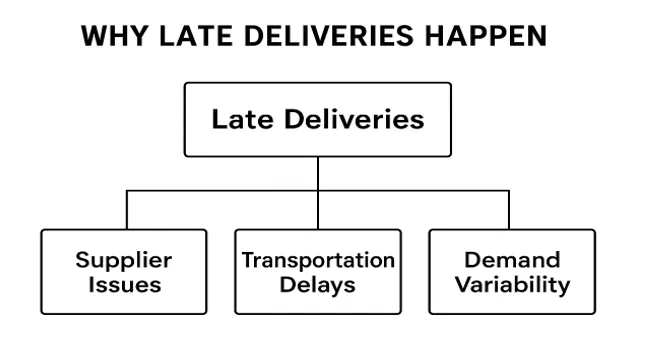
Transportation Challenges
Late deliveries are often linked to transportation difficulties. Shipments can be delayed because of road closures, congestion at ports, or longer processing times at customs. In addition, seasonal weather conditions such as heavy monsoons or snowstorms frequently disrupt logistics and slow down the movement of goods.
Supplier-Side Problems
Another common cause of delivery delays comes from the supplier’s end. Shortages of essential raw materials can halt or slow production. Workforce issues, including strikes or a shortage of skilled labour, also contribute to delays. At times, quality control failures result in products needing rework or replacement, which pushes delivery schedules further.
Demand Surges
Sudden increases in demand can overwhelm both suppliers and manufacturers. When unexpected spikes in orders occur, the existing capacity may not be able to keep up, resulting in longer lead times and late deliveries.
Impact on Manufacturing Operations
1. Production Stoppages: Machines and workers remain idle when parts aren’t available.
2. Increased Costs: Emergency shipping, overtime, and penalty charges for late orders.
3. Customer Dissatisfaction: Damaged reputation and loss of repeat business.
4. Workflow Disruption: Rescheduling production lines can create further inefficiencies.
Early Warning Systems for Delays
1. Set up tracking dashboards to monitor supplier shipments in real time.
2. Use GPS-enabled logistics updates to predict late arrivals before they happen.
3. Share alerts with production managers to adjust schedules proactively.
Collaboration Across the Supply Chain
1. Conduct joint planning sessions with suppliers and logistics partners.
2. Share production schedules to give suppliers visibility of upcoming demand.
3. Participate in vendor development programs to improve supplier capabilities.
What Manufacturers Can Do ?
1. Build Strong Supplier Relationships
Manufacturers can reduce the risk of late deliveries by fostering strong relationships with their suppliers. Open communication and regular updates help both sides stay aligned on production and logistics issues. Sharing demand forecasts allows suppliers to plan their capacity more effectively, while long-term contracts with reliability clauses ensure commitment and accountability.
2. Diversify the Supplier Base
Relying on a single supplier for critical materials can be risky. By sourcing from multiple suppliers across different geographic regions, manufacturers lower their exposure to local disruptions such as strikes, natural disasters, or political issues. A diversified base ensures continuity of supply even if one source fails.
3. Maintain Strategic Safety Stock
Keeping a small reserve of essential raw materials helps cover short-term supply gaps. This buffer stock prevents production from stopping during temporary disruptions. Data analysis can be used to calculate the right balance—maintaining enough stock to stay resilient without locking up too much working capital.
4. Improve Demand Forecasting
Accurate forecasting helps manufacturers align production with market needs. Historical sales records, seasonal demand patterns, and industry trends are valuable inputs. Real-time updates from suppliers and logistics partners can also be incorporated to improve forecast accuracy and reduce unexpected shortages.
5. Invest in Flexible Logistics
Flexibility in logistics can make a significant difference during disruptions. Partnering with logistics providers who offer multiple shipping options helps manufacturers switch routes quickly if one path is blocked. Having agreements for expedited shipping ensures urgent orders can be delivered on time when needed.
6. Monitor Supplier Performance
Regularly tracking supplier performance gives early warnings about potential risks. Metrics such as on-time delivery rates and lead time variations reveal patterns of reliability. Quarterly performance reviews provide a chance to resolve recurring issues and strengthen accountability.
7. Create a Contingency Plan
Even with strong systems in place, unexpected events can occur. A contingency plan outlines “what-if” scenarios and defines clear response actions. Assigning a rapid-response team ensures disruptions are handled quickly and with minimal impact on operations.
Technology’s Role in Reducing Delays
1. Use ERP (Enterprise Resource Planning) systems for better visibility of stock and orders.
2. Adopt AI-based predictive analytics to forecast disruptions.
3. Integrate IoT tracking for high-value shipments to improve monitoring.
Real-World Example
A mid-sized electronics manufacturer in India faced repeated delays in imported circuit boards due to port congestion. By adding a secondary supplier from a nearby state, maintaining a three-day safety stock, and setting up an express shipping agreement, they reduced downtime by 80% within two months.
How to Overcome Late Deliveries and Supply Delays
1. Strengthen Supplier Network
One of the most effective ways to overcome late deliveries is to build a stronger supplier network. Manufacturers should develop relationships with multiple suppliers for each critical component rather than relying on a single source. Maintaining a mix of domestic and international vendors helps reduce geographic risks, such as regional disruptions, political instability, or natural disasters.
2. Keep Micro Safety Stock
Maintaining a small backup inventory for high-risk or long-lead-time materials can prevent production stoppages when suppliers face delays. This “micro safety stock” acts as a short-term buffer until regular supply resumes. To stay efficient, companies should regularly review and adjust safety stock levels in line with changes in demand and market conditions.
3. Use Real-Time Tracking
Real-time tracking is vital for detecting supply issues early. GPS-enabled shipment tracking and supplier dashboards provide visibility into the movement of goods. By identifying delays as soon as they occur, manufacturers can adjust production schedules, allocate resources better, and minimize the impact on final delivery timelines.
4. Build Flexible Production Schedules
Flexible production planning allows factories to continue operations even during shortages. By designing processes so that other product lines can continue when certain parts are missing, downtime is reduced. Cross-training employees to handle multiple tasks further increases adaptability when delays occur.
5. Invest in Technology
Technology offers powerful tools to anticipate and mitigate delivery challenges. Enterprise Resource Planning (ERP) systems and AI-driven demand forecasting provide more accurate insights into supplier performance. In addition, Internet of Things (IoT) sensors embedded in the supply chain can send live shipment updates, helping managers respond quickly to disruptions.
6. Plan for Contingencies
Despite all precautions, delays are sometimes unavoidable, making contingency planning essential. Manufacturers should prepare “Plan B” logistics options, such as using express shipping services or alternative transport routes. An emergency response team should also be in place to coordinate quick solutions and ensure minimal disruption when unexpected delays occur.
Techniques to Manage and Reduce Delays
1. Demand Forecasting
i. Uses past sales data and seasonal trends to predict material needs in advance.
ii. Technique Examples: Moving Average, Exponential Smoothing, Time Series Analysis.
2. Safety Stock Calculation
i. Keeps a minimal buffer to cover short-term shortages.
ii. Formula: Safety Stock = Z × σLT
(Z = service level factor, σLT = standard deviation of demand during lead time)
3. Reorder Point (ROP) Method
i. Identifies the exact stock level to trigger new orders before running out.
ii. Formula: ROP = (Daily Demand × Lead Time) + Safety Stock
4. Supplier Performance Analysis
i. Monitors how often deliveries arrive as scheduled and whether lead times remain steady.
ii. Applies statistical checks such as average, spread of data, and variation patterns to spot suppliers that frequently cause delays.
5. Statistical Process Control (SPC)
i. Uses control charts to monitor quality and reduce rejections that cause delays.
6. Risk Simulation
i. Uses Monte Carlo simulations to test various disruption scenarios and prepare responses.
7. Economic Order Quantity (EOQ)
i. Determines the ideal order quantity that keeps costs low while avoiding the risk of delivery delays.
ii. Formula: EOQ = √(2 × D × S / H)
(where D is annual demand, S is the cost per order, and H is the yearly holding cost per unit)
Read Also : Problem Solving Through Value Stream Mapping (VSM): A Lean Approach to Process Optimization
Conclusion
In manufacturing, delays in deliveries and disruptions in supply are sometimes unavoidable. However, their effects can be reduced through careful planning and proactive measures. Establishing reliable supplier relationships, keeping an adequate safety stock, using real-time tracking systems, and preparing contingency plans help keep production on track even during unexpected challenges. Being prepared not only limits downtime and expenses but also builds customer confidence, supporting long-term success in a changing and uncertain market.
For an in-depth understanding, please refer to our book, “Academic Research Fundamentals: Research Writing and Data Analysis”. It is available as an eBook here, or you may purchase the hardcopy here .